



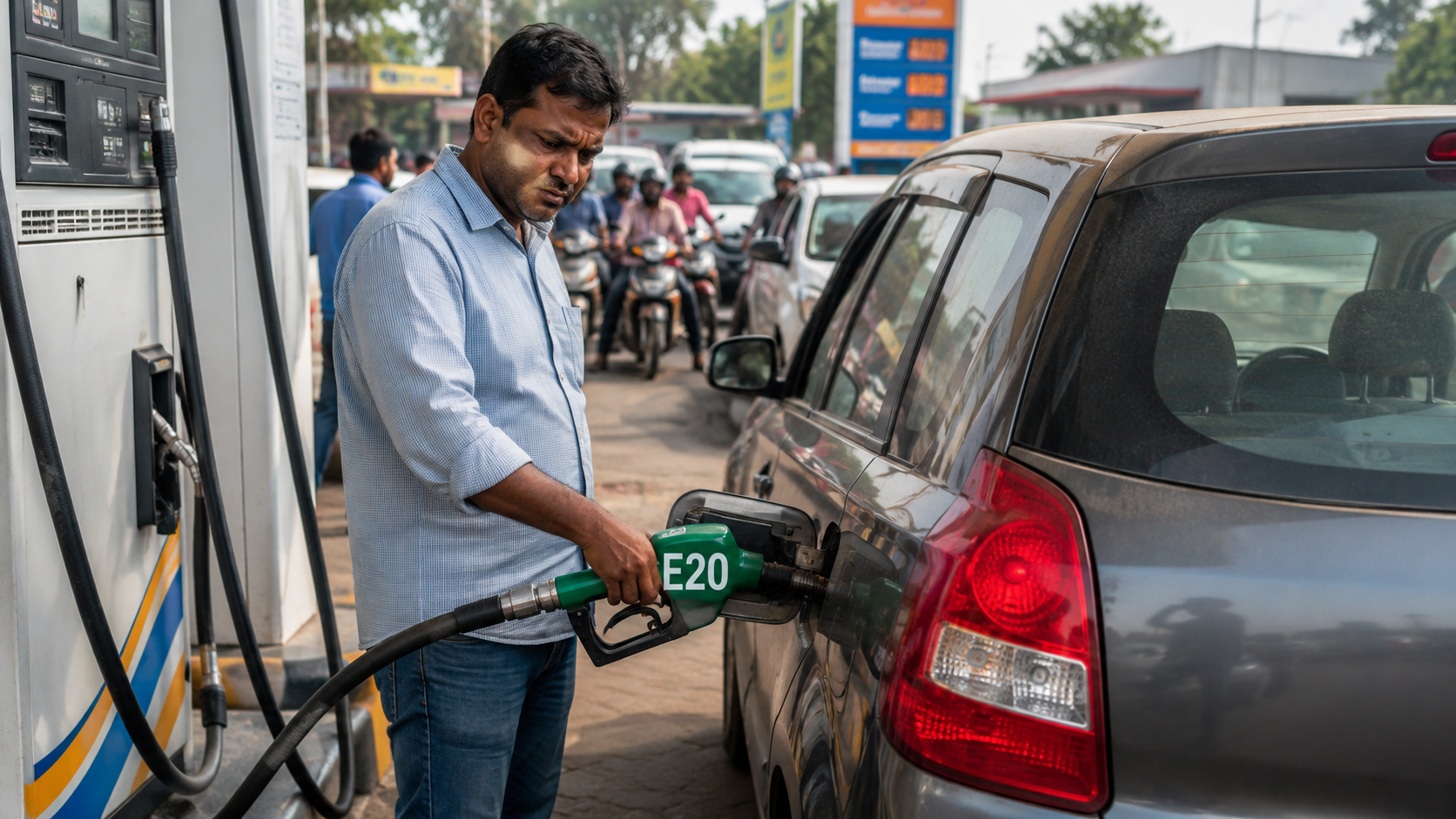
Every time you fill up at a petrol pump in India today, you’re not just buying petrol. You’re buying a fuel that’s one-fifth ethanol, whether you asked for it or not.
This is E20 — petrol blended with 20% ethanol — and since April this year, it has become the only fuel available at most Indian pumps. The problem is that more than 75% of vehicles on Indian roads were never built to run on it.
And here’s the part that should worry you more than the fuel efficiency numbers: nobody has published proof that E20 is actually safe for these older vehicles. Not the government. Not the automakers defending it. The evidence, on both sides, simply doesn’t exist in public.
A rushed rollout
India started blending ethanol into petrol back in the mid-2000s, slowly increasing the share over the years. But the real acceleration happened recently. In 2022, the standard blend was 10% ethanol. By 2025, the government pushed it to 20% — five years ahead of its own original target.
Compare that to Brazil, the country India often points to as its model. Brazil took roughly four decades to build a fleet of vehicles designed for high ethanol blends before mandating them. India did the same job in about three years.
The result is a huge mismatch. Most cars and bikes on Indian roads were built for the older, lower-ethanol fuel. Suddenly, they’re all running on something stronger.
What drivers are experiencing
Since E20 became mandatory, complaints have piled up on social media — reduced mileage, engine trouble, and rising service costs. Last week, a group of motorists even protested in Delhi, accusing the government of forcing the fuel on them without warning or choice.
The government’s response has been blunt: it has called these complaints “misleading” and blamed “social media misinformation,” saying E20 went through extensive testing and does not damage engines.
To back this up, six major automakers appeared alongside government officials at a press conference. A senior official from Maruti Suzuki, India’s largest carmaker, said the company had serviced over 15 million older, non-E20-compliant vehicles and found no fuel-related faults.
But even the automakers admitted one thing: E20 causes a 3-3.5% drop in fuel efficiency, because ethanol has less energy than pure petrol. Independent estimates suggest the real drop could be even bigger — somewhere between 4% and 12%.
What mechanics are actually seeing
Away from press conferences, the picture is murkier. Some mechanics in Mumbai told the BBC they haven’t noticed any unusual problems. Others have.
One mechanic who repairs motorcycle engines said he has serviced several older bikes over the past year for fuel residue building up in carburettors, something he links directly to the higher ethanol content. This buildup can reduce performance and means more frequent, more expensive servicing.
A car servicing centre owner said his customers are reporting lower mileage, meaning they need to refuel more often. And even though ethanol is cheaper to produce than petrol, pump prices haven’t gone down. Customers are paying the same amount per litre, but getting less distance out of it.
Experts warn the real damage may not even be visible yet. Ethanol tends to attract moisture, which can separate from the fuel over time and cause corrosion inside the engine. It can also loosen old deposits sitting inside the fuel system, which may later clog pumps and injectors. One industry expert described it as a “slow-burn impact” that could take 10,000 to 20,000 km of driving to show up.
The bigger question nobody has answered
A survey of more than 44,000 people who bought petrol vehicles before 2023 found a rise in reports of unusual wear and tear or repair needs after the E20 switch.
Yet through all of this, there is still no publicly available scientific study proving either side’s case. Not proof that E20 damages older engines. Not proof that it doesn’t.
This is the real problem. If the government is going to make a fuel mandatory for every vehicle on the road, the burden should be on it to prove that fuel is safe — not on drivers to simply trust it.
There’s also a growing mess around warranties and insurance. It’s still unclear whether damage caused by E20 in older vehicles would be covered. One private insurer briefly suggested that using E20 in a non-compliant vehicle could count as “negligence” and lead to a rejected claim, before reversing that position weeks later.
For now, ordinary drivers are stuck in the middle: paying the same price for less mileage, watching automakers and the government insist everything is fine, and hoping their engines hold up long enough for someone, anyone, to actually prove it either way.
Subscribe Deshwale on YouTube
