



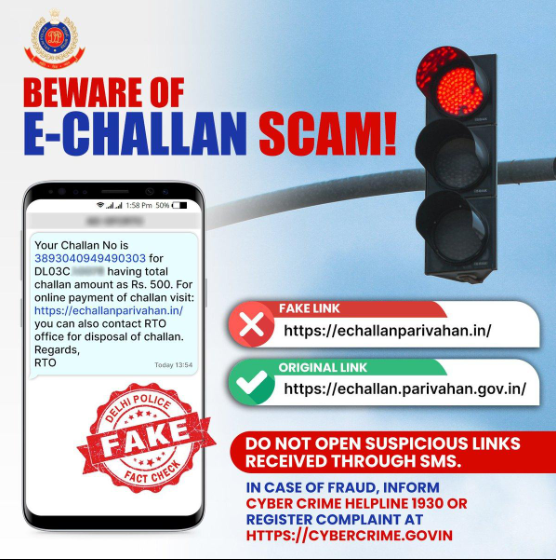
Cyber fraudsters are emptying bank accounts by sending fake e-challans, according to the Ministry of Home Affairs. The ministry shared details of measures being taken to deal with financial cyber fraud and strengthen the country’s cybercrime management system.
The National Crime Records Bureau (NCRB) compiles and publishes statistical data on crimes in its publication “Crime in India”. The latest published report is for the year 2024.
However, the NCRB does not maintain data regarding cases registered, cases resolved and the amount scammed specifically through fake e-challans.
The government has launched the ‘Citizen Financial Cyber Fraud Reporting and Management System’ (CFCFRMS) under the Indian Cyber Crime Coordination Centre (I4C). The system was launched in 2021 for immediate reporting of financial frauds and to stop the siphoning off of funds by fraudsters.
According to the CFCFRMS operated by I4C, more than Rs. 11,158 crore in financial amounts had been saved in more than 32.80 lakh complaints till June 30, 2026.
The government has also launched the ‘Sahyog’ Portal. It was launched to expedite the process of sending notices to IT intermediaries by the Appropriate Government or its agency under clause (b) of sub-section (3) of Section 79 of the IT Act, 2000.
The portal facilitates the removal or disabling of access to any information, data or communication link being used to commit an unlawful act.
Through the Sahyog Portal and proactive action by informing concerned IT intermediaries, I4C has blocked more than 2,77,053 illegal and fraudulent Apps, content, websites, E-mail Accounts, URLs and Links across various platforms.
The Ministry of Home Affairs has also outlined the responsibilities of States and Union Territories in dealing with cybercrime.
‘Police’ and ‘Public Order’ are State subjects under the Seventh Schedule to the Constitution of India. Accordingly, States and Union Territories are primarily responsible for the prevention, detection, investigation and prosecution of cybercrime.
The Central Government, through the Ministry of Home Affairs, supplements the efforts of States and Union Territories. This includes providing policy guidance, technological support, capacity-building assistance and financial resources.
These measures are aimed at strengthening cybercrime management and enforcement capabilities.
The government is also focusing on capacity building among police and judicial officers. The Massive Open Online Courses (MOOC) platform, namely the ‘CyTrain’ portal, has been developed under I4C.
The portal provides online courses on critical aspects of cybercrime investigation, forensics and prosecution.
Till June 30, 2026, more than 1,63,344 police officers and judicial officers from States and Union Territories had registered on the portal. More than 1,61,957 certificates had been issued through the portal.
The government has also introduced the Cyber Commando programme. The programme was launched by the Home Minister on September 10, 2024.
The programme aims to establish a Special Wing of Cyber Commandos equipped with specialised training to counter cybersecurity threats in the country.
It envisions the creation of a dedicated and skilled workforce capable of securing critical information infrastructure and supporting national cybersecurity efforts.
A total of 281 cyber commandos have successfully completed training.
The I4C under the Ministry of Home Affairs is also regularly organising ‘State Connect’, ‘Thana Connect’, ‘Bank Connect’ and peer learning sessions.
These sessions are being organised to share best practices and enhance capacity building.
The government has also established the state-of-the-art National-Digital Investigation Support Centre as part of I4C. The centre was previously known as the National Cyber Forensic Laboratory (Investigation), or NCFL(I).
The National-Digital Investigation Support Centre was established in New Delhi on February 18, 2019, and in Assam on August 29, 2025.
The centres provide early-stage cyber forensic assistance to Investigating Officers of State and Union Territory police.
Till June 30, 2026, the National-Digital Investigation Support Centre in New Delhi had provided its services to State and Union Territory law enforcement agencies in more than 14,064 cases pertaining to cybercrimes.
The Ministry has also issued a comprehensive Standard Operating Procedure (SOP) for NCRP-CFCFRMS.
The SOP has been issued to further strengthen operational efficiency and ensure uniformity in handling cybercrime complaints.
It lays down a standardised framework for complaint processing, bank coordination, grievance redressal, removal of lien markings and restoration of defrauded funds to rightful claimants based on complaints received through the NCRP.
The Money Restoration Module has also been made functional for the expeditious restoration of defrauded money to victims.
The Grievance Redressal Module has been made functional for timely handling of grievances relating to the freezing of bank accounts and lien marking of amounts.
Both modules have been made functional from April 2026.
The Ministry of Home Affairs provided these details in the context of measures related to cybercrime and financial fraud. The information covers systems for reporting financial fraud, blocking fraudulent digital resources, capacity building, cyber forensic assistance and handling complaints received through the NCRP-CFCFRMS.
Subscribe Deshwale on YouTube
