



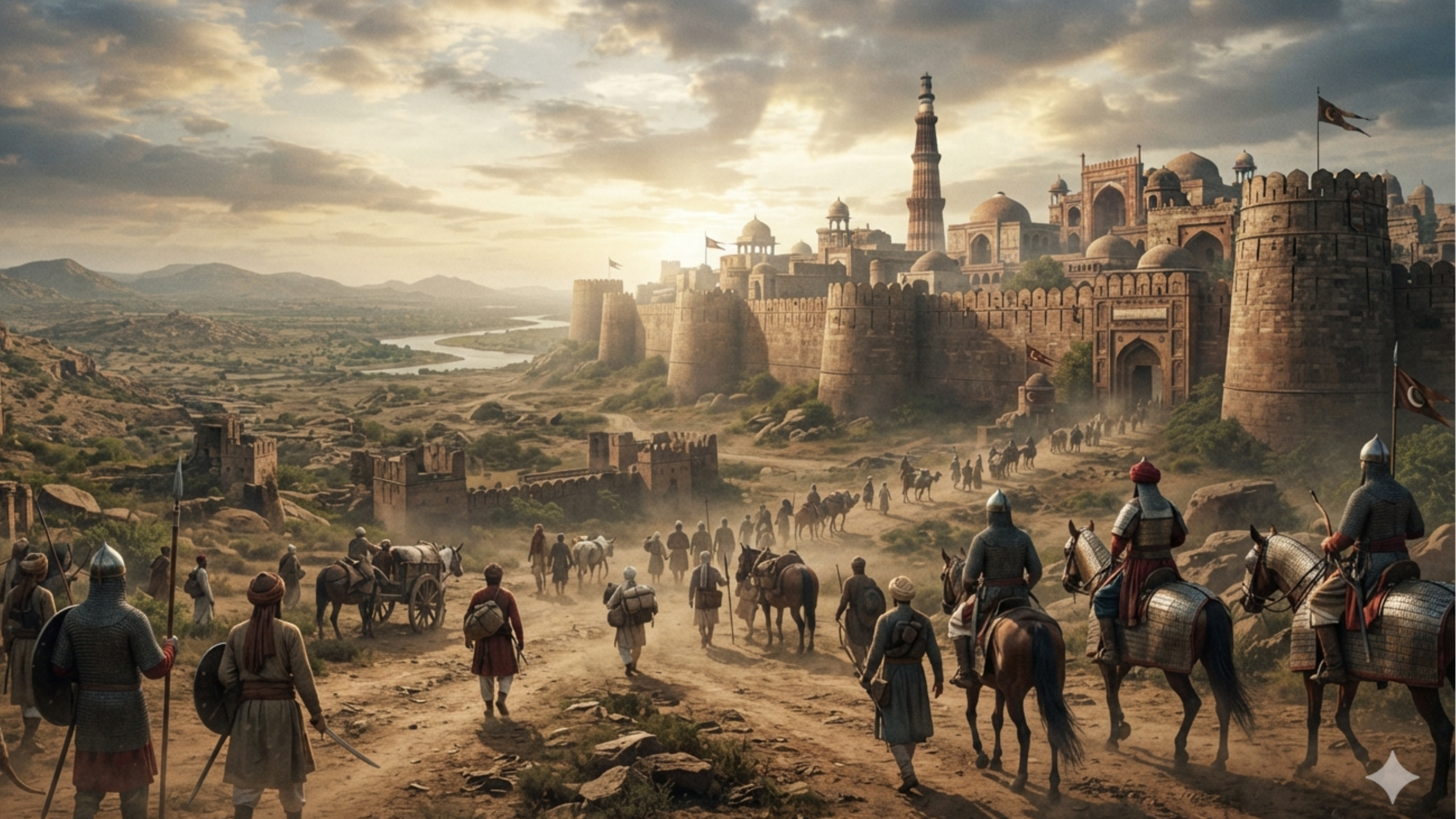
India’s history did not move from one empire to another in a straight line. After the rise of the early medieval powers described in Part 1, the subcontinent entered another period of political transformation. Regional kingdoms grew stronger, new Sultanates emerged, the Cholas and Vijayanagara shaped southern India, and the Mughal Empire later became one of the most powerful states in early modern India. At the same time, Marathas, Sikhs, Mysore and numerous other regional powers continued to shape India’s political landscape. European trading companies eventually entered this complex world and gradually transformed their commercial presence into political power. This is Part 2 of our History of India series, continuing from the early medieval powers and tracing the subcontinent’s journey towards colonial rule and independent India.
13. Islamic Kingdoms and Sultanates
From the 8th century onwards, parts of the Indian subcontinent came under the control of rulers and dynasties from the Islamic world. The first major Arab conquest took place in Sindh in 711–712 CE, when Muhammad ibn Qasim defeated the local ruler Dahir. Centuries later, the Ghaznavids established influence over parts of the northwest, while the Ghurids launched more sustained campaigns into northern India. These developments eventually contributed to the establishment of the Delhi Sultanate in the early 13th century.
The Delhi Sultanate developed through five major dynasties: the Mamluks, Khaljis, Tughlaqs, Sayyids and Lodis. Rulers such as Iltutmish, Alauddin Khalji and Muhammad bin Tughlaq expanded, reorganised or challenged the Sultanate in different ways. At the same time, powerful regional sultanates emerged beyond Delhi. Bengal, Gujarat, Malwa, Jaunpur, Kashmir, Khandesh and the Bahmani Sultanate became important centres of political power. The Bahmani state later fragmented into several Deccan Sultanates, while the Sharqi dynasty ruled the Sultanate of Jaunpur.
This era mattered because it transformed the political landscape of large parts of India without replacing the subcontinent’s existing diversity. Islamic rulers interacted with established Indian kingdoms, local elites, religious communities and commercial networks. New forms of architecture, administration, military organisation and court culture developed alongside older traditions. The Sultanates also created political centres that would influence the rise of later powers, including the Mughals.
14. Vijayanagara and Southern Powers
From the 14th to the 17th centuries, southern India became the centre of powerful kingdoms and regional states. The Vijayanagara Empire was founded in 1336 by Harihara and Bukka and developed around the Tungabhadra region of present-day Karnataka. Its influence eventually extended across large parts of southern India and the Deccan. Alongside Vijayanagara, the Gajapati Kingdom in eastern India and several Nayaka states became important regional powers.
Vijayanagara passed through four major dynastic phases: the Sangama, Saluva, Tuluva and Aravidu dynasties. Under rulers such as Devaraya II and Krishnadevaraya, the empire reached considerable political and military strength. Its capital, Vijayanagara, near present-day Hampi, developed into a major urban and commercial centre filled with temples, markets, palaces and monumental structures. The empire competed repeatedly with the Deccan Sultanates and other neighbouring powers. The Gajapatis of Odisha also built a powerful kingdom, while Nayaka states later became important centres of authority in Tamil Nadu and parts of southern India.
This era mattered because it demonstrated the political and cultural strength of southern India during a period often described mainly through northern kingdoms. Vijayanagara became a major centre of commerce, architecture, literature and temple culture. Its legacy survived long after the Battle of Talikota in 1565 weakened the empire. The political traditions of Vijayanagara and the Nayaka states continued to influence southern Indian history for generations.
15. Deccan Sultanates
The weakening of the Bahmani Sultanate led to the emergence of several independent states in the Deccan from the late 15th century onwards. Five major successor sultanates became known as the Deccan Sultanates: Ahmadnagar, Bijapur, Golconda, Bidar and Berar. Their territories covered large parts of present-day Maharashtra, Karnataka, Telangana and surrounding regions. They frequently competed with one another as well as with Vijayanagara.
The Deccan Sultanates developed powerful armies, fortified cities and distinctive court cultures. Bijapur became famous for monumental architecture, including the Gol Gumbaz. Golconda grew wealthy through trade and its diamond-producing regions, while Ahmadnagar became an important power in the western Deccan. The sultanates also employed soldiers, administrators and artists from different parts of India and the wider Islamic world. Their rivalry with Vijayanagara culminated in the alliance that defeated the Vijayanagara army at the Battle of Talikota in 1565.
This era mattered because the Deccan became one of the most important political and cultural regions of early modern India. The sultanates were not merely temporary fragments of the Bahmani state. They developed their own political institutions, economies, architecture and cultural traditions. Their territories later became major theatres of Mughal expansion and Maratha resistance.
16. Mughal Era
The Mughal Empire emerged in northern India in the early 16th century when Babur defeated Ibrahim Lodi at the First Battle of Panipat in 1526. The dynasty traced its lineage to both Timur and Genghis Khan through its Central Asian ancestry. Although Babur established the Mughal dynasty, the empire went through periods of instability before becoming a durable imperial power. Its authority eventually extended across much of the subcontinent.
Babur strengthened his position after defeating Rana Sanga at Khanwa in 1527. His son Humayun initially struggled to retain the empire and was defeated by Sher Shah Suri, who established the Sur Empire. Sher Shah introduced important administrative and revenue measures before Humayun returned and restored Mughal rule in 1555. Akbar then transformed the empire through military expansion, alliances and administrative reforms. Jahangir continued the imperial system, while Shah Jahan presided over a period of remarkable architectural patronage. Under Aurangzeb, Mughal territory reached its greatest geographical extent. Later Mughal emperors, however, exercised increasingly limited effective authority.
The Mughal era mattered because the dynasty created one of the largest and most influential imperial states in Indian history. Its revenue administration, military institutions, architecture, painting, literature and court culture left a deep mark on the subcontinent. Yet Mughal rule was never synonymous with the whole of India. Powerful regional kingdoms and states continued to exist alongside the empire, sometimes as allies and sometimes as opponents.
17. Other Major Powers During the Mughal Period
Mughal India was never simply a Mughal political landscape. Throughout the 16th, 17th and 18th centuries, powerful states continued to govern large parts of the subcontinent. Rajput kingdoms such as Mewar, Marwar and Amber maintained varying degrees of independence or alliance with the Mughals. In the northeast, the Ahom Kingdom resisted Mughal expansion for centuries. The Deccan Sultanates, Mysore, Travancore, Bengal and Awadh also became important centres of political power.
The political relationships between these states and the Mughals differed considerably. Some Rajput rulers entered imperial alliances, while others fought Mughal armies. The Ahoms successfully resisted repeated Mughal campaigns, including the famous Battle of Saraighat in 1671. In the south, Travancore expanded under Marthanda Varma, while Mysore developed into an increasingly powerful state. Bengal and Awadh later gained substantial autonomy as Mughal authority weakened. Sikh communities also developed growing political and military strength in Punjab.
This era mattered because it reveals the true complexity of early modern India. The Mughal Empire was immensely powerful, but it existed alongside numerous political systems. Regional states developed their own armies, revenue structures, economies and cultures. Understanding these powers is essential to understanding how the Mughal Empire eventually weakened and how the political map of India changed during the 18th century.
18. Maratha Period
The Maratha political rise began in western India during the 17th century under Shivaji. His kingdom was centred in the western Deccan, where he established control over forts and territories and challenged the authority of the Deccan Sultanates and the Mughal Empire. Shivaji was formally crowned in 1674, establishing an independent Maratha kingdom. After his death, the Maratha state survived periods of internal conflict and eventually expanded dramatically under the Peshwas.
During the 18th century, Maratha influence spread across large parts of India. The Peshwas became the dominant political figures within the Maratha state, while major houses such as the Scindias, Holkars, Gaekwads and Bhonsles acquired substantial regional power. The Marathas intervened in the politics of northern India and increasingly became the most powerful challenger to the declining Mughal Empire. Their defeat at the Third Battle of Panipat in 1761 temporarily weakened their expansion, but Maratha power recovered and remained significant until the Anglo-Maratha Wars.
The Maratha period mattered because it represented one of the most important shifts in power after the Mughal era. The Marathas built a political network that stretched across much of the subcontinent and challenged the idea of Mughal supremacy. Their military campaigns, administrative systems and regional institutions profoundly influenced western and central India. Their eventual defeat by the British East India Company opened another decisive chapter in India’s political history.
19. Sikh Empire
The Sikh political rise developed in Punjab during the 18th century, following decades of conflict with Mughal authorities and Afghan invaders. The Sikh community organised itself into a number of autonomous or semi-autonomous misls, which controlled different territories across Punjab. By the late 18th century, these groups were increasingly drawn together under stronger leadership. Ranjit Singh emerged as the dominant Sikh ruler and established the Sikh Empire.
Ranjit Singh captured Lahore in 1799 and was formally recognised as Maharaja in 1801. He gradually united much of Punjab under his authority and expanded the kingdom towards Kashmir, Multan and the northwest. His army was reorganised and modernised, with European officers contributing to military training. The Sikh state also included diverse religious communities and maintained a relatively broad administrative structure. After Ranjit Singh’s death in 1839, internal instability weakened the kingdom, leading eventually to the Anglo-Sikh Wars. The British annexed Punjab in 1849.
The Sikh Empire mattered because it became one of the strongest states in northern India during the period of British expansion. Its military strength prevented the East India Company from easily extending its authority into Punjab for decades. Ranjit Singh’s state also demonstrated the ability of a regional power to unite a politically fragmented region and establish an independent kingdom during the decline of Mughal authority.
20. Mysore
Mysore developed into one of the most important powers of southern India during the 18th century. The Wadiyar dynasty had ruled the kingdom for centuries, but political authority increasingly shifted towards powerful military leaders. Haidar Ali rose to prominence and became the effective ruler of Mysore in the mid-18th century. His son, Tipu Sultan, inherited the state and continued its resistance against British expansion.
Haidar Ali reorganised Mysore’s military and expanded its territory. Tipu Sultan continued these efforts and fought several wars against the British East India Company and its allies. He introduced administrative and economic measures, encouraged trade and maintained diplomatic relations with powers including the French and the Ottoman Empire. Tipu was killed during the British assault on Srirangapatna in 1799 during the Fourth Anglo-Mysore War. The Wadiyar dynasty was restored to the throne under British influence, while Mysore became a princely state.
The Mysore era mattered because it showed the intensity of resistance faced by the East India Company as it expanded in southern India. Haidar Ali and Tipu Sultan built a powerful military state that challenged British ambitions for decades. Mysore’s wars also demonstrated that European expansion was met by organised resistance from established Indian states rather than occurring without opposition.
21. European Colonial Expansion
European involvement in India began with maritime trade and gradually developed into a struggle for commercial and political influence. The Portuguese reached the Indian Ocean at the end of the 15th century, with Vasco da Gama arriving at Calicut in 1498. The Dutch, English, Danish and French later established trading settlements. European powers competed for access to Indian textiles, spices and other valuable goods while Indian rulers used European merchants and military technology for their own political purposes.
The Portuguese established the Estado da Índia and secured important coastal bases, including Goa. The Dutch East India Company developed trading interests but eventually focused more heavily on Southeast Asia. The English East India Company, founded in 1600, established settlements at places including Surat, Madras, Bombay and Calcutta. The French developed settlements such as Pondicherry and competed with the British for influence in the 18th century. European companies increasingly became involved in conflicts between Indian states, using military forces, alliances and diplomacy to protect and expand their interests.
This era mattered because it marked the beginning of a fundamental shift in the balance of power. European powers initially entered India as traders operating within an established political and commercial world. Over time, however, the English East India Company developed the military and financial capacity to intervene directly in Indian politics. The transformation from merchant presence to territorial power would change India’s history permanently.
22. British India
The rise of British power accelerated during the 18th century as the English East India Company expanded beyond its original commercial role. The Company’s victory at the Battle of Plassey in 1757 gave it decisive influence in Bengal, while the Battle of Buxar in 1764 strengthened its position further. In 1765, the Company received the Diwani rights to collect revenue in Bengal, Bihar and Orissa, providing it with enormous financial resources for further expansion.
Over the following decades, the Company expanded through warfare, diplomacy, treaties and policies of annexation. It fought major conflicts against Mysore, the Marathas and the Sikhs and established control over large parts of the subcontinent. The Revolt of 1857 became a major turning point. Following the rebellion, the British Crown ended East India Company rule in 1858 and assumed direct control. The British Raj continued until 1947, while hundreds of princely states retained varying degrees of internal autonomy under British paramountcy.
British rule mattered because it fundamentally reshaped India’s political and economic systems. Railways, telegraphs, modern administrative institutions and new educational structures expanded during the colonial period, while colonial economic policies also had profound and often damaging effects on Indian industries, agriculture and society. British rule generated resistance, political movements and new forms of Indian nationalism. The colonial state ultimately became the central force against which the independence movement organised itself.
23. Indian Independence Movement
The Indian independence movement developed over many decades and involved political organisations, mass movements, revolutionaries, workers, students, soldiers, reformers and ordinary citizens. Its roots can be traced to resistance against colonial rule long before independence. The Revolt of 1857 became one of the most significant early challenges to British authority, while organised political nationalism grew later in the 19th century. The Indian National Congress was founded in 1885 and gradually became a major platform for political mobilisation.
The movement changed dramatically during the 20th century. The Swadeshi movement emerged after the partition of Bengal in 1905, followed by the Home Rule movement during the First World War. Mahatma Gandhi transformed nationalist politics through mass campaigns including Non-Cooperation, Civil Disobedience and the Quit India Movement. Revolutionary groups also challenged British rule through armed resistance. Subhas Chandra Bose and the Indian National Army became another important part of the independence struggle during the Second World War. Political negotiations, communal tensions, the weakening of British power after the war and competing visions for India’s future eventually led to Partition and independence in 1947.
This era mattered because it transformed opposition to colonial rule into a mass political movement capable of demanding sovereignty. India’s independence was not the result of a single leader, organisation or event. It emerged from decades of political mobilisation, social change, resistance and negotiation. On 15 August 1947, India became independent, but independence came alongside the Partition of British India and the creation of Pakistan, accompanied by enormous displacement and communal violence.
24. Independent India
Independent India began as a new state on 15 August 1947 and initially functioned as a dominion within the Commonwealth. The Constitution of India came into effect on 26 January 1950, transforming the country into a republic. The early decades were dominated by the challenges of integrating hundreds of princely states, establishing democratic institutions, developing the economy and reorganising the country’s internal political boundaries. India adopted a parliamentary democratic system and universal adult suffrage.
The integration of princely states was led politically by the government of independent India, with Sardar Vallabhbhai Patel and V. P. Menon playing central roles in the process. The States Reorganisation Act of 1956 reorganised many states largely along linguistic lines. India also developed major institutions in science, education, industry and public administration while navigating wars, economic challenges and changing political movements. Over the decades, the country experienced the Green Revolution, economic liberalisation in 1991, rapid technological development and major social and political changes.
The era of independent India matters because it represents the transition from a civilisation shaped by kingdoms, empires and colonial rule to a modern sovereign republic. India has continued to evolve through elections, constitutional institutions, economic transformations, social movements and regional political developments. The history of the subcontinent therefore did not end with independence. It entered a new chapter in which the people of India became the central political foundation of the state.
With this, the History of India series comes to an end. From prehistoric communities and the first urban civilisation to the Vedic age, Mauryan and Gupta empires, regional kingdoms, Sultanates, the Mughals, Marathas, Sikhs, Mysore and the long struggle against colonial rule, India’s history was shaped by countless peoples, cultures, states and ideas. Independence in 1947 marked not the end of that history, but the beginning of a new chapter in the life of an ancient civilisation as a modern republic.
Subscribe Deshwale on YouTube
