



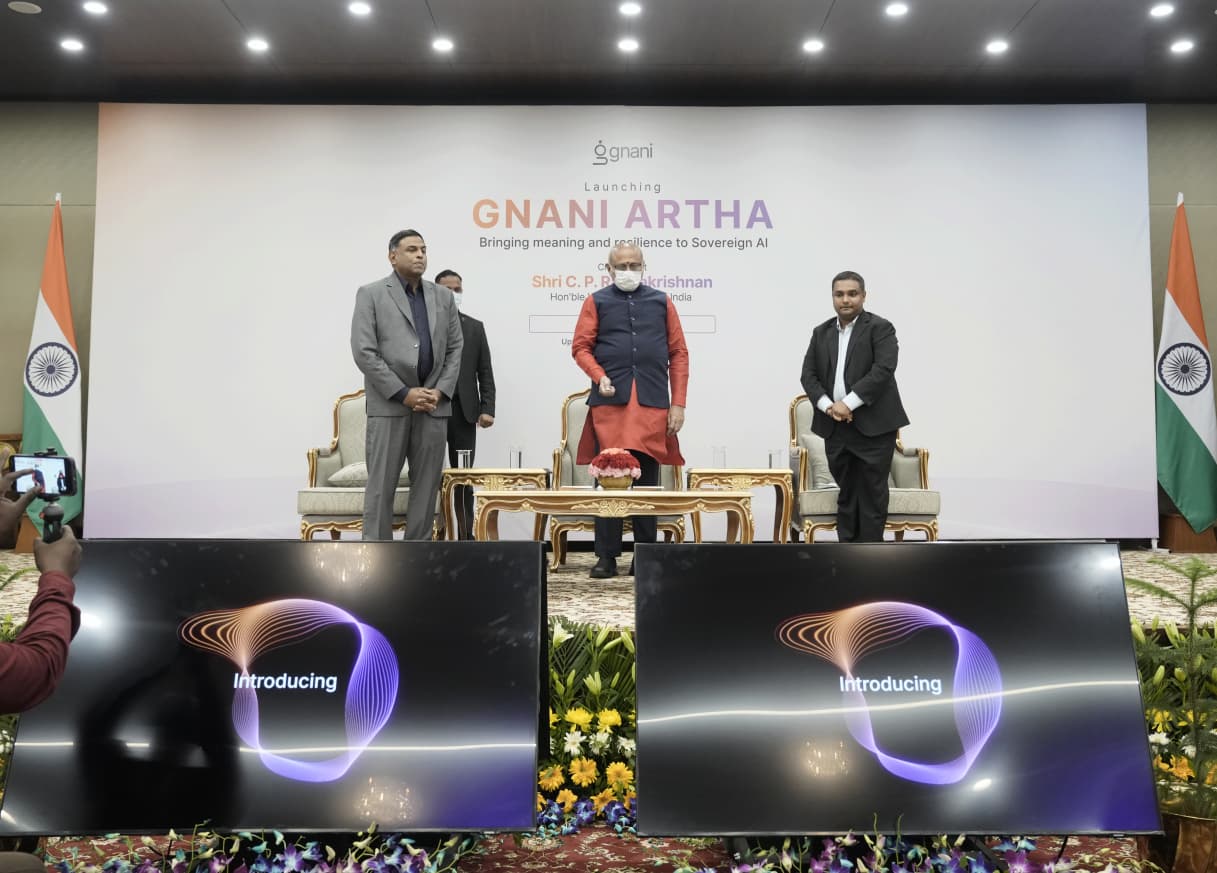
Vice President Shri C. P. Radhakrishnan today launched ‘Gnani Artha’, a sovereign Artificial Intelligence (AI) stack developed by GNANI AI, at Uprashtrapati Bhavan in New Delhi.
Gnani Artha brings together two key technologies, Evon 3.3 and Plexus. Evon 3.3 is a large language model. Plexus is a platform that connects AI capabilities with real-world work and institutions.
The launch marks another step in India’s growing efforts to build advanced technology within the country. It also highlights the role of Indian engineers in developing AI systems for wider use.
Indian Technology Is Advancing
Welcoming the launch, Shri C. P. Radhakrishnan said the combination of Evon 3.3 and Plexus reflects the growing strength of India’s technology ecosystem.
He said Indian engineers are now showing that they can do more than use frontier technologies. They can also build them.
The Vice President recalled how technology has changed over the decades. Typewriters once played a major role in offices. Personal computers later became common in workplaces. Today, Artificial Intelligence and Large Language Models are shaping a new phase of technological change.
He also recalled the early concerns that computers could reduce employment. However, the growth of the IT sector created many new opportunities in India and abroad.
Shri C. P. Radhakrishnan expressed confidence that AI will follow a similar path. He said the technology can create new avenues for employment, innovation and economic growth.
AI Can Support India’s Growth
The Vice President highlighted India’s rapid progress in Artificial Intelligence.
He pointed to initiatives such as the IndiaAI Mission and Centres of Excellence for AI. These efforts are helping build an ecosystem for AI research, development and use in the country.
He also credited the visionary leadership of Prime Minister Shri Narendra Modi for providing strong support to India’s technology journey. He said political will and an ‘India First’ approach are helping strengthen the country’s capabilities in emerging technologies.
The Vice President said technology will play an important role in India’s economic and national development. He added that the country must continue to invest in skills, innovation and indigenous capabilities.
AI Is Already Helping Parliament
Shri C. P. Radhakrishnan also referred to the use of AI in Parliament.
He said the Digital Sansad portal allows parliamentary debates and papers to be accessed in multiple Indian languages. This helps make parliamentary information more accessible to citizens.
He further noted that simultaneous AI-based interpretation in eight languages was introduced during the recently concluded Session.
The facility is expected to be extended to all Scheduled Languages in the future. Such applications show how AI can support public institutions and improve access to information.
India Needs Indigenous Technology
The Vice President stressed the importance of technological self-reliance.
He said India should not remain only a consumer of technology. The country must also create technologies that can be used by others.
“We should not be consumers always; we need to create, so that others can consume,” he said.
His remarks underline the need for India to develop strong domestic capabilities in areas such as AI, semiconductors and other advanced technologies.
He also referred to semiconductor manufacturing. He said India could have started manufacturing chips much earlier and may have emerged as a global leader in the sector.
At the same time, he noted that semiconductor manufacturing has gained fresh momentum in recent years. This progress, he said, is helping strengthen India’s technology base.
Sovereign AI Has Strategic Value
The Vice President emphasised the need to develop sovereign AI capabilities.
Sovereign AI can help countries build and manage AI systems with greater control over technology, data and critical infrastructure. For India, such capabilities can support technological and strategic autonomy.
The launch of Gnani Artha comes in this wider context. Building advanced AI systems in India can help strengthen the country’s ability to develop solutions for its own needs.
It can also support innovation across government, business and other institutions.
Technology and Viksit Bharat
Shri C. P. Radhakrishnan said technological capability will remain an important pillar of India’s journey towards Viksit Bharat @ 2047.
He described Gnani Artha as part of the larger national effort towards technological self-reliance, innovation and global leadership.
The development of indigenous AI systems can contribute to this goal by encouraging research, engineering and technology development within India.
It can also help create an environment where Indian technology companies can build solutions for both domestic and global applications.
Building India’s AI Future
The Vice President congratulated GNANI AI CEO Shri Ganesh Gopalan and Co-Founder and CTO Shri Ananth Nagaraj on the launch of Gnani Artha.
He expressed hope that the initiative will contribute to a stronger, self-reliant and technologically empowered India.
The launch of Evon 3.3 and Plexus reflects a wider shift in India’s technology landscape. The country is moving from adopting advanced technologies to developing them.
As AI becomes a larger part of the economy and public institutions, indigenous capabilities will be important for India’s long-term growth. Initiatives such as Gnani Artha add to this growing ecosystem and support the broader goal of building a technology-driven and self-reliant India.
Subscribe Deshwale on YouTube
