







As investment habits evolve in India, many investors are rethinking one important question: which asset class creates the strongest long-term wealth? Gold, stocks, and land have all remained popular investment choices for decades, but changing economic conditions and rapid urban growth are now reshaping the debate.
The discussion around gold investments recently gained fresh attention after Prime Minister Narendra Modi urged citizens to reduce non-essential gold purchases in order to help conserve India’s foreign exchange reserves. The statement sparked wider conversations across financial circles about whether investors may increasingly diversify towards equities and land-based investments.
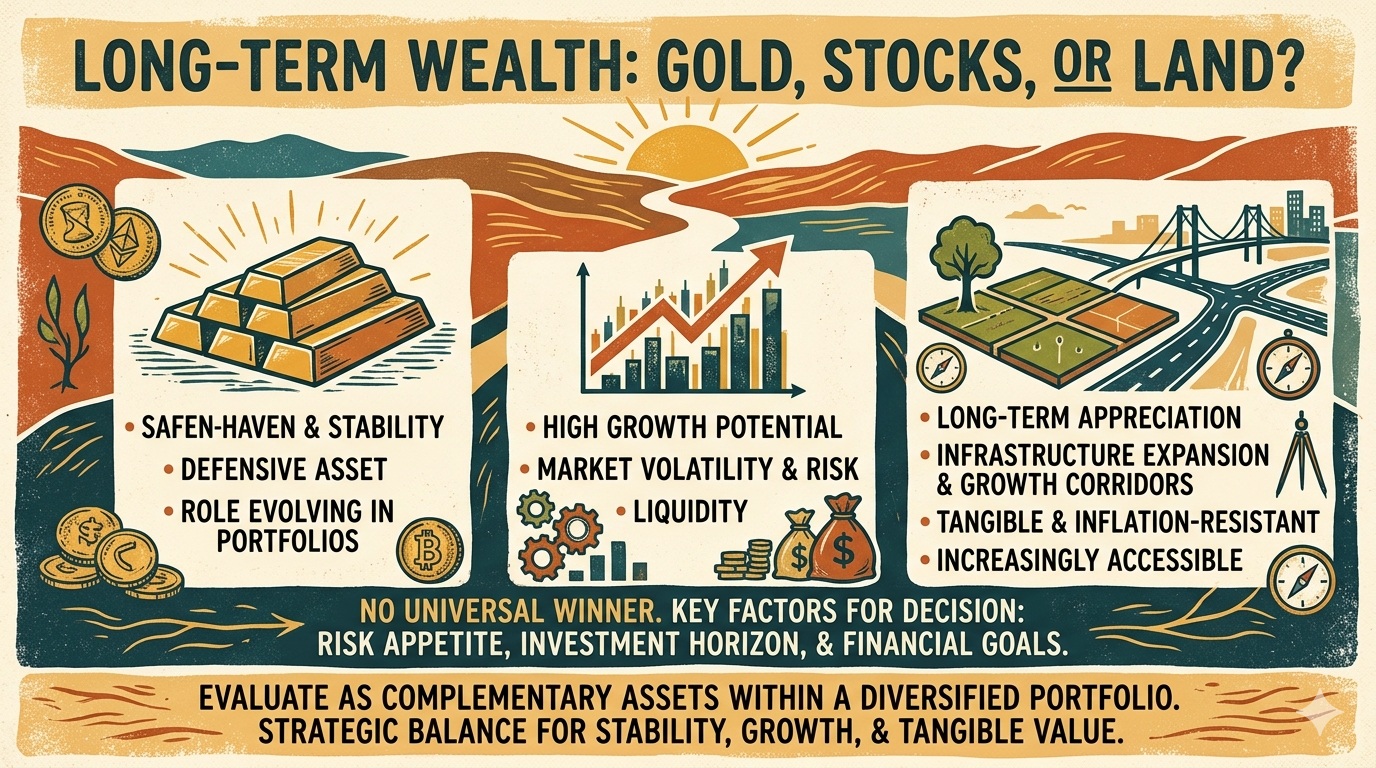
Gold has traditionally been viewed as a safe-haven asset. During periods of uncertainty, inflation, or market instability, investors often turn to gold because of its stability and long-standing cultural value in India. However, financial experts point out that while gold protects wealth, it may not always generate the kind of aggressive long-term growth that younger investors seek today.
Stocks, meanwhile, continue to attract investors looking for higher returns. Over the long run, equity markets have created significant wealth for disciplined investors. However, stock markets also come with volatility. Prices can fluctuate sharply depending on economic cycles, global events, and investor sentiment. This makes equities suitable mainly for investors who are comfortable with risk and willing to stay invested through market ups and downs.
Land investments are increasingly emerging as a strong alternative, particularly in infrastructure-driven growth corridors around major cities. Rapid urbanisation, new highways, metro connectivity, and industrial development are pushing demand for plotted developments and peripheral real estate markets.
Industry experts believe that organised land projects have made this asset class more accessible than before. Salaried professionals and first-time buyers are now showing greater interest in land ownership because of lower entry costs in emerging destinations compared to expensive urban housing markets.
ORA Land Director Unnati Varma said that land investments offer a unique long-term advantage because of their limited supply and growing demand. According to her, infrastructure-led expansion is creating new growth corridors where strategically located land parcels are witnessing strong appreciation potential.
She also highlighted the growing demand for organised plotted developments in destinations such as Karjat, where buyers are increasingly seeking secure and legally transparent land investments that combine lifestyle value with long-term wealth creation.
Similarly, NAREDCO Maharashtra President Kamlesh Thakur noted that each asset class serves a different purpose within a portfolio. Gold provides stability, equities offer high-growth opportunities, while land remains a resilient and inflation-resistant tangible asset with strong appreciation potential over time.
Experts further believe that infrastructure projects such as metro corridors, industrial hubs, highways, and improved connectivity are transforming peripheral regions into future investment hotspots. Investors entering these micro-markets early could potentially benefit from long-term value appreciation.
Financial planners increasingly advise investors not to view gold, stocks, and land as competing assets but as complementary parts of a diversified portfolio. While stocks offer liquidity and growth, gold provides protection during uncertainty. Land, meanwhile, combines tangible ownership with long-term appreciation potential, particularly in fast-growing regions.
As India’s economic landscape continues to evolve, the future of wealth creation may depend less on choosing a single asset class and more on maintaining the right balance between stability, growth, and long-term value.
Subscribe Deshwale on YouTube