









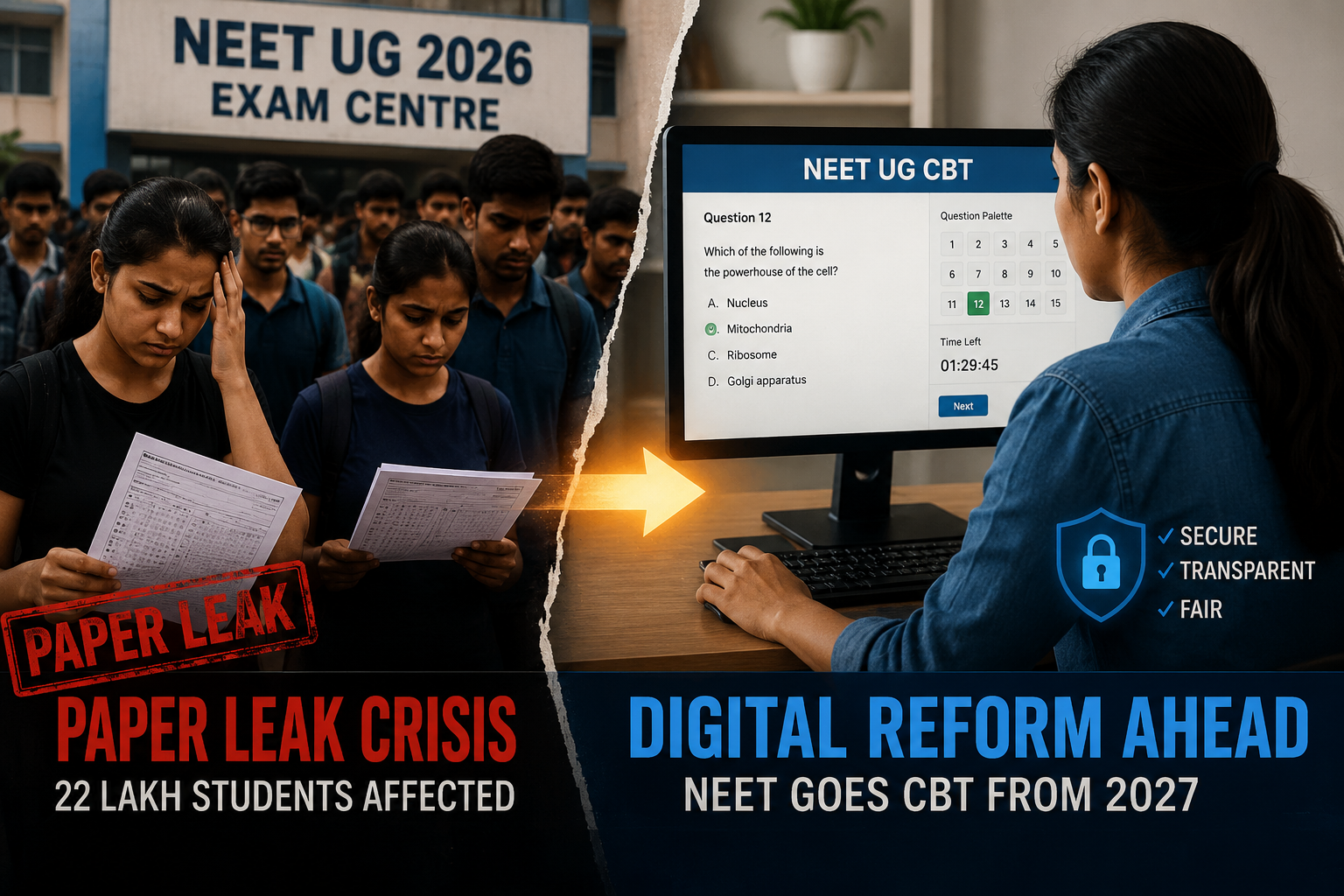
By the time Education Minister Dharmendra Pradhan stepped before the cameras on May 15, 2026, the damage had already been done. Over 22 lakh medical aspirants millions of young Indians who had spent years preparing for a single high-stakes exam had woken up to the news that the NEET UG 2026 examination, held on May 3, had been cancelled. The reason: a confirmed paper leak that had compromised the very foundation of the country’s most consequential medical entrance test.
The announcement that followed was significant. Pradhan declared that NEET UG will shift to a Computer-Based Test (CBT) format from 2027, signalling the end of the pen-and-paper era for India’s gateway to MBBS, BDS, AYUSH and other medical courses.
How the Leak Unfolded
The sequence of events leading to the cancellation reads like a slow-moving catastrophe. The exam took place on May 3. Four days later, on May 7, the National Testing Agency (NTA) received a complaint that a circulating “guess paper” contained questions that matched those asked in the actual examination. The Higher Education Department immediately initiated an inquiry and handed the matter to investigating agencies, while state agencies were also brought in.
By May 12, authorities had confirmed what many suspected: under the cover of a guess paper, the actual NEET UG 2026 question paper had been leaked. Investigators confirmed that what had been circulated as a “guess paper” was in fact the actual question paper — a case of organised malpractice that the government said it could not ignore.
The decision to cancel the examination followed swiftly. “We did not want deserving students to suffer because of unfair practices and organised malpractice networks,” Pradhan stated, defending what was an unprecedented step for an exam of this magnitude.
The Re-Examination: June 21
With the cancellation confirmed, students were left in a state of anxiety over their admissions to medical colleges. The government moved quickly to address this. The NTA announced that the re-examination will be conducted on June 21, 2026, with admit cards expected to be released ahead of that date.
Crucially, the government also announced a full fee waiver for the re-examination. Students who had paid fees for the May 3 exam will have those fees refunded, and no additional charges will be levied for the re-conduct. “Our topmost priority is the future of the students, and the government is sensitive towards their hard work and efforts. We will not let malpractice happen this time,” Pradhan assured students and parents.
The minister defended the NTA, noting that it conducts examinations for nearly one crore students annually and was formed on the recommendation of the Supreme Court. However, he acknowledged that reforms were necessary, promising zero tolerance for errors going forward.
The Structural Fix: Moving to CBT
The most far-reaching announcement was the government’s decision to transition NEET UG to a Computer-Based Test format from 2027. Pradhan described CBT as “better than OMR” and acknowledged that cybercrime has become a major challenge for high-stakes examinations. The government said it is actively working to make the CBT system “foolproof” before implementation.
The shift is not just about technology it is about closing the specific vulnerability that made the 2026 leak possible. A CBT system eliminates the physical paper trail: no printing, no physical distribution chains, and no possibility of question papers being intercepted in transit. Questions can be randomised per candidate, and the entire delivery can be managed digitally under tight security protocols.
This is not the first time India has turned to CBT after a paper leak. When UGC-NET 2024 was cancelled the day after it was conducted over integrity concerns, the re-examination was promptly shifted to computer-based mode. That precedent has now informed a more permanent and systemic shift for NEET.
Accountability and Investigation
Pradhan left no ambiguity on the question of accountability. The Central Bureau of Investigation (CBI) will conduct a detailed probe into the 2026 leak. “No one involved in wrongdoing will be spared whether inside or outside the NTA,” the minister said, confirming that officials at multiple levels are under scrutiny. Cyber monitoring has also been intensified, with reports indicating that approximately 120 Telegram channels linked to the leak were blocked.
The minister also referenced the Radhakrishnan Committee, formed after the NEET irregularities of 2024, whose recommendations were reportedly implemented in full for both the 2025 and 2026 cycles. The fact that a leak still occurred despite those safeguards underlines why a structural overhaul not just procedural fixes is now being pursued.
What This Means for Millions of Students
For the 22 lakh students caught in this crisis, the immediate priority is the June 21 re-examination. For the larger student community, the CBT transition from 2027 represents a fundamental change in how they will prepare and appear for the country’s most competitive entrance test. The government’s message is clear: India cannot afford to let the integrity of NEET be compromised again.
Subscribe Deshwale on YouTube


