










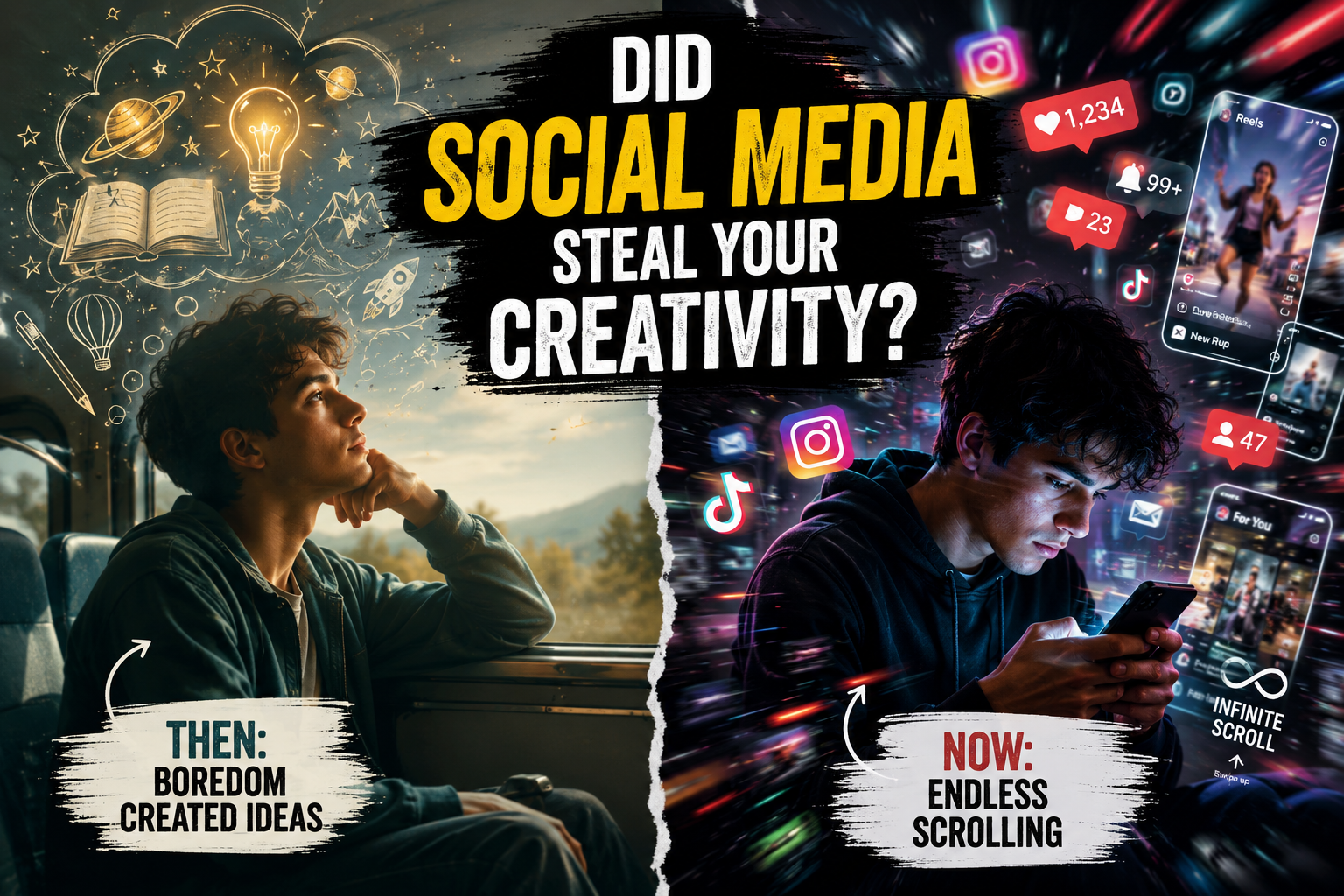
We used to stare at walls, zone out on long bus rides, and let our minds wander freely. Now we reach for our phones before a single quiet moment has a chance to breathe. And science says we are paying a much bigger price for that than we realize.
Think about the last time you were truly, completely bored. Not the kind where you’re waiting for a video to buffer, or doom-scrolling through content you don’t even care about. Real boredom. The kind where you’re sitting quietly, doing absolutely nothing, and your mind just… starts to wander.
Can you even remember that? Because for most people, that feeling no longer exists.
We have filled every single gap in our day with content. Waiting in a queue? Open Instagram. Sitting on the train? Switch on YouTube. Lying in bed before sleeping? Scroll through TikTok until your eyes give up before your brain does. The result is a life with zero empty moments and it is quietly costing us something we didn’t even know we were losing.
We are consuming more than ever before
The numbers are staggering. According to Statista, the average person worldwide spends around 2 hours and 21 minutes every single day on social media alone. Gen Z, those born roughly between the late 1990s and early 2010s, spend close to 9 hours a day on screens in total. If you subtract time for sleep, that means a significant portion of every waking hour is spent looking at a screen.
The average person now spends nearly 42 percent of their waking hours looking at a screen. That is not a small number. That is nearly half of every day.
And in all of that between the reels, the tweets, the short-form videos, the push notifications, the stories, the memes there is not a single quiet second left. We have become afraid of doing nothing. The moment boredom knocks on the door, we slam it shut with our phones.
But what if boredom was actually good for you?
Here is the part that will genuinely surprise you.
Inside your brain, there is a system called the Default Mode Network, or DMN. It was discovered by neurologist Marcus Raichle and it is one of the most fascinating things neuroscience has ever uncovered. The Default Mode Network is a collection of brain regions that become active when you are not focused on the outside world when you are resting, daydreaming, letting your mind drift, or simply doing nothing in particular.
In other words, your brain does not switch off when you are bored. It switches on just differently.
When the DMN is active, your brain begins doing something remarkable. It starts connecting old memories, wandering through unresolved problems, playing with abstract ideas, and making unexpected links between things that don’t seem related at all. This is where creative thinking lives. This is where your best ideas come from.
You have experienced this without realising it. Have you ever had a brilliant idea in the shower, or figured out the answer to a problem you had been stuck on for days while you were just going for a walk? That was your Default Mode Network doing its job. The moment you stopped actively trying, your brain quietly solved the puzzle in the background.
What the research actually says
Researchers Karen Gasper and Brianna Middlewood from Pennsylvania State University ran a study where participants were put in different emotional states: bored, relaxed, elated, or distressed and then given creativity tests. The results were clear. The bored participants outperformed all the others.
In a separate study, researchers Sandi Mann and Rebekah Cadman from the University of Central Lancashire asked participants to either copy numbers out of a phone book, one of the most tedious tasks imaginable or do nothing at all. Afterwards, both groups were asked to think of as many creative uses as possible for a pair of plastic cups. The group who had suffered through the phone book task came up with significantly more creative ideas than the control group.
Boredom, it turns out, is not emptiness. It is a push. It forces the mind to seek stimulation from within and that internal search is the very foundation of creative thought.
It is worth noting that scientists are careful here. Not every study agrees on how direct the link between boredom and creativity is. A 2016 study published in academic research suggested that boredom alone does not automatically make you more creative, it is more about how you respond to boredom that matters. The people who sit with boredom and let their minds wander, rather than immediately escaping it, are the ones who benefit. The key is allowing the mind to roam freely without instantly reaching for distraction.
Social media is designed to never let that happen
This is where the real problem lives.
Every major social media platform is built deliberately, by teams of extremely smart engineers and psychologists to capture your attention and never let it go. The infinite scroll means there is no natural stopping point. The algorithm learns exactly what keeps you watching and serves more of it. The notifications are timed to pull you back in just as you might be about to put your phone down.
These platforms are not designed for your wellbeing. They are designed to hold your attention for as long as possible, because your attention is what they sell to advertisers. Every idle moment you might have had on the train, in a waiting room, on a lunch break is now monetised. Your boredom has been turned into a product.
And when boredom disappears, so does the space where your best ideas used to live.
The ideas we are missing and don’t even know it
Some of the most important ideas in human history came from moments of wandering thought. Isaac Newton described the process of discovery as coming from long periods of quiet thinking. Charles Darwin spent hours walking along a path he called his “thinking path” near his home, letting his mind wander without direction. J.K. Rowling has spoken about how the idea for Harry Potter came to her during a delayed train journey, a moment of forced stillness with nothing to do.
None of those moments would have happened if those people had a phone in their hand.
Stanford neuroscientist Vinod Menon, who has studied the Default Mode Network extensively, put it simply: “We have our phones, we have streaming, we have all these ways to distract ourselves that don’t give us that opportunity to reflect and build on our internal narrative and make those creative leaps. Sometimes boredom is really good for making those connections.”
The solution is not to delete all your social media and move to a cabin in the woods. That is neither realistic nor necessary. But what is worth doing is protecting a few minutes each day where you do absolutely nothing and let your mind go wherever it wants to.
Sit on your commute without putting in your earphones. Have a cup of tea without your phone beside you. Go for a walk and resist the urge to listen to a podcast. Let yourself be bored for ten minutes before bed instead of scrolling.
It will feel uncomfortable at first. That restlessness you feel is your brain looking for stimulation. But if you sit with it, something interesting starts to happen. Your mind begins to wander. Old thoughts resurface. Unexpected ideas appear. Connections form between things you never realised were connected.
That discomfort? That is your creativity waking up.
Boredom was never the enemy. It was the raw material. It was the blank page your imagination used to write on. Social media did not just steal your time, it stole the silence that your best thinking happened in.
The most creative, thoughtful, and innovative people in the world are not the ones consuming the most content. They are the ones brave enough to sit with nothing and see what their own mind comes up with.
In a world that is desperately trying to fill your every second with something, choosing to do nothing is quietly becoming one of the most powerful things you can do.
So the next time you feel bored, try something different. Put the phone down. Stare at the ceiling. Let your mind go wherever it wants.
Subscribe Deshwale on YouTube


