










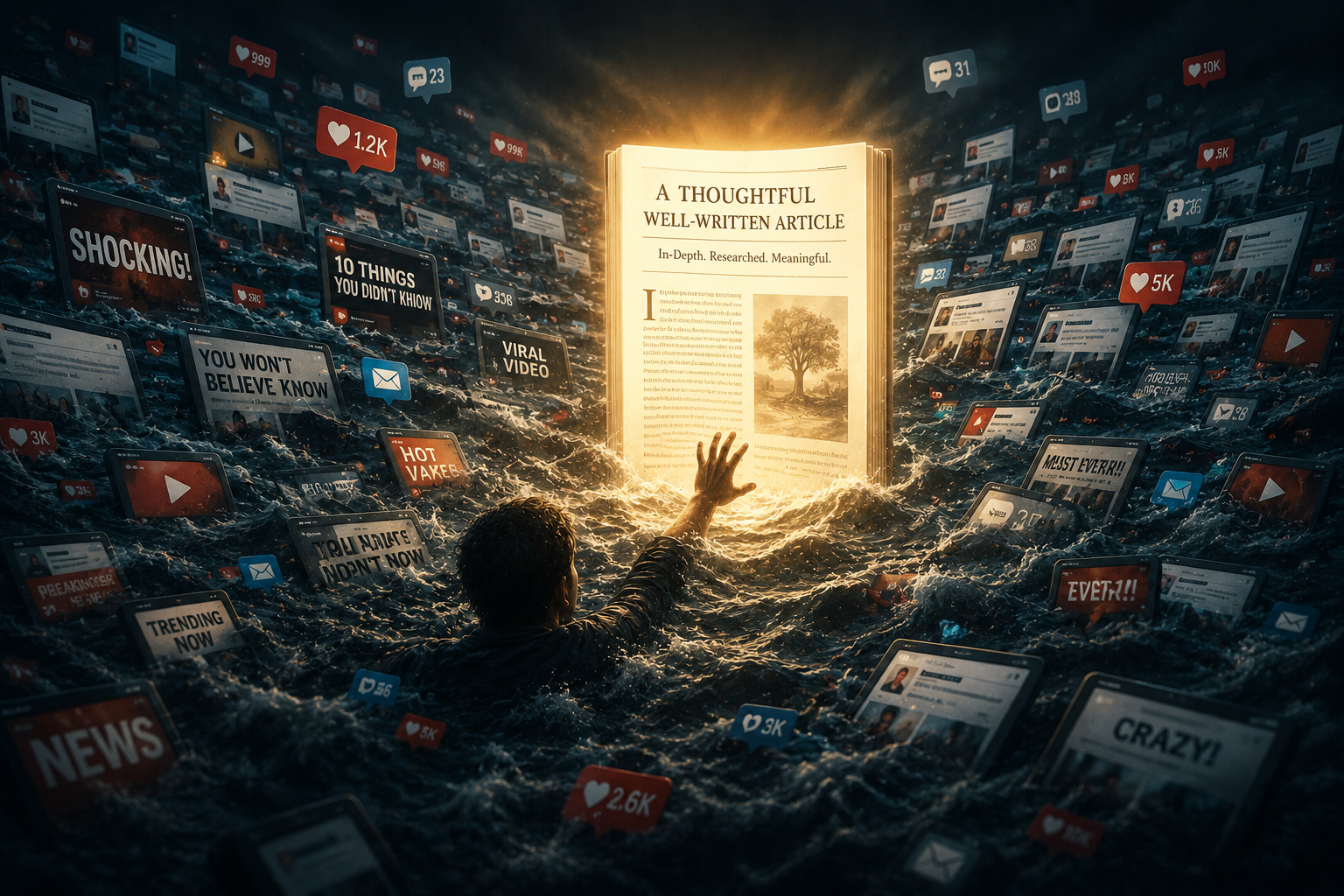
Imagine walking into a library where absolutely anyone can add a book. No editors. No reviewers. No one checks if the information is accurate, well-written, or even useful. Every single day, thousands of new books appear on the shelves. The library keeps growing. But finding something genuinely worth reading? That gets harder and harder.
That is the internet right now.
And the scary part is most of us have stopped noticing.
Publishing used to be hard. That was actually a good thing.
Thirty years ago, getting published was a battle. You had to convince an editor. You had to prove your writing was good enough. You had to go through rounds of reviews, rejections, and rewrites. It was slow, painful, and often unfair especially if you were a new voice without connections.
Then the internet arrived and changed everything.
Suddenly, anyone could publish. A teenager in a small town could share ideas with the whole world. A scientist could bypass traditional journals and post research directly online. Communities formed around niche topics that no mainstream publication would ever cover. This was genuinely exciting. It felt like freedom.
And it was for a while.
The flood nobody saw coming
Here is the problem nobody talked about: when publishing becomes free and effortless, everyone does it. Not just the people with great ideas. Everyone.
Today, over 7 million blog posts are published every single day. Millions of videos are uploaded to YouTube every hour. Social media platforms process billions of posts, tweets, and updates around the clock. The volume of content created in a single day today would have taken decades to produce just thirty years ago.
At first glance, this sounds amazing. More content means more choice, right?
Not quite.
Because while publishing got cheaper, your attention did not get bigger. You still have the same 24 hours. You still get tired. You still have a limited amount of focus to spend each day. And now you are being asked to sift through an ocean of content to find the few drops that are actually worth your time.
The race to the bottom
Here is where things get really interesting and a little dark.
When everyone is publishing constantly, the pressure to keep up becomes enormous. Online communities, blogs, and media outlets start chasing one number above everything else: output. How many posts this week? How many videos this month? How often are we showing up in people’s feeds?
This creates what you could call a race to the bottom.
Writers start producing articles in two hours that should have taken two days. Creators start making videos on topics they barely understand because the algorithm rewards frequency. Communities start prioritising clicks over correctness, headlines over depth, and speed over substance.
The incentives are completely broken. A well-researched, carefully written 2,000-word article might take a week to produce. A rushed, surface-level listicle takes an afternoon. And on most platforms, the listicle performs just as well, sometimes better because it is shorter, snappier, and easier to share.
So why bother going deep?
What we lose when quality dies
This is the hidden cost that nobody puts a number on.
When quality loses to quantity online, the damage is not immediately visible. It is slow and quiet. It looks like this:
You stop trusting what you read. When every website is pumping out content just to fill space, you start to sense even if you cannot articulate it that a lot of what you’re reading is hollow. So you skim. You scroll faster. You stop engaging deeply with anything.
Misinformation spreads faster. Accurate, well-researched content takes time to produce. False or misleading content can be generated in minutes. In a world that rewards speed, bad information has a head start.
Real expertise gets buried. The person who has spent years mastering a subject and writes one thoughtful piece a month is competing against accounts that publish ten times a day. The algorithm does not always reward depth. It rewards consistency and engagement and the fastest way to get both is to keep feeding the machine, quality or not.
Communities become echo chambers. When online spaces prioritise volume, the loudest voices win not the wisest ones. The people willing to post fifty times a week shape the conversation, regardless of whether they have anything meaningful to say.
The attention economy has no interest in your growth
Here is the uncomfortable truth at the heart of all this.
The platforms that host our communities social media sites, content aggregators, recommendation algorithms are not designed to make you smarter or more informed. They are designed to keep you scrolling. The longer you stay on the platform, the more ads you see, the more money they make.
And what keeps people scrolling? Not depth. Not nuance. Not carefully argued ideas that require effort to understand.
What keeps people scrolling is outrage, novelty, and the dopamine hit of something new every few seconds.
Quality content that asks you to slow down and think is, in a very real sense, bad for the business model of most platforms. So the algorithm quietly punishes it by showing it to fewer people, burying it under more immediately gratifying content.
Can quality fight back?
The good news is yes. But it requires a conscious effort.
Some platforms are beginning to recognise the problem. Substack has grown by betting on long-form writing that readers pay for directly, removing the advertiser from the equation. Newsletters have made a comeback for the same reason when someone invites your writing into their inbox, the relationship is different. More personal. More accountable.
Readers are also beginning to push back. There is a growing appetite for slower, deeper, more honest content. Podcasts that run two hours. Essays that take forty minutes to read. Documentaries that refuse to simplify complex stories. People are hungry for substance; they are just struggling to find it amid the noise.
What you can do right now
Change starts with individual choices.
As a reader: Be more intentional. Follow fewer sources and read them more carefully. Reward quality with your attention, your shares, and your subscriptions. Stop clicking on headlines designed to trick you.
As a writer or creator: Resist the pressure to publish constantly. One honest, well-crafted piece will always outlast ten hollow ones. Write what you actually know. Take the time to get it right.
As a community member: Celebrate depth over volume. Upvote the post that taught you something, not just the one that made you laugh for three seconds.
The internet gave everyone the power to publish. That was a gift. But like most powerful things, it came with a cost we did not fully see until it was already here.
Publishing got cheap. Attention did not. And in that gap between the endless flood of content and the limited hours in your day quality is quietly drowning.
The question is not whether we can save it. The question is whether enough of us care to try.
Subscribe Deshwale on YouTube


