









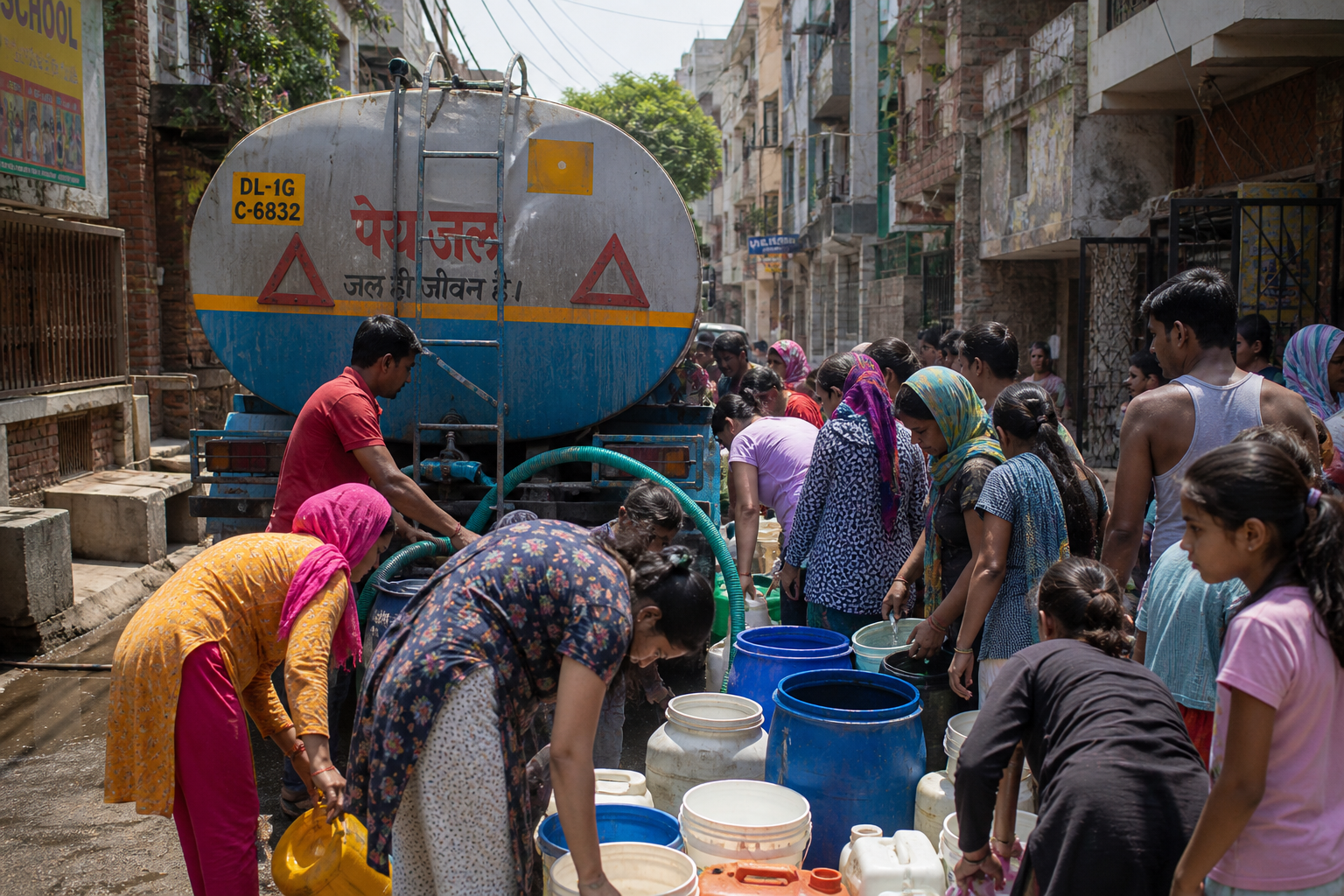
Delhi has a water problem. Anyone who has lived in the city through its brutal summers knows that the taps run dry, tankers become a daily sight, and groundwater keeps going deeper every year. The Delhi government has now decided to act on this in a more structured way, and Chief Minister Rekha Gupta has announced that the government is working on a dedicated borewell policy to address the growing water crisis in the capital.
The announcement came on April 30 during the ‘Catch the Rain’ event organised by the Delhi Jal Board as part of its rainwater harvesting programme. CM Rekha Gupta, who participated in the event, made it clear that the borewell policy will not be a free pass for everyone. There is a condition attached to it that only those houses and residential colonies that already have a proper, functioning rainwater harvesting system in place will be eligible for an authorised borewell. This is a significant detail because it ties together two things that should always go hand in hand: drawing water from the ground and putting water back into it.
The chief minister did not mince words about why this is urgent. She pointed out that rising population and rapid urban development are pushing water demand higher every year, while groundwater levels continue to fall. Delhi is caught in that familiar trap: more people, more concrete, less water. And the city cannot keep depending on the same limited sources forever. Gupta said the water crisis can no longer remain a topic of discussion and demands immediate, decisive action.
To encourage residents to take rainwater harvesting seriously, the government has put some real incentives on the table. Subsidies of up to Rs 50,000 are being offered, along with discounts of 10 to 15 per cent on water bills and free technical assistance for those who want to set up harvesting systems. Citizens who adopt the system will also be eligible for a rebate of up to 10 per cent on their water bills. These are not small numbers, and the government seems to be betting that financial incentives will push people to act where awareness campaigns alone have failed.
But the government is not just offering carrots there are sticks too. Water Minister Parvesh Sahib Singh, who was also present at the event, made it clear that rainwater harvesting in government establishments will be implemented in a serious and time-bound manner. He added that failure to comply will not be taken lightly. An initial 10 per cent cut will be imposed on those who do not follow through, and if the lapses continue, the water connection itself will be disconnected. That is a strong signal that the government is serious about making this work on the ground and not just on paper.
One of the more concrete steps announced is that rainwater harvesting systems will be made mandatory for all buildings measuring 100 square metres or more. This essentially brings a large part of Delhi’s housing under the ambit of this policy. Whether it is a residential colony, a government building, or a commercial property, if it crosses that threshold, it will need to have a harvesting system in place.
As part of the event, the Delhi Jal Board also unveiled a dedicated mascot for the ‘Catch the Rain’ initiative, a small but symbolic step aimed at building awareness and giving the campaign a visible identity.
Delhi’s water crisis is not new, and no single policy will solve it overnight. But tying borewell access to rainwater harvesting is a sensible approach. It tells people that if you want to take water out of the ground, you first need to show that you are doing your part to put some back. Whether this policy gets implemented effectively will be the real test. The intent, at least, is in the right direction.
Subscribe Deshwale on YouTube


