



This week, a story went viral about Singapore. The tiny island nation has grown nearly 28% larger since 1965, almost entirely by importing sand and dumping it into the sea to create new land. Its neighbours, tired of watching their coastlines vanish, shut the tap one by one. Malaysia banned exports in 1997 and again in 2018. Indonesia and Vietnam followed. Cambodia made its ban permanent in 2017, after activists proved the country had shipped out far more sand than official records showed.
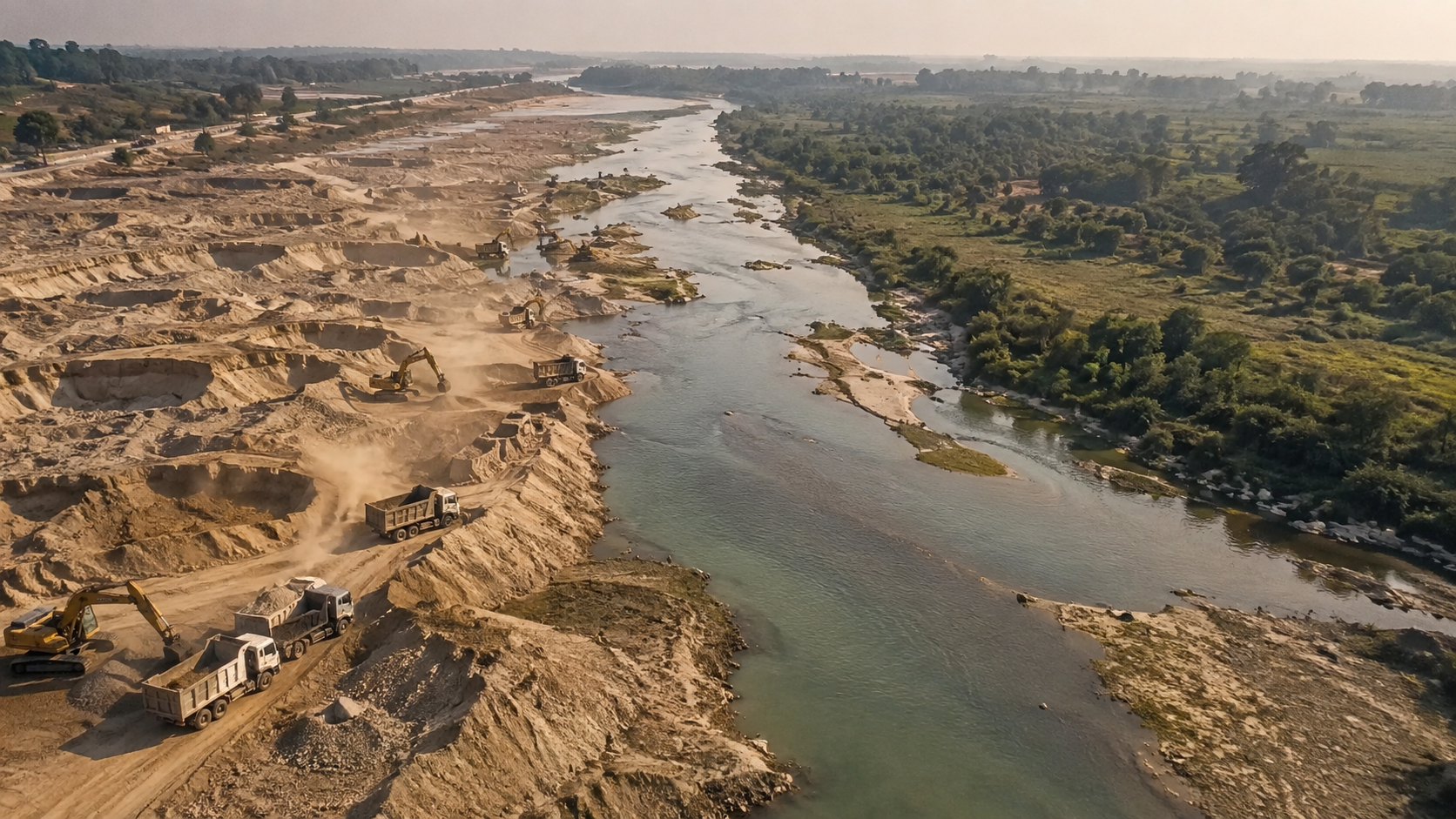
It’s a dramatic story. But if you live in India, you don’t need to look that far to see the same pattern playing out. You just need to look at your nearest riverbed.
The demand is staggering
India’s construction industry needs an enormous amount of sand every year. Some estimates put the country’s total annual demand at close to 900 million tonnes. Urban India alone was using around 60 million tonnes a year back in 2019, and the Indian Bureau of Mines expects nationwide demand to cross 1.5 billion tonnes by 2030 as smart cities and industrial corridors keep expanding.
That demand has to come from somewhere. Sand is officially mined under state licenses, but a huge share of it is dug up illegally from riverbeds, often at night, often with the help of local officials who look the other way. A 2018 United Nations Environment Programme report named India, alongside China, as one of the world’s most critical hotspots for sand extraction damaging rivers, lakes and coastlines.
Where it’s happening
The list of affected rivers is long. The Yamuna near Delhi and Agra has been dredged so heavily that its bed has changed shape in places. The Chambal and Banas rivers in Rajasthan, both fragile desert ecosystems, have seen years of unchecked extraction, which is partly why the state introduced a new manufactured-sand policy in 2024 to reduce pressure on natural riverbeds.
In Jammu and Kashmir, environmental clearances have reportedly been fast-tracked even where illegal mining is already visible on the ground. In Uttarakhand, mining has crept into tributaries of the Ganga itself, the river most Indians consider sacred.
The environmental cost mirrors what happened in Indonesia’s Riau Province, where unchecked sand exports to Singapore destroyed dozens of small islands. In India, riverbed mining has been linked to erosion, falling groundwater levels, damaged fish breeding grounds, and weakened bridges that were never built to withstand a riverbed several feet lower than the one they were designed for.
A trade with a body count
What sets India’s version of this story apart is the violence attached to it. Cambodia’s sand story has activists facing surveillance and harassment. India has a rising body count.
In June 2020, journalist Shubham Mani Tripathi was shot dead in Unnao district, Uttar Pradesh, while riding home on a motorcycle, days after he wrote publicly that he feared for his life over his reporting on illegal sand mining. He was not the only one. In the years around his death, at least two other journalists were killed in Madhya Pradesh and Bihar for similar reporting, and a fourth in Tamil Nadu was repeatedly threatened over her coverage of illegal beach sand mining.
It isn’t only journalists. In 2018, a Hindu monk named Swami Sanand died after fasting for more than three months to protest mining activity near the Ganga in Haridwar. In Andhra Pradesh, a truck linked to illegal sand transport once ploughed into a crowd of protesting villagers, killing fourteen people. Reports have repeatedly described a “nexus” between mining contractors, local politicians and police that makes enforcement almost impossible, no matter how many court orders are issued against it.
By some estimates, the illegal sand trade in India is worth over two billion dollars a year. That is roughly the scale of a shadow industry running alongside the legal one, largely untouched by the rules meant to control it.
Rules exist. Enforcement doesn’t
India isn’t short of paperwork on this issue. The environment ministry released sustainable sand mining guidelines in 2016. The mines ministry followed with a sand mining framework in 2018. The National Green Tribunal has passed multiple orders over the years demanding stricter checks.
None of it has meaningfully slowed the digging. Investigations and court petitions keep surfacing the same pattern: mining continues in banned zones, licenses are exceeded, and satellite alerts flagging illegal activity are routinely ignored by the state departments meant to act on them.
The uncomfortable comparison
Singapore’s sand story makes headlines because it involves other countries, trade bans and geopolitics. It feels distant and abstract. India’s sand story rarely makes national headlines at all, even though the human and environmental cost is arguably worse.
The next time you walk past a construction site, or drive over a bridge, it’s worth remembering where that sand likely came from. There’s a real chance it wasn’t legally mined, and a real chance someone who tried to report on it never made it home.
Subscribe Deshwale on YouTube
