



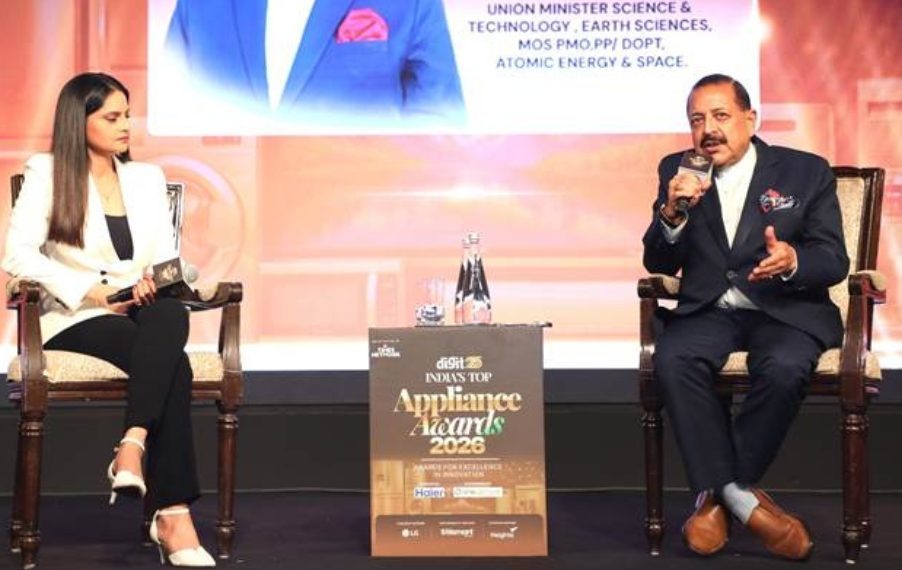
Union Minister of State (Independent Charge) for Science and Technology and Earth Sciences, Dr. Jitendra Singh, said India is set to become an essential player in the next industrial revolution, which he said will be driven by biotechnology and artificial intelligence. He noted that unlike the previous industrial revolution, which was led by information technology and where India joined the global transformation at a later stage, the country is now positioned to be among the early participants in emerging technologies.
Speaking at a media conclave, Dr. Jitendra Singh said India is among the first few countries in the world to have a dedicated biotechnology policy through the BioE3 initiative. He also highlighted the National Quantum Mission and the India AI Mission as key initiatives supporting technological advancement. Referring to the country’s achievements in the space sector, he said India’s space economy, which was once almost negligible, has grown to around USD 9 billion and is projected to reach between USD 40 billion and USD 45 billion over the next eight to nine years.
The conclave brought together technology developers, industry leaders and other stakeholders to discuss India’s emergence as a global manufacturing and technology hub. Discussions focused on technological innovation, private sector participation, the pace of technological change and opportunities in frontier sectors. During the event, Dr. Jitendra Singh also congratulated the winners of the Digital Appliance Awards.
Highlighting India’s technological progress, the Minister said the country has undergone a significant transformation and is now working alongside global benchmarks in several fields. Referring to the Chandrayaan mission, he said the detection of evidence of water molecules on the Moon demonstrated India’s contribution to global scientific knowledge. According to him, India has always possessed scientific talent and capability, but an enabling policy environment was necessary to translate those strengths into measurable outcomes.
Dr. Jitendra Singh said the global economy is gradually shifting towards emerging sectors such as biotechnology, the circular economy, recycling and other technology-driven industries while continuing to build on traditional manufacturing. He said artificial intelligence and biotechnology are expected to shape the next phase of industrial transformation, with India already becoming an active participant in this transition.
He said the Government’s BioE3 initiative, which stands for Biotechnology for Economy, Employment and Environment, aims to strengthen India’s biotechnology ecosystem. According to the Minister, biotechnology is expected to play an increasingly important role in medical science, agriculture and food production while also creating new opportunities for employment and economic growth.
Referring to the decision to open the space sector to private participation in 2020, Dr. Jitendra Singh said the move demonstrated how policy reforms can unlock the country’s capabilities. He said India’s space economy has expanded rapidly since then and continues to grow. He pointed to the emergence of Indian space start-ups, including companies that have developed rockets and achieved unicorn status within a few years, as examples of the opportunities created through an enabling policy framework.
The Minister also said the Government is gradually opening sectors that were previously outside the scope of private enterprise. Referring to the opening of the nuclear sector to private participation, he said the decision creates new opportunities for industry while also requiring companies to prepare themselves by developing the capabilities needed for emerging sectors.
Speaking about India’s long-term development goals, Dr. Jitendra Singh said the country has limited time to prepare for the opportunities associated with the vision for 2047. He said every sector will need to evolve if India is to strengthen its global position, and the private sector must be ready to participate in new areas of growth. According to him, the Government is creating the enabling conditions required to support this transition.
The Minister also highlighted the role of technology in expanding access to education and opportunities, particularly for young people living outside major metropolitan cities. Recalling his interaction with a student from a financially constrained family who cleared the IIT-JEE examination using digital learning resources, he said technology has democratised access to educational opportunities that were previously difficult for many students to obtain.
Dr. Jitendra Singh said the growth of India’s start-up ecosystem demonstrates that innovation is no longer limited to major urban centres. He noted that many entrepreneurs are now emerging from smaller towns and that access to technology is creating new opportunities for young Indians across the country.
The Minister also spoke about the Government’s efforts to simplify governance by removing outdated laws and procedures. He said nearly 2,000 obsolete laws have been repealed, including provisions that had remained in force despite changes in society and governance.
He referred to reforms related to family pension rights for single daughters, nomination rights for women government employees and pension provisions for families of employees who pass away before completing ten years of service. He also recalled the decision to end the requirement for gazetted officer attestation for a large number of documents, saying the reform reflected greater trust in citizens and the country’s youth.
Dr. Jitendra Singh said India’s vision for 2047 requires the country to move beyond being a follower and strengthen its position as a nation whose innovations and capabilities can be adopted globally. He said achieving this objective would require closer cooperation between the Government and industry.
Calling for stronger collaboration between the public and private sectors, the Minister said earlier scepticism between the two should be replaced with mutual learning and partnership. Government and industry, he said, must work together, adopt effective practices from one another and strengthen cooperation to support India’s technological and economic growth.
Concluding his address, Dr. Jitendra Singh said a “whole of government plus whole of nation” approach would be essential for achieving India’s broader developmental, technological and economic aspirations.
Subscribe Deshwale on YouTube
