









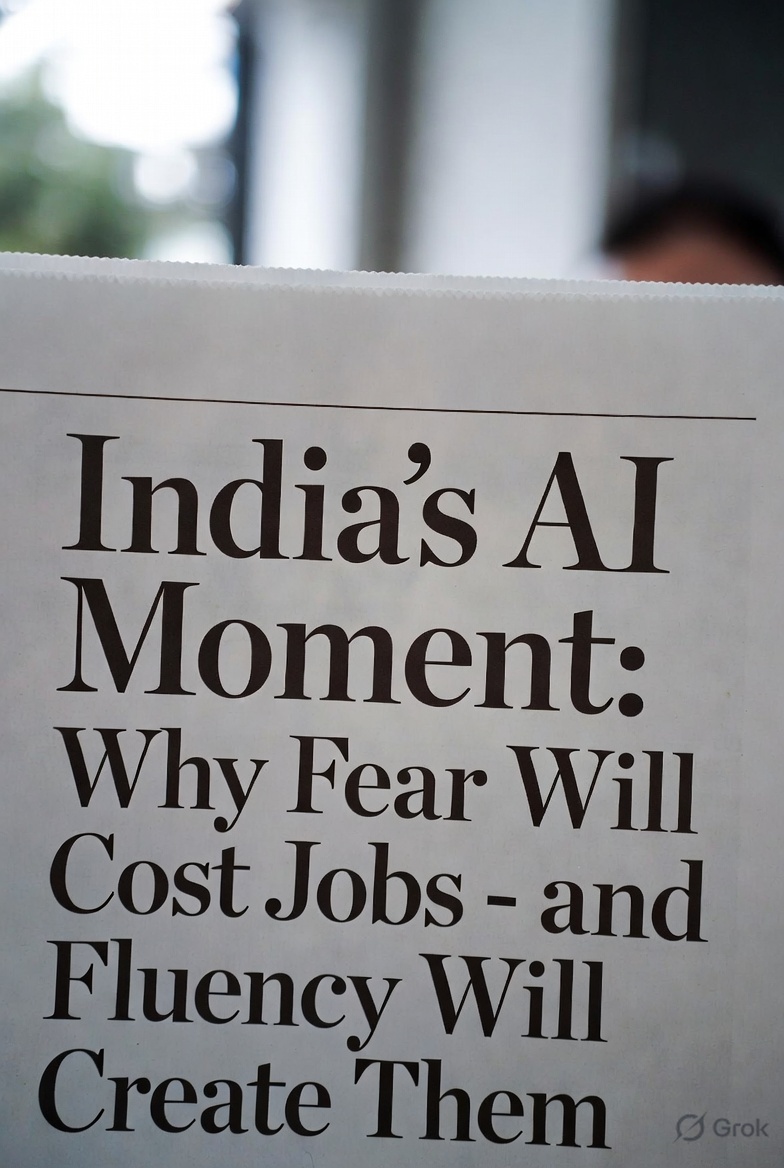
Every technological wave in India follows a pattern.
In the 1990s, English fluency was a competitive edge. In the 2000s, computer literacy became essential. By the 2010s, Microsoft Office proficiency was assumed.
In 2026, the new baseline skill is AI literacy.
Not coding expertise. Not advanced machine learning. But the ability to work with artificial intelligence tools.
The uncomfortable truth is this: in India’s job market, AI is no longer a “plus.” It is rapidly becoming the entry requirement.
And hesitation carries economic consequences.
KEY FIGURES AT A GLANCE
| Metric | Figure |
|---|---|
| Projected AI-skilled roles demand by end 2026 | 1 million+ |
| Current AI talent pool | 600,000-650,000 professionals |
| IT workforce with meaningful AI capabilities | 16% |
| AI-linked hiring growth year-on-year | Nearly doubled |
| White-collar job listings requiring AI familiarity (Bengaluru) | 10%+ |
| Salary premium for AI-integrated roles | 20–50% |
| Engineers graduating annually in India | ~1.5 million |
The Scale of the Shift
India’s AI expansion is not speculative. It is measurable.
According to NASSCOM, demand for AI-skilled professionals is expected to exceed one million roles by the end of 2026. The current AI talent pool stands at roughly 600,000-650,000 professionals – meaning demand already outpaces supply.
The imbalance is structural.
Data from the Ministry of Electronics and Information Technology indicates that barely 16 per cent of India’s IT workforce possesses meaningful AI capabilities. Meanwhile, AI-linked hiring has nearly doubled year-on-year across major metros.
In Bengaluru, over 10 per cent of white-collar job listings now require AI familiarity. In Mumbai’s financial sector and Delhi’s consulting ecosystem, penetration is rising quickly. Even traditional industries – logistics, healthcare, agriculture – are integrating AI workflows.
This is not hype. It is labour-market recalibration.
The Fear Narrative – and Why It Is Incomplete
Public discourse often frames AI as a job destroyer.
Automation anxiety is real. Generative AI can draft reports, generate code, summarise contracts and analyse data in seconds. Routine cognitive work is increasingly automated.
However, the deeper data tells a more nuanced story.
Research from the International Labour Organization shows that AI is more likely to augment high-skill roles than eliminate them. The displacement risk is highest where tasks are repetitive and rule-based – not where human judgement, creativity or domain expertise are central.
The dividing line is not “AI versus humans.” It is “AI-literate versus AI-avoidant.”
Workers who integrate AI tools into their workflow see productivity gains. Those who resist are gradually sidelined.
The economic risk, therefore, is not AI adoption. It is AI avoidance.
The Inequality Risk
India faces a more subtle danger: widening skill inequality.
Urban professionals in global capability centres are rapidly adopting AI tools. Multinational firms are training teams in automation, analytics and AI-assisted decision systems.
Meanwhile, large sections of the workforce remain unfamiliar with even basic AI interfaces.
If this divide persists:
- Salary gaps will widen.
- Employability gaps will expand.
- Regional disparities will intensify.
NITI Aayog has projected that AI could contribute hundreds of billions of dollars to India’s GDP by the end of the decade. But that projection assumes workforce adaptation.
Without upskilling, AI growth could paradoxically deepen unemployment among mid-skilled workers.
In other words: AI can either democratise opportunity – or concentrate it.
The outcome depends on adoption speed.
Where the Jobs Are Emerging
The AI job market is not limited to data scientists.
New and expanding roles include:
- AI-assisted financial analysts
- Healthcare diagnostics coordinators
- Prompt engineers
- AI governance and ethics specialists
- Automation workflow designers
- Data labelling and model training supervisors
Even traditional professions are evolving. A marketing executive now uses AI tools for content drafting and campaign analytics. A lawyer leverages AI for contract review. A supply chain manager relies on predictive forecasting systems.
The role survives – but the workflow changes.
Salary data reflects this shift. AI-integrated roles command premiums of 20-50 per cent compared to their non-AI counterparts.
The market is rewarding fluency.
The Strategic Reality for India
India has a demographic advantage: a young workforce entering employment at scale. Approximately 1.5 million engineers graduate annually.
If this cohort gains AI fluency early, India can become a global exporter of AI-enabled services – much as it dominated the BPO wave in the 2000s.
If it does not, automation tools built elsewhere will replace rather than empower Indian talent.
The global AI race is not only about building models. It is about building a workforce that knows how to use them.
What AI Fluency Actually Means
AI fluency does not require a PhD in machine learning.
It requires:
- Understanding how generative tools function
- Knowing how to write effective prompts
- Interpreting AI outputs critically
- Integrating AI into domain workflows
- Recognising ethical and data risks
In practical terms, this can be learned in months – not years.
Short-term certification programmes, industry portals and modular courses offered through platforms supported by NASSCOM and academic institutions are increasingly accessible.
Most importantly, experimentation is free. Many AI tools offer trial versions. Familiarity comes from usage.
Avoidance is often psychological, not technical.
Productivity Gains Are Already Visible
Firms that embed AI into operations report measurable gains:
- Faster turnaround times
- Reduced operational errors
- Improved data insights
- Lower process costs
Employees who combine domain knowledge with AI tools become more valuable, not less.
The productivity dividend does not eliminate roles – it reshapes them.
Those who adapt become supervisors of automation rather than victims of it.
The Hard Truth
Choosing to ignore AI in 2026 is comparable to refusing to learn computers in 2002.
The market will not wait.
AI is being integrated into enterprise software, government systems, customer service platforms and education technology. Soon, AI interaction will be as routine as email.
Employers will not ask whether a candidate “likes” AI. They will assume competence.
The workforce transition is already underway.
The Defining Question
India stands at a familiar crossroads.
We can treat AI as a threat and slow adoption through fear. Or we can treat it as infrastructure and democratise capability.
The difference between the two outcomes is workforce readiness.
AI will not eliminate ambition. But it will penalise complacency.
For professionals across Mumbai, Bengaluru, Delhi – and increasingly Tier-2 cities – the calculation is straightforward.
Fluency expands opportunity. Fear contracts it.
The future of work in India will not be decided by algorithms alone. It will be decided by how quickly Indians learn to work alongside them.
Subscribe Deshwale on YouTube


