









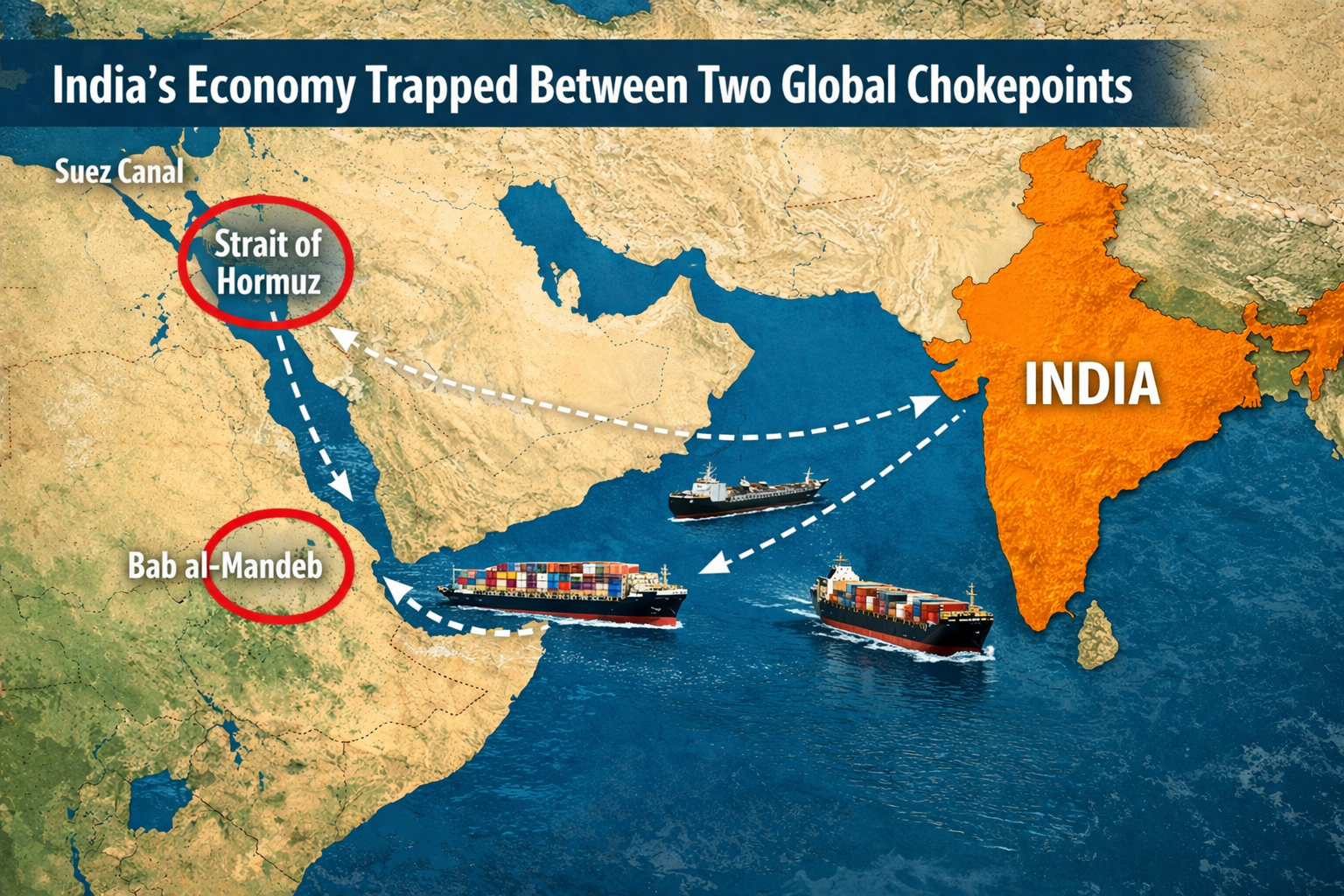
As missile strikes in the Red Sea threaten the world’s most vital maritime chokepoint, India faces a ‘Double Whammy’ that links Yemeni hillsides to the inflation in Indian kitchens. Behind the headlines of war lies a forensic story of fuel costs, insurance premiums and the fragile architecture of global trade.
The maritime geography of India is often romanticised as a vast, open gateway to the world. But for those in the cold rooms of South Block or the high-frequency trading floors of Mumbai, the reality is more claustrophobic. India’s economic lifeblood does not flow through an open ocean; it is squeezed through two narrow, volcanic needles: the Strait of Hormuz to the northwest and the Bab al-Mandeb to the southwest.
In their latest escalation on 28 March 2026, the Houthi rebels say they fired a barrage of ballistic missiles targeting ‘sensitive Israeli military sites’ in southern Israel. This direct challenge to regional missile defences signals a shift from maritime harassment to a broader regional offensive. For India, this move from the metaphorical to the literal “Double Whammy” has transitioned from a theoretical war game to a live, systemic threat to national stability.
The Geography of a Chokepoint
The Bab al-Mandeb (the “Gate of Tears”) is a 29-kilometre gap between Yemen and the Horn of Africa. It serves as the southern vestibule of the Suez Canal. Sovereignty over this corridor is a complex legal tapestry. While the strait itself is an international waterway governed by the right of “transit passage,” the physical features that define it are under distinct national jurisdictions:
- Perim Island (Mayun): A rocky volcanic island sitting at the very heart of the chokepoint. It is under the absolute sovereignty of Yemen and serves as the strategic “pylon” that splits the strait into two channels.
- Alexander’s Strait (Bab Iskender): This is the narrow eastern channel, measuring just 3 kilometres wide. It flows between Perim Island and the Yemeni mainland and falls entirely within Yemeni territorial waters.
- Dact-el-Mayun: The wider western channel, spanning 26 kilometres. This is the deep-water highway used by international shipping, flowing between Perim Island and the coasts of Djibouti and Eritrea.
When the Houthis, entrenched in the rugged heights of Yemen, launch a drone, they are not just targeting a hull; they are weaponising their proximity to these specific, irreplaceable channels.
A Fragmented Nation: Who Governs Yemen?
The political situation in Yemen today is far from stable; the country is no longer a single, united nation in any administrative sense. Yemen is a fractured landscape of competing authorities. While the Houthis control the capital, Sanaa, and the strategic northern highlands, the internationally recognised government operates largely from the southern city of Aden or from exile in Saudi Arabia.
This legally recognised administration, currently led by the Presidential Leadership Council, is significantly Sunni-dominated in its political and religious character. It draws its primary support from the Shafi’i Sunni majority of the south and east, as well as from powerful Sunni tribal confederations and political parties like Al-Islah. This religious and regional divide has sharpened the conflict, as the Sunni-led south views the Houthi movement as a vehicle for Zaydi Shia revivalism and foreign influence.
The Presidential Leadership Council has vociferously condemned the Houthi actions in the Red Sea. They argue that the Houthis are using the regional conflict as a pretext to tighten their domestic grip and divert attention from the economic misery in the north. According to the Aden-based government, these missile strikes are “irresponsible gambles” that invite foreign intervention and destroy any hope for a permanent Yemeni peace deal. Administratively, the country is split between different currencies, different tax systems and different military commands.
The Rise of the Ansar Allah
The Houthis, officially known as Ansar Allah (Supporters of God), are a Zaydi Shia revivalist movement that emerged from Saada in the 1990s. Their ideological origins were a response to perceived Saudi-backed Salafi encroachment and the marginalisation of the Zaydi minority by the central government. At the time, the government under Ali Abdullah Saleh was perceived as increasingly Sunni-dominated in its political patronage, despite Saleh himself having Zaydi roots.
The demographics of the era provide the necessary context. In the 1980s and 1990s, Zaydi Shias made up approximately 35% to 40% of the population, with Sunni Shafi’is forming the majority. Today, despite decades of war, the demographic split remains roughly similar, but the political reality has flipped. By 2014, the Houthis seized Sanaa and have since survived a decade of bombardment by a Saudi-led coalition.
The Arsenal and the Benefactors
The question of who funds and arms the Houthis is central to the crisis. While the movement maintains a degree of domestic autonomy through “zakat” taxes, their strategic weaponry is widely attributed to Iranian support. Intelligence reports consistently point to Tehran providing the blueprints and components for the long-range “Samad” drones and “Quds” cruise missiles. This provides the Houthis with high-tech capability that far exceeds what a typical rebel group should possess.
The American Equation and Past Deterrence
The Americans have a long, tangled history of dealing with the Houthis. In the past, Washington largely viewed them through the lens of the Saudi-Yemen war, providing intelligence and refuelling to the coalition. Later, the US moved toward a policy of targeted sanctions and intermittent airstrikes under “Operation Prosperity Guardian” to degrade their launch capabilities. However, these efforts have largely failed to deter the group.
The strike on 28 March 2026 against southern Israel represents a major failure of that deterrence. By targeting sensitive military sites, the Houthis are demonstrating that they can project power far beyond the Red Sea, forcing the US and its allies to defend multiple fronts simultaneously. This is the birth of the “multi-front maritime war” where traditional naval superiority is challenged by low-cost, high-frequency attrition.
Bluster or Real Firepower?
Analysts are debating whether the Houthis are indulging in regional bluster or if they possess genuine staying power. The evidence suggests the latter. Their strategy is one of “maritime blockade.” They do not need to sink every ship; they only need to make the route too dangerous and expensive for commercial companies to use.
Their latest actions (firing hypersonic-capable missiles and deploying unmanned underwater vehicles) show a terrifying technical evolution. Their strength lies in their ability to shut down a trade route by making insurance costs explode. They have the firepower to last because their weapons are cheap, their resolve is ideologically driven and their launch sites are mobile and hidden in the mountains.
The Mathematics of the Detour
When a missile claim is verified, the insurance markets in London react in seconds. For an Indian exporter, the choice is binary: pay the extortionate insurance or take the “Cape Route” around the southern tip of Africa. This adds roughly 6,500 kilometres to a journey from Mundra to Rotterdam.
“The crisis creates a lopsided war: a drone costing Rs. 2,00,000 can effectively hold hostage a cargo ship carrying goods worth hundreds of millions of dollars, forcing a fuel-heavy detour that ripples through the Indian consumer price index.”
In the forensic language of a CAG audit, this is a disaster. A standard container ship faces an additional fuel bill of nearly Rs. 8 Crore for the detour. According to recent trade data, nearly 25% of India’s total outbound trade (exports) flows through the Red Sea. When this route is choked, the “Just-in-Time” model of Indian manufacturing collapses. The 10-day delay means that components for a smartphone assembly line in Noida or a car plant in Chennai simply do not arrive.
The Shadow of Hormuz
While the Bab al-Mandeb handles the “value,” the Strait of Hormuz handles the “volume.” India imports nearly 85% of its crude oil, much of it via Hormuz. The strategic nightmare is a synchronised disruption. If the Houthi actions embolden other actors in the Persian Gulf, India faces a supply-side shock that no amount of strategic petroleum reserves can fully mitigate.
Economically, this is an “inflationary pincer.” Every one-dollar increase in the price of a barrel of oil expands India’s import bill by approximately Rs. 10,000 Crore annually. This is money that is diverted from infrastructure, health and education.
A Strategy for Resilience and Diplomatic Realism
The response from the Indian government has been one of “strategic autonomy.” India operates its own naval convoys to protect national interests without joining foreign military alliances. This is a delicate balancing act. By not joining the US-led Operation Prosperity Guardian, India maintains its “neutral” status, which is vital for its energy diplomacy with Iran and the Arab world. However, the long-term solution is not just more warships.
The proposed India-Middle East-Europe Economic Corridor (IMEC) takes on a new urgency. This multimodal rail and ship project is designed to bypass the Red Sea altogether. But IMEC is not a “plug-and-play” solution. It requires massive capital investment and, more importantly, a stable West Asia. In 2026, as missiles fly over the Negev, that stability feels more distant than ever. India is forced to play a “double game”: protecting the old routes with high-tech destroyers while desperately trying to build the new ones through diplomatic grit.
The Final Choke: A 5-Trillion-Dollar Dream on a Leash
Ultimately, the Indian economy remains tethered to these two narrow straits. India is a nation that dreams of becoming a 5-trillion-dollar economy, but that dream is currently being held hostage by a few dozen kilometres of water and the unpredictable trajectory of a Houthi missile. The “Double Whammy” is not just a maritime problem; it is a structural vulnerability in the Indian growth story.
The sun sets over the Arabian Sea, and for a sailor on a tanker heading toward the Mandeb, the beauty is secondary to the fear. He knows that his ship is a sitting duck in a narrow pond. Back in India, the consumer at the petrol pump remains unaware that their daily struggle is being dictated by a group of men in the mountains of Yemen, looking at a radar screen, waiting for the next “Gate of Tears” to open. The world trade order, built on the assumption of safe seas, is facing its greatest stress test since the 1970s. For India, the test is not just one of military might, but of economic survival in a world where the chokepoints are finally closing in.


