








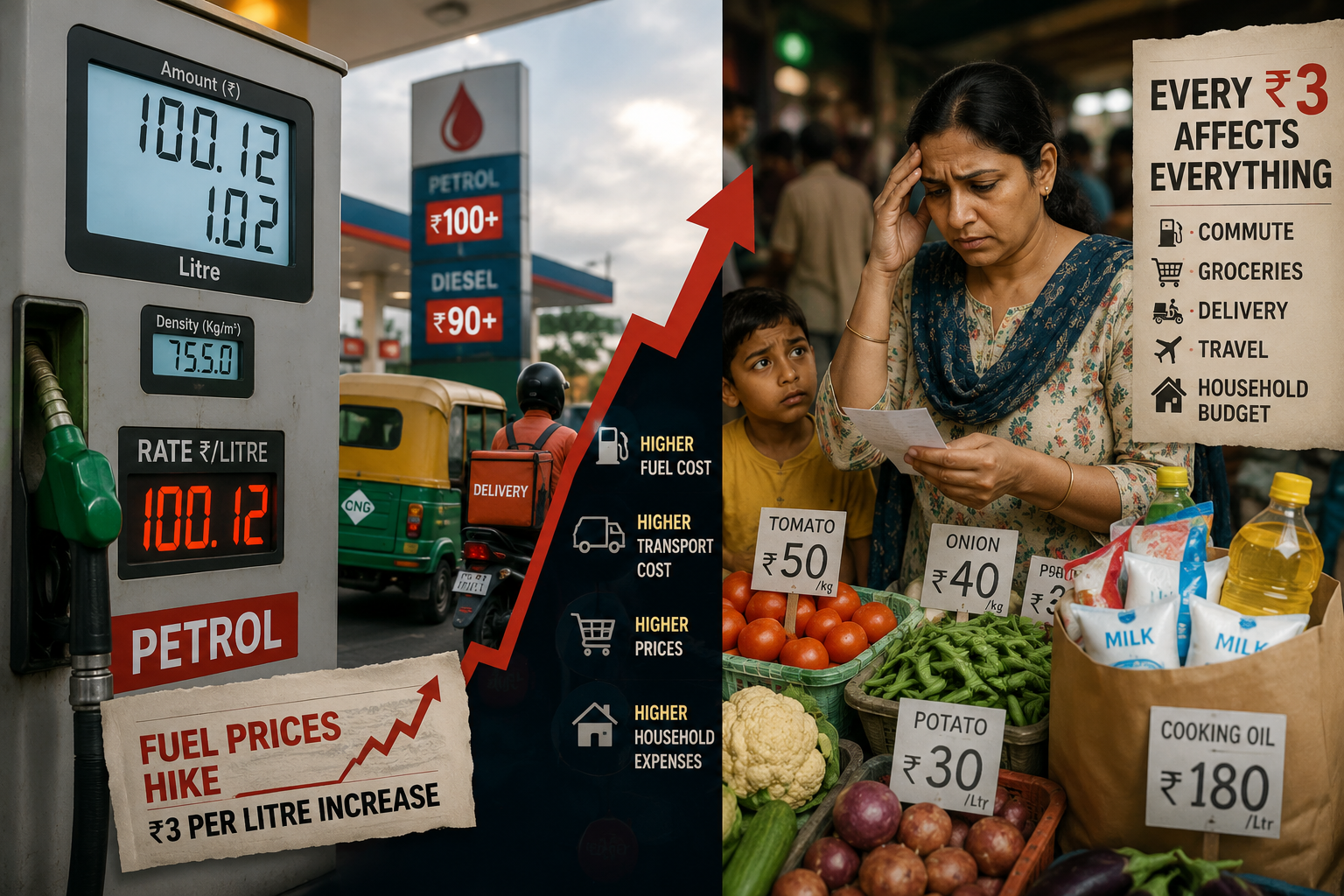
It sounds small. Three rupees. Less than the cost of a candy. Less than the spare change rattling around in your pocket. But on May 15, 2026, that ₹3 per litre hike in petrol and diesel prices set off a chain reaction that will quietly reach into every Indian kitchen, every school run, every trip to the vegetable market and every household budget over the coming weeks and months.
This is not just a story about fuel. This is a story about how one number at the petrol pump becomes fifty different numbers everywhere else.
The day the four-year freeze ended
For 49 months almost four full years petrol and diesel prices in India had not moved up even by a single rupee. That extraordinary freeze ended on Friday, May 15, 2026, when state-owned oil companies Indian Oil Corporation (IOC), Bharat Petroleum (BPCL) and Hindustan Petroleum (HPCL), which together run over 90 per cent of India’s fuel stations, raised petrol and diesel prices by ₹3 per litre each. It was the first such hike in more than four years.
In Delhi, petrol now costs ₹97.77 per litre, up from ₹94.77. Diesel has risen to ₹90.67 from ₹87.67. In Mumbai, petrol is now ₹106.68 per litre. In Kolkata, it is ₹108.74. In Chennai, ₹103.67. The differences are driven by varying state taxes.
For the average commuter filling up a 40-litre tank, the immediate hit is around ₹120 extra per visit to the pump. That alone is manageable. What is not so manageable is everything that follows.
Your autorickshaw, your cab, your daily commute
The first place most people will feel this hike is in their daily commute. Fuel costs are the single biggest expense for auto-rickshaw drivers, taxi operators, and app-based cab drivers. When fuel prices go up, fares follow not always immediately, but inevitably.
In Delhi, CNG prices have also increased by ₹2 per kg alongside the petrol and diesel hike, which directly squeezes the margins of the lakhs of auto-rickshaw and cab drivers who run on CNG. Auto unions across cities have historically demanded fare revisions whenever fuel costs rise and stay elevated. That demand is already building.
For app-based ride-hailing and delivery services, the adjustment may be more subtle but equally real. Base fares might not change overnight, but surge pricing, platform fees and delivery charges are likely to creep up over time. The next time your food delivery app adds a slightly higher convenience fee, you will know where it started.
The grocery bill is next
Here is something most people do not think about when they hear the words “fuel price hike”: almost every item in your kitchen got to you on a diesel-powered truck.
Vegetables, fruits, milk, grains, packaged foods, edible oils the entire supply chain of India’s daily essentials runs on diesel. When diesel prices go up, transporters face higher costs on every trip they make. They do not absorb those costs forever. Over time typically within two to three months, as economists note freight charges rise, and those higher charges show up as higher prices on shop shelves and at your local sabzi mandi.
Perishables like tomatoes, onions and leafy vegetables are especially vulnerable. Cold-chain transport and refrigerated logistics, which keep perishables fresh over long distances, are heavily fuel-dependent. When these costs go up, the margin for keeping prices low shrinks fast.
And it is not just vegetables. Amul and Mother Dairy raised milk prices by ₹2 per litre just a day before the fuel hike on May 14, 2026 citing rising costs of cattle feed, fuel, packaging and procurement. The message is clear: the pressure on everyday household expenses was already building before Friday’s announcement, and the fuel hike has added fresh weight to it.
Farmers feel it too
The impact does not stay in cities. India’s rural economy runs on diesel. Farmers use it to power tractors, run irrigation pumps, and transport produce to mandis. A sustained rise in diesel prices increases cultivation costs and those costs ultimately reflect in the prices city consumers pay for food.
During sowing and harvesting seasons, when diesel demand in rural areas peaks, the pressure is even sharper. A farmer already dealing with uncertain monsoons and volatile market prices now has to absorb higher fuel bills on top of everything else.
The fuel hike arrives at a moment when India’s inflation story was already becoming uncomfortable.
Official data released just a day before the hike showed that the Wholesale Price Index (WPI) hit a 42-month high of 8.3 per cent in April 2026, driven by a staggering 24.71 per cent surge in fuel and power prices at the wholesale level. Petrol WPI inflation stood at 32.4 per cent and diesel at 25.19 per cent in April alone.
Congress leader Jairam Ramesh called the hike inevitable but warned it is “bound to lead to further inflation that is now projected to be close to 6 per cent for this financial year.” With the Reserve Bank of India already holding the repo rate steady at 5.25 per cent and keeping a close watch on inflation, the fuel hike adds a fresh layer of uncertainty to an economy that is still finding its footing.
Why ₹3 is just the beginning
Here is the part that should worry households most: industry experts say the ₹3 hike is only a fraction of what is actually needed.
Before the West Asia war broke out, India’s crude oil import basket averaged $69 per barrel. By the weeks following the conflict, it had surged to $113–114 per barrel a jump of over 50 per cent. The three PSU oil companies were absorbing losses of approximately ₹100 per litre on diesel and ₹20 per litre on petrol before the hike. Even after Friday’s increase, ICRA estimates that oil marketing companies are still losing around ₹500 crore every single day.
In other words, the ₹3 hike is, as many industry sources describe it, only one-tenth of the correction actually needed. More hikes could follow if global crude prices remain elevated.
The ₹3 at the pump is just the visible part of what is coming. Over the next two to three months, Indian households are likely to see:
Higher auto and cab fares as drivers seek to recover rising fuel costs. Gradual increases in grocery and vegetable prices as transport costs are passed on. Rising delivery charges on food and e-commerce orders. Higher airline ticket prices as jet fuel costs surge alongside crude oil. And for farmers, tighter margins that will eventually feed back into food prices.
A ₹3 hike sounds like a small number. But in an economy as interconnected as India’s where fuel touches every supply chain, every commute, and every meal small numbers have a way of becoming very large ones.
The tank may only cost ₹120 more to fill. The real bill will arrive over the months ahead.
Subscribe Deshwale on YouTube