









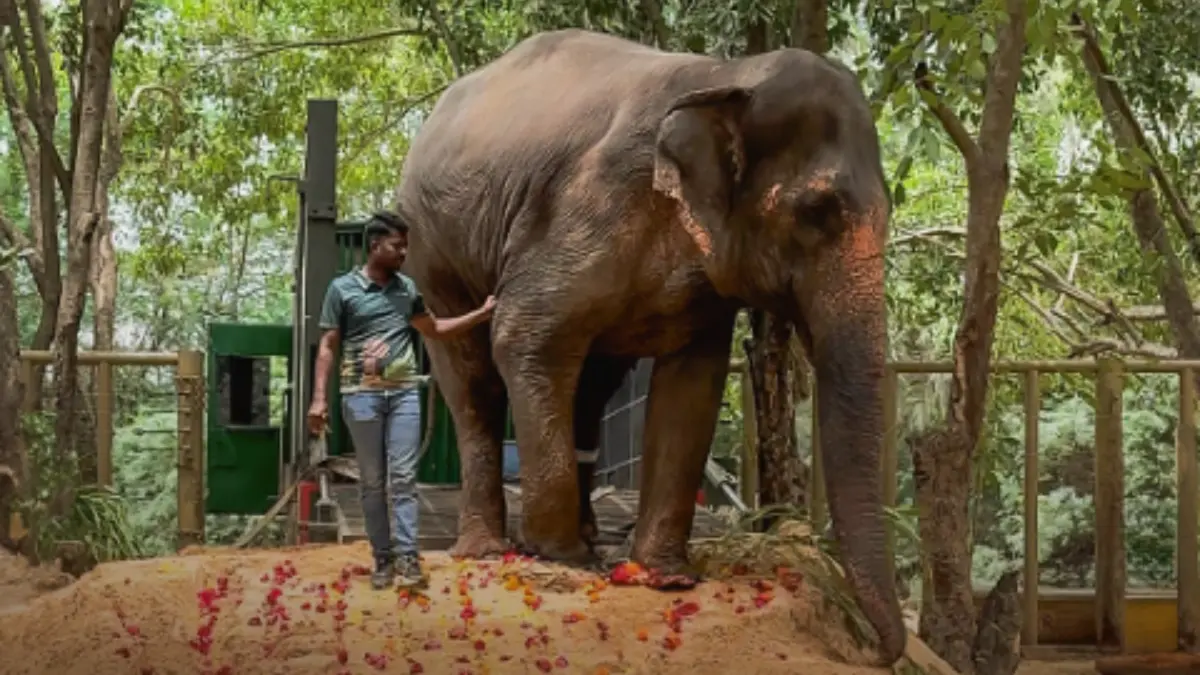
7,000 Hearts Bid Farewell to Kolhapur’s Beloved Elephant
On a humid July morning in Kolhapur’s Nandani village, the air felt heavy with grief. The narrow lanes leading to the Jain mutt were crowded with thousands of villagers, their hands folded in prayer, eyes brimming with tears. Some carried coconuts and marigold garlands, others clutched their children close, urging them to touch the great elephant one last time. Mahadevi, the 36-year-old elephant who had been part of their lives for over three decades, was leaving. For many, she was more than just an animal. She was a symbol of faith, a living deity, and a silent witness to their joys and sorrows.
A Life of Devotion and Chains
Mahadevi’s story began in 1992, when she arrived at the Jain mutt as a young calf. Over the years, she became inseparable from the village’s religious identity. She walked in temple processions draped in silk, stood in rituals as priests offered prayers at her feet, and was treated like a sacred presence. Children grew up knowing her as the gentle giant who blessed them during festivals.
For 33 years, Mahadevi lived in chains, her health deteriorating. Veterinary assessments later revealed chronic foot rot, arthritis, and untreated abscesses. Animal welfare activists argued she was in distress, far from the life elephants were meant to lead.
The Court’s Verdict
In July, the Bombay High Court intervened, siding with a Supreme Court-appointed panel that deemed Mahadevi unfit for captivity. The judges ruled that her welfare had to come before tradition, ordering her relocation to Vantara, a private elephant sanctuary in Jamnagar, Gujarat. The decision, later upheld by the Supreme Court, stirred raw emotions in Nandani.
For villagers, the order felt like losing a family member. For animal rights groups, it was a long-overdue act of compassion. The stage was set for one of the most emotional farewells the region had ever witnessed.
A Farewell Like No Other
On the day of her departure, more than 7,000 people gathered. Women sang devotional songs, while elders placed turmeric and kumkum on Mahadevi’s broad forehead, as blessings. Children clung to her legs, some too young to understand why she was leaving.
The scene was charged with conflicting emotions. There were prayers and chants, but also loud protests. Some shouted slogans demanding she stay. Others sobbed quietly, accepting what they could not change. As her handlers led her towards the waiting animal ambulance, drums beat in rhythm, and garlands piled high around her neck. It felt ceremonial, yet unbearably sad.
Tensions flared briefly when a section of the crowd turned unruly, throwing stones and vandalising vehicles. When the truck finally rolled out, thousands followed it barefoot for nearly a kilometre, waving goodbye until it disappeared from view.
From Chains to Care
On Wednesday Mahadevi reached Vantara, a sprawling sanctuary designed for rescued elephants. Here, she was welcomed not with rituals but with medical care. Specialists treated her infected feet, while caregivers offered fresh fruit and cool baths.
At Vantara, she now has access to hydrotherapy pools, grassy enclosures, and the company of other elephants. For an animal that had lived alone for so long, this is not just relocation; it is freedom.
A Village Left Behind
In Nandani, however, her absence is palpable. The temple courtyard feels empty without her towering presence. Morning prayers are quieter, and processions seem incomplete. Videos are now circulating on Instagram and Facebook, showing Mahadevi’s life in the village, children laughing as they ran around her, villagers feeding her bananas and sugarcane, and the gentle giant playfully nudging the kids with her trunk. These clips, watched and rewatched by locals, have turned into bittersweet reminders of a time when she was at the heart of their daily lives.
An Ending and a Beginning
For Kolhapurkars, Mahadevi’s departure was a moment of collective heartbreak. For Mahadevi, it marked a new life, one where she is no longer an ornament of faith, but a living being finally allowed to heal.
As the sun set that evening, Nandani village felt quieter than ever. The lanes that once echoed with the slow thud of elephant footsteps now stand still. Yet in Jamnagar, Mahadevi walks free, her story becoming one of hope not just for herself but for countless other captive elephants waiting for their own release.
Her chains are gone. Her journey has just begun.


