









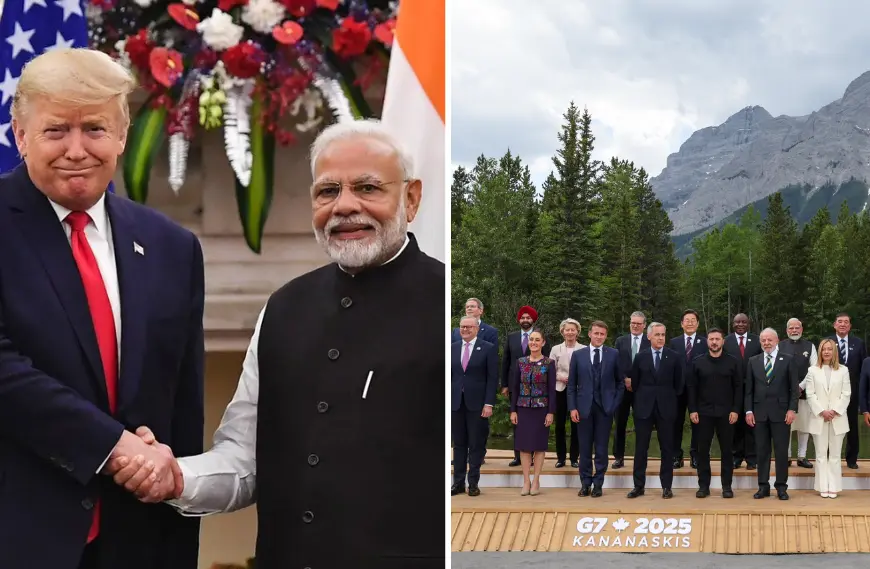
PM Modi reaffirms no third-party mediation in discussion with Trump
Indian Prime Minister Narendra Modi has reiterated that India will never accept third-party mediation in its dealings with Pakistan.
During a 35‑minute phone call with US President Donald Trump on 18 June, Foreign Secretary Vikram Misri reported that Modi emphasised this long-standing policy while briefing Trump on Operation Sindoor, the precision strikes India carried out against terror camps in Pakistan following the Pahalgam attack.
Modi outlined that the recent pause in Operation Sindoor was made at Pakistan’s request via bilateral military channels, with no involvement from third-party states, including the US . He clarified that terrorism will now be regarded as an act of war, not merely proxy activity .
Trump reportedly extended a US invitation for a follow-up meeting, but Modi declined due to prior commitments although he invited Trump to the forthcoming Quad Summit in India.
No discussions on trade deals took place during the call, Mr Misri confirmed.
Google DeepMind launches stable Gemini 2.5 Flash & Pro, unveils Flash‑Lite preview
Google DeepMind has announced the stable release of its Gemini 2.5 Flash and Gemini 2.5 Pro AI models. A preview of Gemini 2.5 Flash‑Lite has also been introduced, hailed as the fastest and most cost-effective variant in the 2.5 family.
Gemini 2.5 Pro represents Google’s flagship reasoning model. It boasts advanced configurable “thinking budgets” that let developers control depth of reasoning. It is now fully production-ready across Google AI Studio and Vertex AI, offering enhanced performance in coding, long‑form coherence, and multimodal tasks.
Gemini 2.5 Flash provides balanced speed and cost efficiency, also suitable for enterprise use. In addition, the model retains multimodal understanding and supports long context windows of up to one million tokens.
Previewed today, Gemini 2.5 Flash‑Lite is optimised for high‑volume, latency‑sensitive workloads such as translation and classification. It delivers superior efficiency at a significantly lower cost, while maintaining core Gemini capabilities like tool integration and multimodal input handling.
How Long Do Iran’s Ballistic Missiles Take to Reach Israel?
As Iran fires ballistic missiles at Israel amid escalating tensions, experts say the weapons reach their targets in just minutes.
Ballistic missiles travel through distinct flight stages. First, the boost phase, powered by rocket engines, lasts a few minutes. They then coast through space before re‑entering the atmosphere for the terminal phase, which lasts under a minute.
With Iran and Israel separated by around 1,300–1,500 km, missiles travelling at Mach 5 a typical speed for medium‑range ballistic missiles, can reach Israel in approximately 12 minutes. Some hypersonic systems like Iran’s Fattah‑1 can reach up to Mach 13–15 (roughly 15,000 km/h), possibly shortening flight time marginally.
By contrast, cruise missiles can take nearly two hours to arrive, while drones might need up to nine hours. The brevity of the ballistic missile flight leaves minimal reaction time for Israel’s defence systems.
Maharashtra clarifies Hindi is not mandatory third language in primary schools
The Maharashtra government has issued a revised notification clarifying that Hindi is no longer compulsory for pupils in Classes I–V.
Earlier this week, a Government Resolution designated Hindi as the “general” third language in Marathi and English-medium schools. Other Indian languages may be offered if at least 20 students opt for them. In such cases, instruction will be arranged onsite or via online classes.
School Education Minister Dada Bhuse explained the government will remove the term ‘mandatory’ from the policy text. He assured that Marathi remains the compulsory first language, followed by English, and then one optional Indian language.
The move has met resistance from political leaders and educators. MNS chief Raj Thackeray has urged a return to just Marathi and English, warning of protests if alternatives are sidelined. More than 20 teacher associations have called for a complete rollback of the three-language policy.
‘State of diplomacy in crisis’: G7 response to Iran–Israel tensions and Russia–Ukraine war
G7 leaders in Canada highlighted growing global strains caused by conflicts in the Middle East and Ukraine.
At the Kananaskis summit, members urged fresh sanctions on Russia and reaffirmed support for Israel. European leaders labelled Iran “a source of regional instability” and stressed the importance of stable energy markets.
Despite calls for unity, the summit ended without a formal communique, reflecting deep divisions—largely due to differing positions on Ukraine and the US early departure. President Trump left early, citing the Iran–Israel crisis, and publicly backed Israel, even urging Tehran to evacuate.
Ukrainian President Volodymyr Zelensky attended part of the summit. Canada pledged C$2 billion in military aid to Ukraine, but the US blocked a unified statement on Kyiv, weakening collective resolve.
The divided tone of the G7 underscored the “crisis” state of global diplomacy, as leaders navigated overlapping conflicts that threaten regional and economic stability.
Heavy rain forecast for Mumbai amid yellow alert
Mumbai is set to experience intense rainfall today, with the India Meteorological Department (IMD) issuing a yellow alert.
Conditions include a 97% chance of heavy showers and winds reaching up to 37 km/h. Temperatures are expected to range between 26 °C and 29 °C.
Authorities have cautioned residents to prepare for possible flooding and disruptions to transport. Commuters are advised to remain vigilant as waterlogging may impact roads and suburban train services. While no official warnings have been issued regarding schools or public events, citizens are urged to stay updated with local weather advisories. Air quality may worsen due to damp conditions, as humidity levels are projected to stay elevated throughout the day.
Air India Flight AI‑159 from Ahmedabad to Gatwick cancelled amid safety review
Air India cancelled Flight AI‑159, scheduled to depart Ahmedabad for London Gatwick, due to “airspace unavailability” and the ongoing safety inspections.
Originally set to leave at 13:10 IST, the flight was later rescheduled to 15:00 before being cancelled. The airline cited delayed aircraft turnaround, precautionary checks and regional airspace constraints not a technical fault. A spokesperson confirmed the jet had arrived late from London and underwent extended pre‑flight procedures .
Passenger re‑routing and customer support measures have been activated as Air India works to navigate disruptions heightened by the crash inquiry.


