



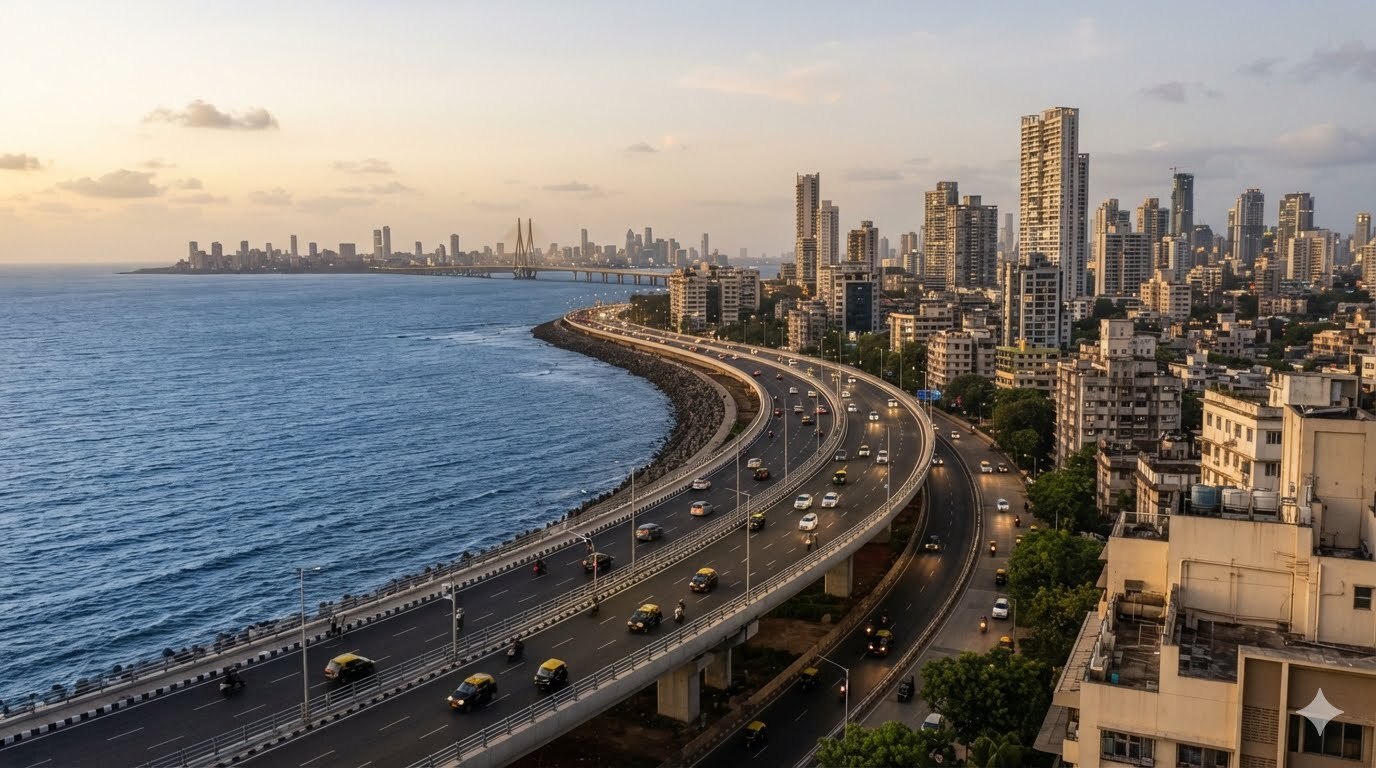
Mumbai’s real estate market is increasingly being shaped by one factor: time.
As the city grows and mobility improves, locations that offer easier access to workplaces, business districts and social infrastructure are likely to become more attractive. This is where the Coastal Road could prove transformative.
The project is not simply adding another transport corridor to Mumbai’s infrastructure network. It is changing how different parts of the city connect with one another.
For the real estate market, that shift could be significant.
A New Connectivity Link for Mumbai
The Coastal Road is emerging as one of Mumbai’s most important connectivity projects. Its wider network is designed to strengthen links between the city’s southern and western stretches, creating a faster alternative to some of Mumbai’s traditionally congested routes.
The southern section between Marine Drive and Worli is already operational, while the northern extension is expected to further strengthen connectivity towards the western suburbs.
For Mumbai, the biggest benefit may not simply be the kilometres saved. It may be the time saved.
That distinction matters in a city where long daily commutes have traditionally influenced decisions about where people live and work.
The operational section has already attracted significant traffic since opening, indicating that the road is becoming part of Mumbai’s everyday mobility network.
As additional connections become available, its importance could extend beyond transportation and influence how residents perceive accessibility across the city.
Why the Western Suburbs Matter
The significance of the Coastal Road becomes clearer when it is viewed as part of Mumbai’s wider mobility network.
The northern extension, the Versova-Bandra Sea Link, metro corridors and other major infrastructure projects can collectively create stronger connections between different parts of the city.
For the western suburbs, this could be particularly important.
Andheri, Jogeshwari, Goregaon and Borivali are no longer simply residential destinations. Over the years, they have developed into mature urban catchments with employment centres, retail, education, healthcare, entertainment and established communities.
That distinction is important for real estate.
The Coastal Road does not need to create demand from scratch. Instead, improved connectivity could strengthen markets that already have established residential and economic activity.
Better access can potentially make these locations more attractive to people who want to remain connected to Mumbai’s core while living in established suburban neighbourhoods.
A Stronger Western Residential Corridor
Mumbai’s western suburbs have already demonstrated resilience as residential markets.
Market data from Knight Frank has pointed to continued price growth across several western suburban locations, including Andheri, Goregaon and Dahisar.
Such performance highlights an important point: the western corridor already has a strong foundation.
Infrastructure, therefore, should not be viewed as an isolated driver of real estate value.
Instead, it can amplify the strengths of locations that are already fundamentally sound.
The western suburbs have established housing stock, social infrastructure, commercial activity and multiple transport options. Additional road connectivity can add another layer of accessibility to this existing ecosystem.
That could gradually widen the effective catchment of these markets.
Connectivity Could Redefine Location
For homebuyers, improved connectivity can change the traditional definition of location.
A property does not necessarily need to be physically close to South Mumbai to provide convenient access to it.
If infrastructure can reduce travel time to major employment, business and lifestyle districts, accessibility can become almost as important as physical proximity.
This could make well-connected western-suburb locations increasingly attractive to buyers looking for a balance between connectivity, lifestyle and value.
The question, therefore, may gradually shift.
Instead of asking only “How far is the property?”, buyers may increasingly ask:
“How long does it take to reach where I need to go?”
That change in perspective could have wider implications for Mumbai’s residential market.
What It Could Mean for Investors
For investors, the opportunity is not simply about buying into a location because a major infrastructure project is being built nearby.
The more important question is whether improved connectivity can support the next phase of demand.
Established markets with existing residential activity are potentially better positioned to benefit because infrastructure is being added to an already functioning urban ecosystem.
Better accessibility can support residential demand, improve the attractiveness of rental locations and strengthen the long-term positioning of established neighbourhoods.
This makes the western suburbs particularly relevant.
They already have large residential communities, supporting infrastructure and established economic activity. Improved connections with other parts of Mumbai could further strengthen their role within the city’s overall residential landscape.
At the same time, infrastructure alone should not be treated as a guarantee of price appreciation. Real estate performance continues to depend on factors such as supply, affordability, employment, development quality and broader economic conditions.
Mumbai’s Urban Boundaries Are Changing
There is also a larger urban transformation underway.
Mumbai’s growth is no longer simply about expanding outward. Increasingly, it is about making existing districts function as parts of a more integrated city.
The Coastal Road, when viewed alongside the metro network, sea links and other major infrastructure projects, can contribute to this transformation.
As connectivity improves, traditional geographic boundaries between South Mumbai and the western suburbs could become less important in everyday decision-making.
A location that once appeared distant may become more accessible because the journey itself has become faster and more predictable.
This could influence not only where people choose to live, but also where businesses locate, how workers commute and how developers evaluate future opportunities.
The Next Growth Story Could Be About Time
Mumbai’s next real estate growth cycle may therefore be shaped not only by where development takes place, but also by how quickly people can move between different parts of the city.
The Coastal Road is helping reshape that equation.
By improving connectivity between the city core and the western corridor, the project has the potential to strengthen the position of established markets such as Andheri, Jogeshwari, Goregaon, Borivali and surrounding areas.
But the larger opportunity lies in the interaction between three factors:
infrastructure, existing demand and accessibility.
The Coastal Road alone will not determine the future of Mumbai’s real estate market. Nor should every location connected to new infrastructure automatically be viewed as an investment opportunity.
Its significance lies in how it fits into Mumbai’s broader urban network.
As roads, metro corridors and sea links increasingly connect different parts of the city, the meaning of “prime location” could gradually evolve.
For homebuyers, investors and the wider real estate market, the message is becoming increasingly relevant:
In a city where distance has always mattered, time could become the more important measure of location.
Subscribe Deshwale on YouTube
