









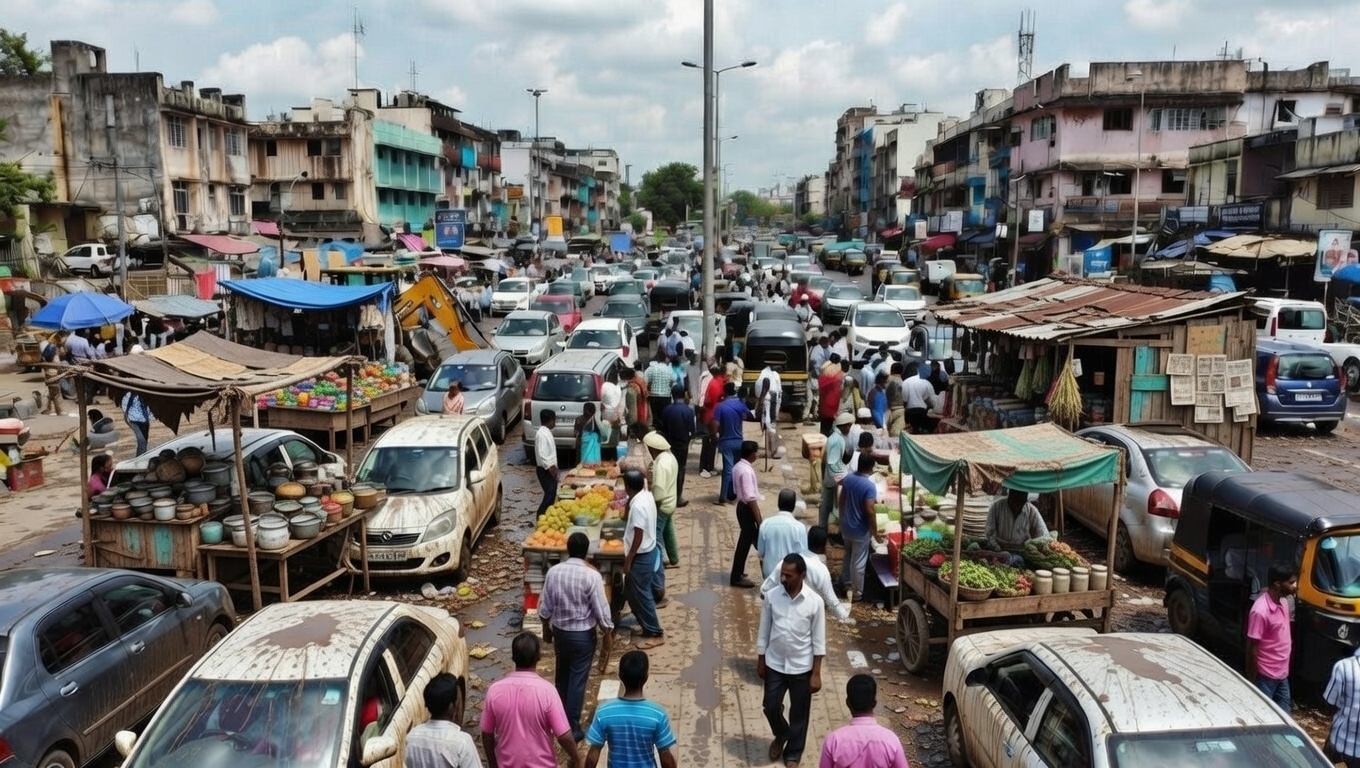
Mumbai has a ritual. Civic officials arrive with cameras, JCB machines, and a notice. Stalls are cleared. Photographs are taken. Press releases go out. And then, almost always within a day or two, the hawkers are back.
The latest edition of this ritual unfolded on 23 February 2026, when Brihanmumbai Municipal Corporation (BMC) Commissioner Bhushan Gagrani conducted a surprise inspection across the F South, F North and G North wards, covering stretches in Dadar, Parel, Matunga, Mahim and Sion. Walking the streets alongside senior officials including Deputy Commissioners Prashant Sapkale and Vinayak Vispute, Gagrani assessed the progress of the civic body’s ongoing anti-encroachment drive, being undertaken in compliance with orders from the Bombay High Court. Citizens he met along the way expressed satisfaction. Traders asked questions about rehabilitation. Both responses were thoroughly familiar to anyone who has followed this story for more than a decade.
The story, simply told, is this: the law exists, the courts have spoken, the drives keep happening, and the footpaths keep disappearing.
A Citywide Problem, Not a Pocket Problem
The scale of illegal vending in Mumbai is difficult to overstate. A 1997 census survey conducted by the Tata Institute of Social Sciences and YUVA on BMC lands enumerated over 1,02,000 vendors across 23 wards alone. Estimates since then have placed the total number of street voters in Mumbai at anywhere between 2,00,000 and 3,11,000, making the city home to the largest concentration of hawkers in India. The 1,28,000 vendors surveyed in 2014 under the framework of the Street Vendors (Protection of Livelihood and Regulation of Street Vending) Act, 2014 represent only the tip of an iceberg that the BMC has never fully mapped.
The areas where anti-encroachment drives have been conducted repeatedly in recent years form a near-complete map of the city’s busiest corridors. Dadar, around both the east and west sides of the railway station, has been cleared and reclaimed so many times that residents treat each drive with weary scepticism. The Colaba Causeway, Mohammad Ali Road, Crawford Market, Andheri’s Irla Road and S.V. Road, Borivali East and West, Kandivali’s Mahavir Nagar stretch, Mulund, Vidyavihar, Kurla West, Matunga and Jogeshwari have all been the sites of repeated BMC action.
In January 2026, the BMC conducted a special drive between 17 and 24 January and seized 544 handcarts, 968 gas cylinders and 1,251 other items including stoves and shawarma machines. In February 2026, around 200 unauthorised hawkers were removed near Cooper Hospital in Andheri alone, where their stalls had been blocking ambulance access. In B Ward, covering the Mohammad Ali Road and Yusuf Meherally Road belt, around 150 illegal hawkers were evicted and demolition action was taken against 50 structures and 25 stalls in a single week during early February. The Kandivali drive on 21 February 2026 brought down 65 structures, deploying three JCBs, seven dumpers and 47 civic workers backed by police.
And yet, the footpaths along all these stretches have been encroached upon again and again.
Who Tips Them Off
The most structurally damaging aspect of the illegal hawker problem in Mumbai is not the hawkers themselves. It is the system that protects them in advance.
Senior BMC officials have acknowledged in published accounts that hawkers frequently vanish before enforcement teams arrive, and that political involvement makes sustained action difficult. The source of the advance warnings, whether junior civic staff, police contacts or ward-level political workers, has never been formally established, but the pattern has been documented consistently enough that it is no longer treated as coincidence by those who work in this space.
Civic activists working across wards in the western suburbs have alleged a pattern in which residents who lodged written complaints against hawkers at ward offices subsequently received threatening calls from hawker leaders. If the allegation is accurate, it would suggest that complainants’ contact details were being passed on from somewhere within the system. Ward-level officials have declined to comment on the pattern when approached by reporters.
The warning network is reinforced by the political layer. Because many illegal hawkers operate under the informal patronage of local political figures, party workers and ward-level contacts are often the first to hear of an impending drive. The hawkers disperse. The drive proceeds. The stalls return. The cycle completes.
The Economics of the Cycle
The tip-off system would not matter quite so much if returning to an encroached spot carried a real financial penalty. It does not, and that is where the economics become relevant.
Research indicates that street vendors contribute roughly 14 per cent of non-agricultural urban informal employment in India, and Mumbai’s vendors serve millions of daily customers. A Mumbai Hawkers Union survey found that 59 per cent of vendors borrow money to fund their operations, sometimes at interest rates between 5 and 10 per cent a month. They have real financial stakes in their locations and will return to them at considerable personal risk.
The informal tax on this economy flows upward, not into civic revenues. Civic activists working in areas such as Juhu, Malad and Matunga have described a system where hawkers pay daily informal charges of Rs. 100 or more to BMC inspectors and police personnel. Over a month, across the thousands of stalls operating on Mumbai’s footpaths, the sums involved are substantial. The raids are, in effect, a renegotiation of terms. The BMC collected fines of Rs. 5.14 crore from unlicensed hawkers over two years, according to one verified account, but that figure tells only part of the story because what is collected officially is a fraction of what flows through informal channels.
This is the context in which the BMC’s 2026 budget, tabled at Rs. 80,952 crore, carries some significance. The budget includes allocations for road infrastructure, footpath repair and encroachment removal, and the civic body has separately earmarked funds for the survey and rehabilitation of eligible street vendors. But budget allocations and enforcement outcomes have historically diverged sharply in Mumbai. The BMC has budgeted for hawker rehabilitation in previous cycles without the Town Vending Committees required to implement it being properly constituted. Money set aside for a system that does not function tends to be absorbed elsewhere.
The 2003 Bombay High Court judgment in Janhit Manch vs State of Maharashtra laid down specific norms for hawker licensing, zoning and clearance. The Street Vendors Act, 2014 created a legal architecture around Town Vending Committees and vendor registration. More than a decade after the Act’s passage, the BMC had still not fully constituted its TVCs. The 2024 TVC elections, held in August of that year, were contested at 42 polling stations and saw a turnout of just 49.46 per cent, partly because the BMC had reduced the registered vendor count from over 1,28,000 to approximately 22,000, effectively disenfranchising tens of thousands. The Supreme Court intervened to halt the declaration of results following petitions from the Maharashtra Ekta Hawkers Union.
An economy that has survived six decades of municipal action, multiple court judgments, three different laws and countless demolition drives is not going to be dismantled by a JCB and a press release.
The Citizen Who Buys and Then Complains
There is an uncomfortable fact that rarely features in coverage of this issue. The illegal hawker economy in Mumbai survives, in very large part, because Mumbaikars use it every single day.
Residents of Dadar, Borivali and Andheri buy vegetables, fruit, street food, cheap clothing and accessories from the very footpath vendors they later complain about. The proximity, the price and the convenience are real advantages in a city where inflation and rushed commutes are constant realities. Research published in urban planning literature acknowledges this tension explicitly, noting that even citizens who consider hawkers a nuisance continue to buy from them and would like them to be present but less visible.
The problem is that consumer demand sustains the supply side. As long as millions of Mumbaikars continue to buy vada pao, bhel puri, vegetables and inexpensive household goods from footpath vendors, the economic incentive to operate illegally on the street remains overwhelming. The vendor who is evicted today calculates, often correctly, that the same customers will return tomorrow.
This dynamic also shapes political calculations. When a councillor or MLA faces a choice between enforcing the law and alienating a constituency that both uses the footpaths and buys from the hawkers, many choose studied inaction. The formal complaint, the court petition, the residents’ association letter, all exist alongside a quiet, daily act of commerce that funds the very problem being complained about.
Hotspots That Keep Coming Back
Some areas in Mumbai have become almost emblematic of enforcement failure. The Colaba Causeway is perhaps the most cited example. Despite repeated court orders and multiple drives, residents and activists say that hawkers there have never actually been cleared for more than a few hours before they begin drifting back. Locals who have watched previous drives describe a familiar pattern: stalls removed in the morning, stalls back by evening, sometimes the same evening.
Dadar West, outside the railway station, has been cleared and reoccupied so many times that it has become a kind of informal benchmark for the effectiveness of BMC enforcement. The area was one of Commissioner Gagrani’s specific stops during his February 2026 inspection, and residents noted some improvement, but activists warned that without sustained daily follow-up, the situation would revert within days.
Mohammad Ali Road and the connected belt of Abdul Rehman Street, Yusuf Meherally Road and Nagdevi has seen persistent encroachment, partly because the commercial density of the area and the scale of daily footfall make it one of the most contested stretches in south Mumbai. Andheri has been similarly resistant. The Irla Road and S.V. Road area near Cooper Hospital was cleared of around 200 hawkers in January 2026, but proximity to a hospital was what finally triggered emergency action, not the years of pedestrian complaints that preceded it.
Malad, Borivali and Kandivali in the western suburbs have seen repeated drives that civic activists describe as inconsistent. A civic activist from Kandivali who has been tracking encroachment patterns for several years noted that the same thirty-odd spots in the Mahavir Nagar and Thakur Village stretches have been cleared and reoccupied at least four times in three years. Some ward officers act with conviction. Others treat the issue as someone else’s problem, and residents can tell the difference immediately.
Outside Goregaon Railway Station (W), the writer saw terrible filth, grime and illegal hawkers in early January 2026. The entrance to the railway station was hellishly disorderly, with autorickshaws plying haphazardly on those narrow roads. There are shops and commercial buildings adjacent to those roads. The noise in that area in the evening disoriented the writer for some days. Imagine how much it would have disoriented the legal shopkeepers nearby. Or have they got used to the noise and grime of the area? Obviously, amidst all that filth and grime, passengers were entering and exiting the railway station, with some buying stuff from the illegal hawkers. The area resembled an epitome of war-torn chaos and civic apathy.
What the BMC Actually Says
Commissioner Gagrani, during his February 2026 inspection, was careful to frame the current drive not as a punitive exercise but as a restructuring of public space. He stated that the campaign was designed to protect pedestrian rights while giving vendors a regulated path to continue earning, with official hawker zones to be designated for registered and eligible vendors, proper surveys conducted and rehabilitation plans put in place.
New Mayor Ritu Tawde, upon taking office in early February 2026, made tackling illegal hawkers her stated first priority and announced that monthly review meetings would track the 276 identified encroachment cases. She also signalled an investigation into what she described as illegal hawkers operating with forged documents across several wards.
Whether the current drive will prove different from those before it depends on three things that have consistently been absent: sustained enforcement after the initial sweep, structural accountability for officials who have facilitated encroachment through inaction or active connivance, and a functioning Town Vending Committee system that gives legal vendors a reason to comply rather than operate in the grey zone.
The Demoralisation of the Lawful Citizen
The cumulative effect on the law-abiding resident of Mumbai is one that rarely makes headlines but is deeply felt. An ordinary citizen who uses the footpath for its intended purpose, who pays municipal taxes, who follows traffic rules, who does not extend their shop front onto the road, watches someone else face no meaningful consequence for doing exactly the opposite.
The footpath encroachment issue is not just a question of public space. It is a question of what the city’s social contract actually means. When a pedestrian is forced onto a road because the footpath is occupied by a stall that has been there for years under the apparent protection of a local political figure and an inactive BMC inspector, the message received is that the formal rules are for those who cannot afford to break them.
Residents’ association leaders across the western suburbs have repeatedly made the point that BMC penalties for unauthorised hawking are too low to serve as a genuine deterrent, and that ordinary taxpaying citizens are penalised more heavily for minor civic infractions than illegal vendors are for persistent encroachment.
The Bombay High Court, in one of its pointed observations on the matter, remarked that if the situation continued unchecked, citizens would eventually resort to horses and bicycles to navigate the city. The remark was received as dark humour. For many Mumbaikars who walk to work every morning along an occupied footpath, it barely qualifies as an exaggeration.
The test of Commissioner Gagrani’s surprise inspection, and of Mayor Tawde’s stated priority, will not be the photographs taken in February 2026. It will be the state of those footpaths in June.
Subscribe Deshwale on YouTube


