



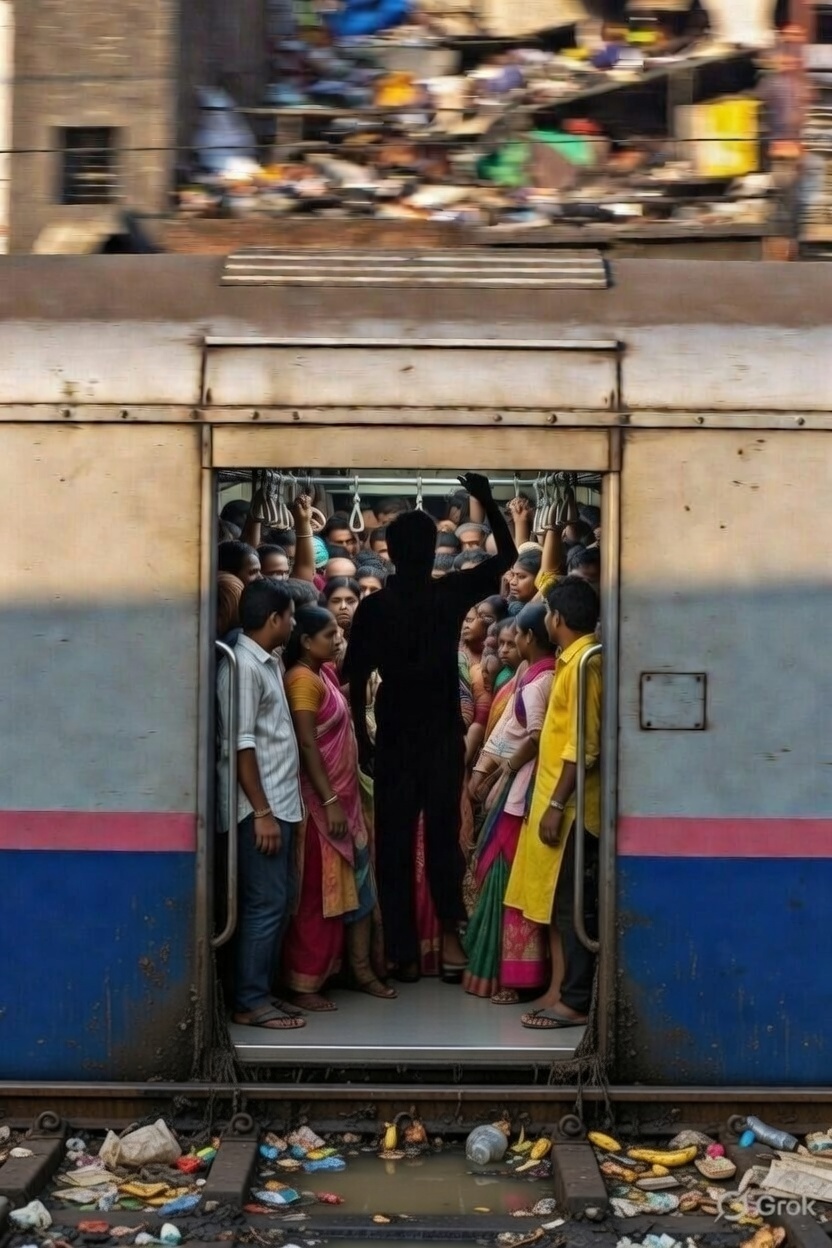
Asia’s oldest suburban railway was born in 1853. It still runs. But at what cost and compared to whom?
On Mumbai’s platforms, where the air thickens with sweat and desperation, the suburban railway stands as both saviour and scourge. This 390-kilometre network, threading the Western, Central, and Harbour lines, propels 7.5 million commuters daily, a figure that eclipses most global peers in raw volume.
Yet beneath the heroism of its endurance lies a grim ledger.
The toll in numbers
- Over 2,500 deaths in 2024 alone from falls, electrocutions and stampedes
- Ten lives claimed each day, as if by ritual
- Carriages bloated to 500% capacity
- 50,000 deaths recorded over two decades of overcrowding
- Signal failures account for 40% of delay incidents
- Trains capped at 100 kmph on 150-year-old girders
What began as an imperial conduit for cotton and clerks has become a humanitarian crisis. Promises of reform have been drowned repeatedly in monsoon floods and bureaucratic inertia.
This is not an isolated failure. It is a damning indictment of Indian Railways’ stewardship, a monolith that has prioritised long-haul profits over urban lifelines, leaving Mumbai’s commuters dangling from doorways.
Contrast this with two elder siblings of the iron road: London’s suburban network, tracing its roots to the 1830s, and New York’s commuter system, ignited in 1834. Both were forged in the Industrial Revolution. Both have not merely survived but evolved into integrated arteries of efficiency and equity, serving millions without the spectre of daily carnage.
Their trajectories offer not paeans to progress but stark mirrors to Mumbai’s myopia.
London’s labyrinth: from Victorian vapours to a unified urban symphony
London’s suburban rail began modestly in 1836 with the London and Greenwich Railway, a 6-kilometre spur that expanded into a 1,747-kilometre web enveloping Greater London by the 20th century. By 1863, the Metropolitan Railway’s steam-powered tunnels had birthed the Underground, while the suburban overground evolved as a radial commuter mesh, electrified piecemeal from 1905.
Post-war nationalisation under British Rail in 1948 faltered amid the Beeching cuts of the 1960s, which slashed lines in favour of roads. Yet the 1980s pivot to privatisation seeded resilience. Transport for London, established in 2000, orchestrated a new kind of integration, 402 kilometres of Underground combined with 1,300 kilometres of suburban National Rail, serving 3.5 million passengers daily across 600-plus stations.
London’s network at a glance
- Daily ridership: 3.5 million
- Capacity utilisation: 80% (vs Mumbai’s 500%)
- Stations: 600-plus
- Delays: under 5% (vs Mumbai’s 20-30 minute monsoonal gridlocks)
- Non-fare revenues fund 60% of operations, without taxpayer bailouts
- Step-free access at 100 stations targeted by 2026
The innovations are systemic, not cosmetic. The Oyster contactless card, introduced in 2003 and now supplanted by direct bank-card tapping, works seamlessly across bus, Tube and overground. The Elizabeth line (Crossrail), opened in 2022 as a 100-kilometre east-west spine, cut journey times by 30%. AI-driven predictive maintenance keeps delays below 5%. Solar-powered signalling is being rolled out. TfL reinvests 100% of revenues locally, where Indian Railways funnels suburban surpluses to intercity services, London’s authority grows the network with the metropolis rather than choking it.
London’s ascent is not without blemish. Strikes paralysed services in 2022. Post-Brexit labour shortages created persistent gaps. Crossrail overruns pushed costs from £15 billion to £19 billion. Heat waves warp Victorian viaducts much as Mumbai’s tracks buckle in 45-degree summers. Fare debates persist in a city of stark inequality.
Yet London’s core lesson endures: devolving powers to a mayoral body, mandating 95% on-time metrics, and treating rail as urban oxygen rather than an afterthought produced a network that serves rather than suffocates.
New York’s iron resolve: from gilded age grids to resilient radii
New York’s commuter rail system emerged from two founding lines. The Long Island Rail Road dates to 1834. Metro-North traces its origins to New York Central lines from 1835. Both began hauling oysters and day-trippers from Brooklyn farms to Wall Street wharves, before electrification and expansion transformed them into metropolitan necessities.
The Metropolitan Transportation Authority, consolidated in 1965, became the institutional backbone. It weathered near-bankruptcy in 1975 with federal bailouts that birthed a “Save the Rails” commitment: capital plans worth $19 billion by the 1980s modernised rolling stock. When Hurricane Sandy devastated the network in 2012, a $5 billion rebuild catalysed flood barriers and resilient signalling that now shield Penn Station.
New York’s network at a glance
- Combined route length: 2,667 kilometres
- Stations: 248
- Daily ridership: 300,000 (pre-pandemic peak: 685 million annually)
- Capacity utilisation: 70-80%
- On-time performance: 97% (app-tracked, real-time)
- Station retail and advertising offset 40% of operating costs
- Governance: 21-member board blending state oversight with commuter advocates
East Side Access, completed in 2023, threads the LIRR beneath Manhattan for 45-minute Grand Central links. Positive Train Control, implemented in 2018, averts collisions. Air-conditioned coaches and Wi-Fi are standard. MTA’s Hudson Yards transit-oriented development yields $1 billion yearly, funding further expansion.
Challenges persist without pretence. Sandy’s scars remain as elevated flood risks. The 2017 “summer of hell” saw signal failures delay 75% of trains, an echo of Mumbai’s perennial bottlenecks. Fare evasion costs $700 million yearly. Equity gaps sideline outer-borough minority communities in ways that mirror Mumbai’s unreserved-carriage crisis.
Yet the MTA enforces accountability through annual audits, a transparency Indian Railways evades through opaque budgeting. Where Mumbai’s lines terminate in strained suburbs, New York’s radiate to revitalised ones, demonstrating that reinvestment generates ridership rather than resentment.
Mumbai’s reckoning: a network adrift in denial and decay
Mumbai’s suburban railway, for all its Herculean loads, embodies systemic neglect.
Conceived under British administration for elite movement, it was nationalised in 1951 but stagnated. Electrification of the Central line came only in 1925. Full EMU deployment across the Harbour line followed as late as 2015. Indian Railways’ cross-subsidisation model, suburban fares of Rs 10-50 funding air-conditioned mail trains, starves the network of upgrade capital, producing Rs 1,500 crore in annual losses while London and New York self-sustain through fares covering 50-60% of costs.
Overcrowding is not fortitude. It is a policy failure with a body count.
Mumbai’s structural deficits
- 4,000 passengers per rake against a design capacity of 1,800
- Zero fencing on most stretches of track
- Trackside encroachments and sewage overflows left unaddressed
- Women-only coaches introduced in 1992 remain a band-aid on endemic harassment
- MUTP phases promised 300 km of additions since 1993; only 20 km materialised
- Rs 2.65 lakh crore in Indian Railways capex for 2024, with 70% directed to bullet train ambitions and only 10% to suburban safety
- The 2023 deluge drowned more than 100 in flooded tunnels, repeating the pattern of 2005’s floods, which claimed 1,000 lives
The political story is paralysis. Land disputes and corruption scandals have stalled expansion projects for decades. Without integrated metro or BRT feeders comparable to London’s orbital Overground, Mumbai’s linear structure funnels all passenger movement to island cores, amplifying congestion rather than dispersing it.
Indian Railways’ failure here is not one of fiscal penury. Rs. 2.65 lakh crore in capital expenditure for 2024 alone demonstrates that. It is a failure of allocation. Mumbai, which drives India’s GDP, is being throttled. The “spirit of Mumbai” narrative has too long served as cover for policy abdication.
Forging ahead: Mumbai’s borrowed blueprints for redemption
London and New York did not conquer congestion by accident. They did so by institutional design.
Both cities devolved authority to dedicated transport bodies wielding ring-fenced budgets. Both adopted Communications-Based Train Control signalling, slashing headways to two minutes in London compared to Mumbai’s three to four. Both pursued transit-oriented development to generate revenues independent of the fare box.
The reform agenda Mumbai must pursue
A Mumbai Rail Authority Corporatise suburban operations under a dedicated metropolitan body, mandating 90% on-time performance via positive train control and AI-assisted operations, funded through transit-oriented development above stations, following the MTA’s Hudson Yards model.
Circular lines A Panvel-Virar connection via Airoli would decongest radial corridors, replicating Crossrail’s load-sharing logic across a network currently trapped in linear bottlenecks.
Zero-tolerance safety infrastructure Full track fencing, elevated pedestrian corridors and behavioural interventions comparable to New York’s priority seating programme, which cut fatalities by 80% between 2010 and the present.
Unified fare integration An Oyster-style pass combining Mumbai’s suburban rail, BEST buses and metro lines into a single app and ticketing system, targeting a modal share rise from 50% to 70%.
Equitable privatisation with safeguards Japan’s JR model preserved employment while boosting revenues by 60% through real estate development. Privatisation must prioritise the EBC commuter while pursuing fiscal self-sufficiency.
Congestion-based cross-subsidy Fund passenger subsidies through congestion taxes on private vehicles rather than cross-hauls from intercity services.
What London and New York prove
Both networks, now approaching 190 years of age, demonstrate that evolution is a choice rather than a circumstance.
London treated commuter rail as urban oxygen and built an institution, Transport for London, to deliver it. New York institutionalised capital planning, absorbed catastrophe, and rebuilt with greater resilience each time. Neither city romanticised the suffering of its commuters as spirit or grit.
Mumbai’s suburban railway, at 173 years old, teeters not for want of passengers but for want of vision. Indian Railways’ structural priorities- prestige projects over people, bullet trains over basic safety- have betrayed a metropolis that generates the economic weight to demand far better.
As another MUTP deadline approaches in 2026, the case is unambiguous: reform the institution, ring-fence the funding, and build the city’s central nervous system as if lives depend on it.
They do. They always have. The tracks await.
The Long Island Rail Road is the oldest operating railroad in the United States. Transport for London was established in 2000 under the Greater London Authority Act. East Side Access opened as Grand Central Madison in January 2023. Mumbai’s MUTP (Mumbai Urban Transport Project) has been in phased implementation since 1993. India’s Union Budget 2024 allocated Rs 2.65 lakh crore to Indian Railways capital expenditure.
Subscribe Deshwale on YouTube
