



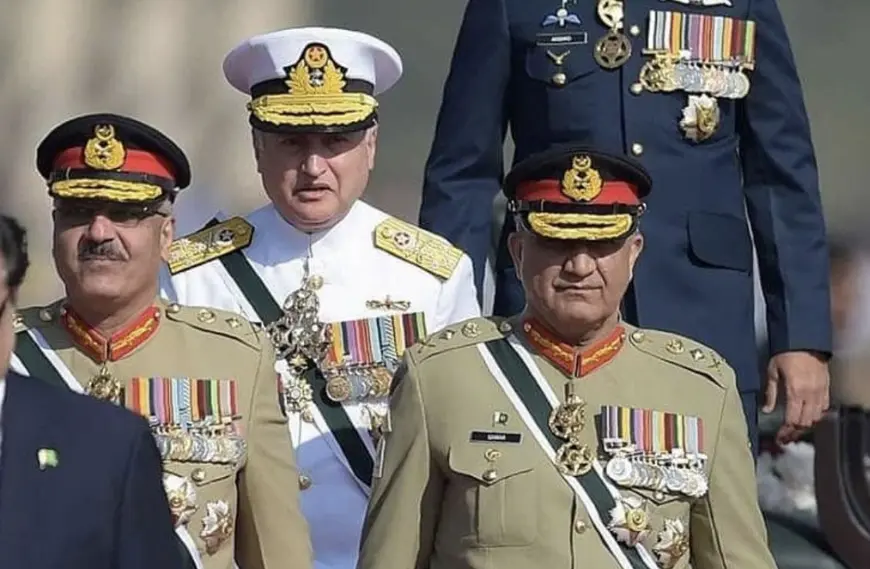
How one of the world’s most powerful militaries runs a shadow economy, exploits national resources, and undermines democracy.
In most democratic nations, the military exists to serve and protect the nation. But in Pakistan, the armed forces have evolved into a parallel state—wielding power not just over defence but over politics, the economy, and civilian life. From fertilisers to real estate, Pakistan’s military owns and operates a multi-billion-dollar business empire with minimal accountability. This article explores how the Pakistani military has entrenched itself in the country’s economic system, the resulting corruption, and its far-reaching impact on the common citizen.
A Military Empire: From Barracks to Boardrooms
The roots of Pakistan’s military capitalism go back to the post-independence era, but it was in the late 20th century that the armed forces institutionalised their economic ventures. Today, through various foundations and front companies, they control vast segments of Pakistan’s economy.
Key Military-Owned Conglomerates:
- Fauji Foundation
Established in 1954, originally to support ex-servicemen. It now owns over 100 companies in sectors such as fertilisers (Fauji Fertilizer), cement (Fauji Cement), banking (Askari Bank), food (Fauji Cereals), and power. - Army Welfare Trust (AWT)
Operates in cement, insurance, aviation, and real estate. One of the largest welfare groups run by the Pakistan Army. - Shaheen Foundation
Managed by the Pakistan Air Force, with investments in aviation (Shaheen Air), media, and education. - Bahria Foundation
Linked to the Navy, it runs businesses in maritime services, energy, and schools. - Defence Housing Authority (DHA)
Controls massive swathes of urban land across Pakistan, building luxury housing schemes often criticised for displacing poor communities.
Unregulated Wealth and Corruption
According to defence analyst Dr. Ayesha Siddiqa, author of Military Inc., the total value of Pakistan military’s economic empire exceeds $20 billion, and this estimate may be conservative.
What makes this wealth particularly controversial is the lack of transparency. These military-run enterprises are exempt from audits by the Auditor General, do not fall under civilian oversight, and benefit from tax exemptions unavailable to civilian businesses.
Major Allegations:
- General Qamar Javed Bajwa, former army chief, and his family allegedly amassed wealth worth over ₹12 billion ($54 million) during his tenure. These revelations were made public via leaked tax documents.
- In the Pandora Papers, several former and serving military officers were named for offshore holdings and alleged financial misconduct.
These instances are not isolated. The military’s unchecked control over economic assets has created an elite officer class enjoying privileges while the public faces rising inflation and poverty.
Impact on the Common People
The military’s economic expansion comes at a cost to ordinary Pakistanis. Public land is routinely allocated to the military for commercial use, displacing farmers and slum dwellers. For example, in cities like Lahore and Karachi, land acquisitions by DHA have been met with protests by locals who claim their ancestral land was forcibly taken.
Additionally:
- Military businesses receive tax benefits and state support, which private businesses do not—creating an uneven economic playing field.
- With so many public funds and resources diverted, basic services like healthcare and education remain underfunded.
- Political manipulation by the military has undermined democracy, leading to civilian governments that act under military pressure rather than public interest.
International Implications
Pakistan’s military also plays a significant role in foreign-funded projects like the China–Pakistan Economic Corridor (CPEC). While these projects were meant to boost development, they are often executed under military supervision, with minimal transparency or public consultation.
This overreach has not only eroded civilian institutions but has also made foreign relations opaque, particularly with China, Saudi Arabia, and the US, where military-to-military engagement often overshadows diplomacy.
A Nation in Uniform’s Shadow
Pakistan’s military-industrial complex has grown beyond its constitutional mandate. The line between national security and economic exploitation has blurred. As long as the military continues to act as a corporate behemoth and political powerbroker, true democratic reform in Pakistan remains a distant dream.For any meaningful change, civilian institutions must be strengthened, the military’s economic assets must come under civilian audit, and corruption must be addressed transparently. Until then, the common Pakistani citizen will continue to bear the burden of a system where guns and greed go hand in hand.
