








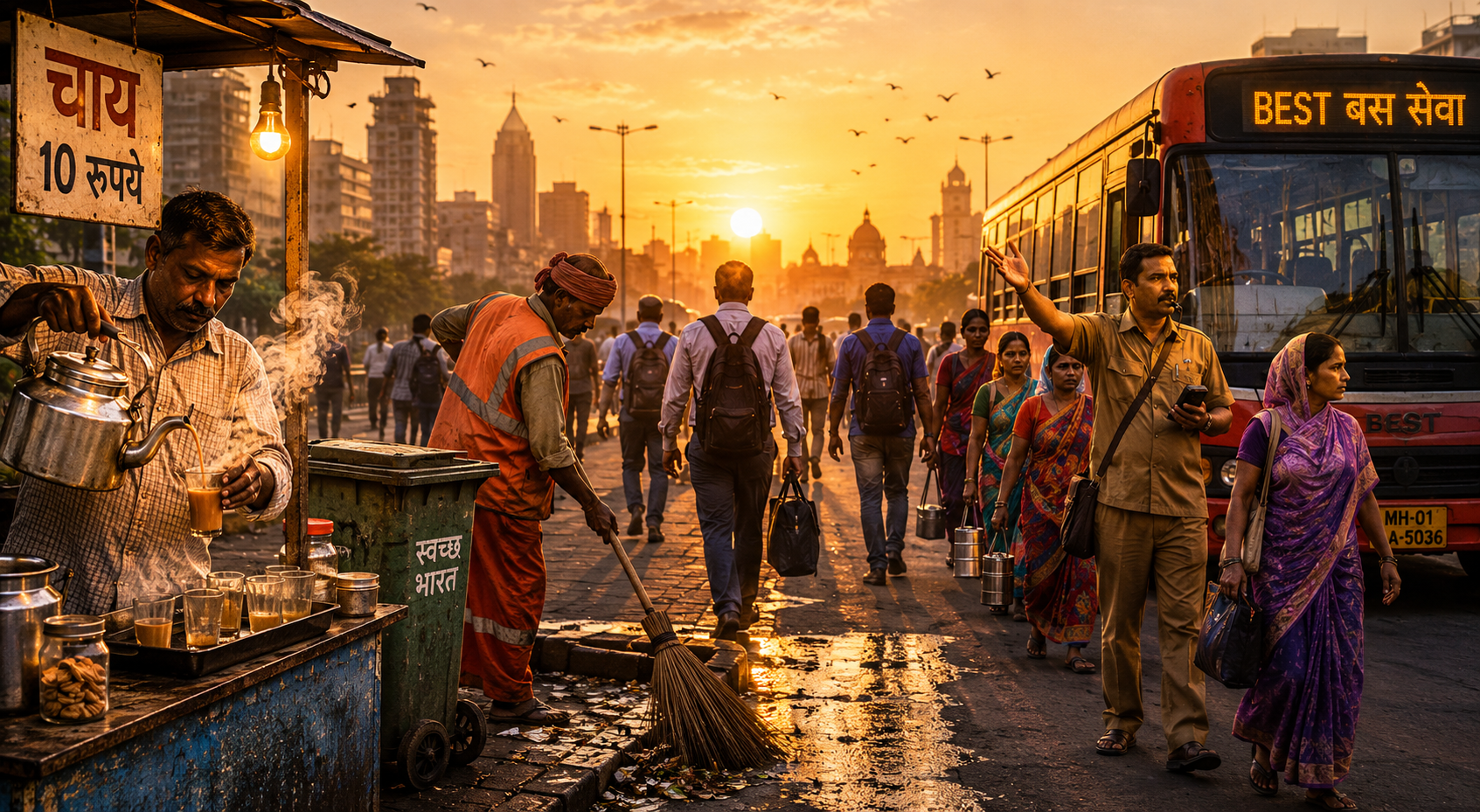
Every morning, millions of Indians wake up before sunrise and begin work long before most cities fully come alive. Some drive auto-rickshaws through crowded streets. Some deliver food to homes and offices. Some clean buildings, guard apartments, work at construction sites or travel long distances to factories and farms. They are present in almost every part of daily life, yet their contributions are often under-recognised in larger public conversations.
This is the story of what can be called “Invisible India” — the vast workforce that quietly keeps the country moving while rarely becoming the centre of national attention.
India today is often described as one of the world’s fastest-growing economies. News headlines regularly focus on stock markets, startups, technology, billionaires and global investments. The country’s digital growth and economic ambitions have become symbols of a changing India. Yet behind this progress stands another India that receives far less attention.
According to government and international labour estimates, a large section of India’s workforce still belongs to the informal sector. These are workers who often do not have permanent contracts, stable monthly incomes or access to formal social security benefits. They include street vendors, delivery riders, domestic workers, migrant labourers, drivers, sanitation workers, small shopkeepers and many others who form the backbone of daily life.
Their importance becomes most visible when systems stop functioning.
The Covid-19 lockdown offered one of the clearest examples of this reality. During those difficult months, millions of migrant workers returned to their villages after losing work in cities. Images of workers travelling long distances on foot became one of the defining moments of the pandemic in India. At the same time, delivery workers, healthcare staff, sanitation workers and transport employees continued working under difficult conditions to help cities function during the crisis.
For a brief period, the country’s attention shifted towards the people who often remain in the background of economic discussions. But as normal life returned, many of these workers slowly faded from public focus once again.
The rise of digital India has also created a striking contrast. Online conversations often revolve around luxury lifestyles, influencers, startup culture and artificial intelligence. But another India still struggles with rising living costs, uncertain employment and unstable incomes. This gap between visible India and invisible India continues to shape everyday life across the country.
Take the example of a delivery worker in a large city. He may spend the entire day travelling through traffic, delivering meals to expensive apartments and office towers. He becomes part of urban convenience and modern living. Yet many workers in the gig economy continue to deal with long working hours and income uncertainty. Similar realities exist for construction workers building modern skylines, or farmers producing food while facing unpredictable weather conditions and changing market prices.
None of this means India has not progressed. The country has seen major improvements in infrastructure, digital access and economic opportunities over the past decades. Millions of Indians have entered the middle class, and new industries continue to create jobs and innovation. However, the idea of Invisible India raises an important question: who is included in the story of progress, and who remains outside it?
Another important issue is dignity of labour. In many societies, service jobs and manual work receive greater public recognition. In India, however, many workers continue to feel socially invisible despite contributing significantly to urban and economic life. The challenge is not only financial. It is also emotional and psychological.
Security guards spend entire nights protecting buildings where many residents may barely know their names. Domestic workers enter homes every day but rarely become part of conversations about economic growth. Small farmers continue working through uncertainty even though agriculture still supports millions of Indian families.
Invisible India is not limited to villages or rural regions. It exists strongly inside big cities as well.
Urban life today moves at extraordinary speed. People rush between offices, traffic signals, meetings and digital screens. In this fast-moving environment, workers who make daily convenience possible often become background figures. Technology has made services quicker, though it has also changed the way people interact in urban life.
At the same time, younger Indians increasingly aspire towards financial stability, modern lifestyles and professional success. Ambition itself is not the problem. However, conversations around success sometimes overlook the millions who work equally hard without visibility, influence or recognition.
The challenge for India in the coming years will not only be economic growth but also inclusive growth. The country’s future depends not just on billion-dollar companies and urban expansion, but also on the wellbeing of workers who keep transport systems running, deliver services, grow food and support daily life across cities and villages.
Invisible India represents a very large section of the workforce.
Perhaps the country’s biggest paradox is this: the people who help keep India moving every single day are often the ones who receive the least attention in the larger story of modern India.
Subscribe Deshwale on YouTube


