



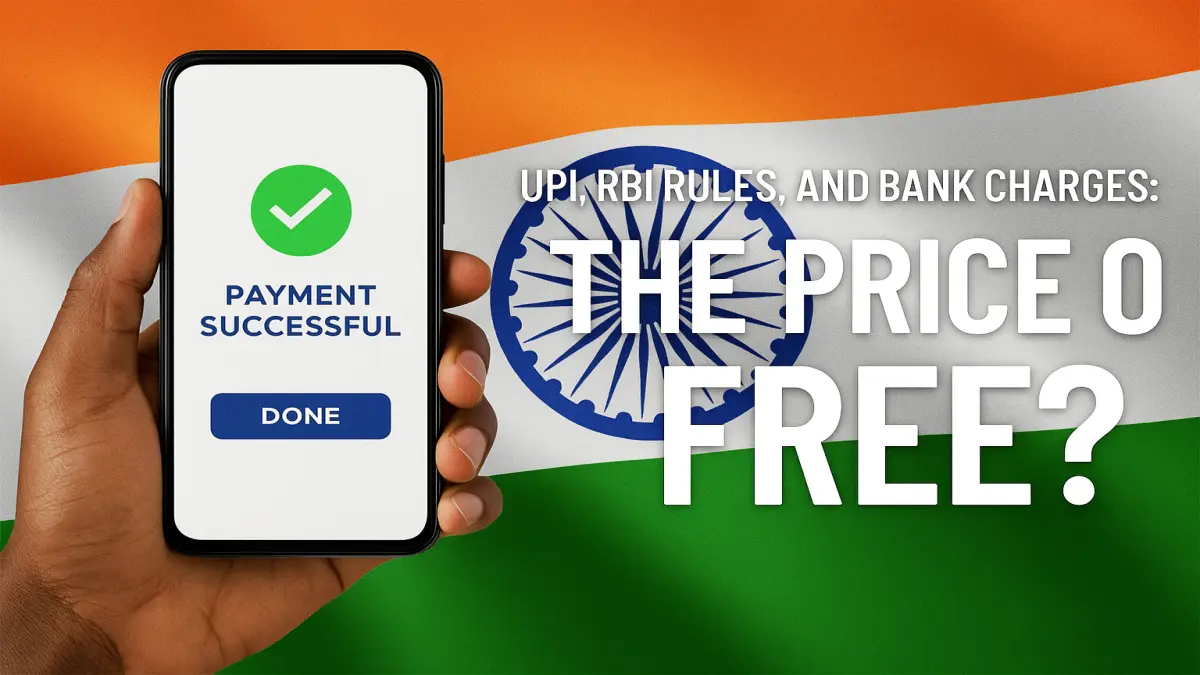
For years, the Indian consumer has enjoyed the digital revolution as if it were a divine gift—swift, seamless, and free. Scan a QR code, send a rupee to a friend, or pay for milk at the corner shop, all without opening your wallet. Unified Payments Interface, or UPI, became the beating heart of this transformation. But behind this ease lies a complex financial web now coming under strain. With new RBI guidelines and murmurs of service charges, a simple question arises: can ‘free’ really last forever?
UPI, launched in 2016 by the National Payments Corporation of India (NPCI), became a tool of empowerment for both urban users and rural merchants. It offered a cashless, frictionless experience that revolutionised the way India thought about money. By 2023, UPI was processing over 11 billion transactions a month. But for every transaction, there’s a cost—servers, infrastructure, security systems, and human labour. Who’s paying for all that?
Until now, the answer was simple: nobody directly. Banks, fintech firms, and digital wallets absorbed the cost, encouraged by the RBI’s zero-MDR (Merchant Discount Rate) policy on UPI. While great for consumers and small traders, it left many service providers wondering how long they could sustain operations without charging anything. The RBI had an answer—slow, careful change.
In January 2024, the Reserve Bank of India released a discussion paper, suggesting a potential restructuring of UPI’s pricing framework. Though the government later clarified that UPI would remain free for users “for now,” the paper opened the door to a conversation India had long avoided: digital services are not free to provide, and sooner or later, someone has to foot the bill.
This comes alongside other reforms from the RBI, such as increased oversight on loan apps, stricter Know Your Customer (KYC) norms, and tweaks in banking fees. Banks, too, are adjusting their fee structures, charging for everything from SMS alerts to ATM withdrawals after a threshold. While these may seem like minor changes, they reflect a shift in how the financial system is being recalibrated.
Let’s take a step back. India’s banking model has long relied on a delicate balance. On one end, there is financial inclusion—bringing every Indian into the banking fold. On the other, there’s commercial viability—ensuring that banks and fintechs survive. UPI disrupted that balance, for better and worse. It opened access but shut revenue doors. And in the process, it made us believe that real-time money movement could exist outside the laws of economics.
But reality is catching up. In countries like Singapore, UK, and even the US, real-time payments often come with costs. Even mobile wallets charge processing or transfer fees. India stood out because of its policy-led digital generosity. But even generosity must evolve into sustainability.
So, what does this mean for the common user? For now, nothing drastic. You can still pay your chaiwala with a scan. But behind the scenes, banks are lobbying for some MDR relief. Fintechs are exploring premium features. And RBI is creating an environment where small, transparent charges may soon become a norm rather than an exception. Already, some banks have introduced nominal charges for UPI transactions done via credit cards. The door is ajar.
There’s a moral dilemma here too. If India wants to ensure financial inclusion, charging people for basic access feels regressive. But if banks collapse under free service pressure, who benefits then? The solution may lie in tiered pricing—keep basic services free but charge businesses or high-volume users for advanced tools. That way, the system supports itself without punishing the poor.
Another issue is communication. Many Indians don’t even know they’re being charged. A monthly ₹5 SMS alert fee might go unnoticed, but it adds up over crores of accounts. Transparency is key. If banks are to earn user trust, they must inform customers clearly, in regional languages, about fees, charges, and limits.
And yet, there’s a bigger picture. UPI isn’t just about payments. It’s about data, trust, and national strategy. With countries like France and UAE adopting UPI, India is exporting its fintech vision. To keep that vision credible, we must show it can sustain itself financially. Foreign investors look for long-term viability, not digital charity.
At the core of this issue is a paradox: India created one of the most successful digital payment systems in the world by making it free. Now, it must preserve that success by making it viable. The transition won’t be easy, and it must be fair, but it’s necessary.
As users, we must understand that while freedom from cash is liberating, someone always pays the bill. Perhaps it’s time to ask: what are we willing to pay to keep it going?
