



By: Hiren Gandhi
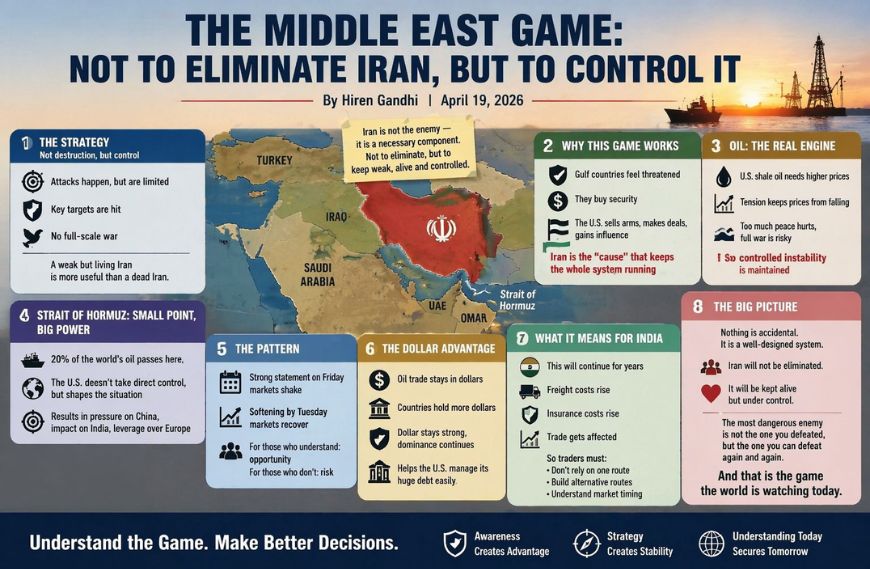
Amid ongoing tensions in the Middle East, a growing view among analysts suggests that the United States may not be seeking the complete elimination of Iran, but rather a strategy focused on containment and control.
Recent developments in the region point towards a pattern of calibrated actions. While targeted strikes and strong rhetoric continue, there has been no escalation into a full-scale ground conflict. Observers note that such restraint indicates a strategic balance rather than an attempt at outright destruction.
According to experts, maintaining a weakened yet functional Iran serves broader geopolitical and economic interests. A state of controlled tension in the Middle East keeps neighbouring Gulf nations under perceived threat, prompting them to strengthen defence capabilities. This, in turn, leads to increased arms purchases and security partnerships, many of which involve the United States.
The region’s energy dynamics further complicate the situation. Sustained instability often prevents a sharp fall in global oil prices. This is significant for the US, where shale oil production remains viable only above certain price thresholds. Analysts believe that a balance between conflict and calm helps maintain favourable price levels without triggering global economic shocks.
A critical factor in this equation is the Strait of Hormuz, through which nearly one-fifth of the world’s oil supply passes. Any disruption or pressure in this region has immediate global consequences. While the US does not directly control this route, its influence over regional dynamics provides it with significant strategic leverage.
The ripple effects extend beyond the Middle East. Countries such as China and India, both major energy importers, remain sensitive to fluctuations in supply and pricing. Similarly, European economies face indirect pressure through energy security concerns.
Market behaviour in recent months also reflects this pattern. Sharp reactions often follow strong geopolitical statements, only to stabilise once tensions ease slightly. This cyclical trend has created both risks and opportunities for global investors.
Another dimension of the ongoing situation is its impact on the US dollar. Continued geopolitical uncertainty reinforces the dominance of the dollar in global oil trade. As countries maintain higher dollar reserves for energy transactions, the currency’s global position remains strong, indirectly supporting the US economy and its financial obligations.
For India, the implications are both immediate and long term. Rising freight and insurance costs, along with potential disruptions in trade routes, pose challenges for businesses. Experts suggest that Indian traders and policymakers need to diversify supply chains and prepare alternative logistics strategies to mitigate risks.
Overall, analysts agree that the current situation is unlikely to be resolved quickly. Instead, it reflects a structured geopolitical approach where controlled instability plays a central role. Within this framework, Iran remains a key factor not as a target for elimination, but as a strategic element in a broader global equation.
The evolving dynamics underline a larger reality: in modern geopolitics, sustained influence often depends less on decisive victories and more on maintaining long-term strategic balance.

Secretary — InGlobal Business Foundation (IBF)
Director — ReNis Agro International LLP, Ahmedabad, India
Subscribe Deshwale on YouTube
