









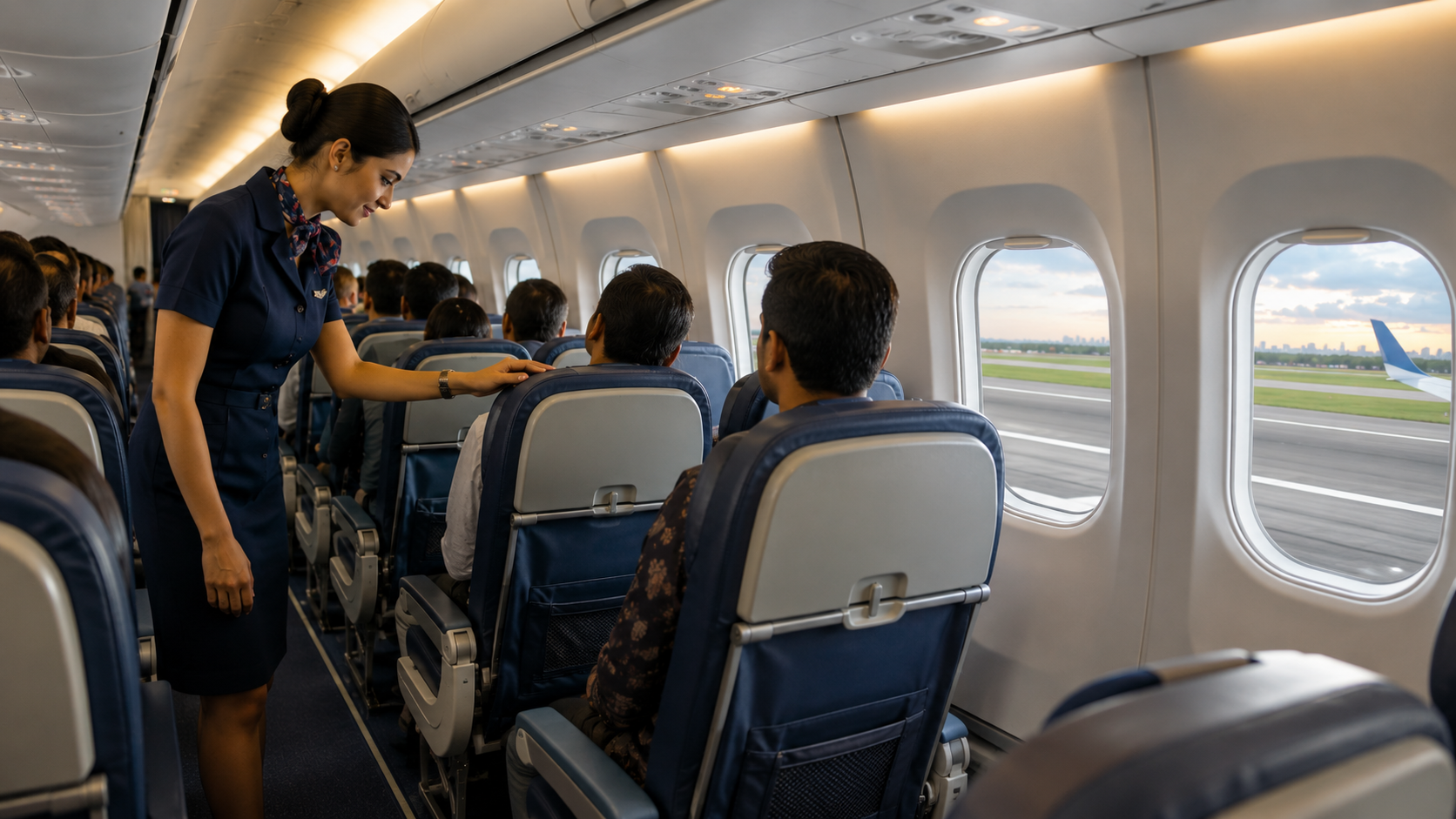
AI Generated image
Have you ever wondered why cabin crew always ask passengers to return their seats to the upright position before take-off and landing?
Every frequent flyer has heard the announcement: “Please return your seat to the fully upright position for take-off and landing.”
While the instruction may seem unnecessary or even a little annoying, it is based on aviation safety standards rather than airline preference. Keeping your seat upright during these critical phases of a flight is backed by years of crash testing, engineering research and emergency evacuation studies designed to improve passenger safety.
Why do seats have to be upright?
Aircraft seats are designed to provide maximum protection only when they are in the upright position. Since take-off and landing are considered the most critical stages of a flight, safety procedures are focused on reducing the risk of injuries if an emergency occurs.
The US Federal Aviation Administration (FAA) requires aircraft seats to undergo strict safety certification before they can be installed on commercial airplanes. During these tests, engineers use crash-test dummies to simulate the impact of a hard but survivable landing. The objective is to check whether the seat and the seatbelt can protect a passenger under extreme force.
These tests are conducted with the seat locked in the upright position. In this position, the seat frame, backrest and the tracks attached to the aircraft floor work together to provide maximum stability.
If the seat is reclined, that tested position changes. Since seats are certified in the upright position, the same level of protection cannot be assumed when they are tilted backwards.
What happens if the seat is reclined?
Airplanes use lap belts rather than the three-point seatbelts found in cars. When you are sitting upright, the belt rests securely across your hip bones, which are strong enough to absorb impact during sudden deceleration.
However, reclining the seat changes your sitting posture. Your body shifts slightly forward, increasing the possibility of sliding underneath the seatbelt during a sudden impact. This phenomenon, known as submarining, can cause the belt to move from the hips to the softer abdominal area, increasing the risk of injuries to the abdomen and lower spine.
A reclined position also allows your upper body and head to travel a greater distance before being stopped. The extra movement can increase the force of impact during an emergency, whereas sitting upright limits that motion and offers better protection.
Why does the seat position matter during evacuation?
Safety is not only about surviving an impact. Passengers may also need to leave the aircraft quickly if an emergency occurs.
A reclined seat reduces the space available for the passenger seated behind, making it more difficult to stand up, move into the aisle or exit the aircraft quickly. Even a delay of a few seconds in each row can slow down the evacuation of the entire cabin.
This is one of the reasons cabin crew insist that seats are returned to the upright position before take-off and landing. Seats located near emergency exits are also designed with restricted or limited recline to help keep evacuation paths clear.
Why isn’t this rule followed throughout the flight?
The requirement mainly applies to take-off and landing because these are the phases when most aviation accidents and incidents occur. During cruising altitude, the likelihood of a serious accident is significantly lower, which is why passengers are generally allowed to recline their seats.
Most flights take off and land safely without any incident. However, aviation safety is built around preparation rather than probability. Every procedure, from seat design and seatbelt positioning to emergency evacuation planning, assumes that passengers will follow safety instructions if an unexpected situation arises.
So, the next time the cabin crew asks you to return your seat to the upright position, remember that it isn’t just another routine announcement. It is a small step that has been built into aviation safety standards to help protect both you and the passengers around you.
Subscribe Deshwale on YouTube


