 Deshwale
Why Delimitation Keeps Dividing Parliament
In brief · AI summary An A-to-Z of delimitation: what it means, what the failed 2026 bills proposed, and why the south and the north see it differently.
Delimitation sounds like a dry word until you realise it decides how much say your state has in Delhi. Here is the simple version.
What is it? After every census, the number of Lok Sabha seats for each state, and the boundaries of each constituency, are meant to be redrawn to match population. India froze that exercise in 1976. Seat shares are still based on the 1971 census, and the freeze runs until the first census after 2026.
Why did it become a fight? Because population grew unevenly. Northern states grew faster than southern ones. A fresh redraw based on numbers would give the north a bigger share of the House. Southern leaders see that as a penalty for managing population growth well.
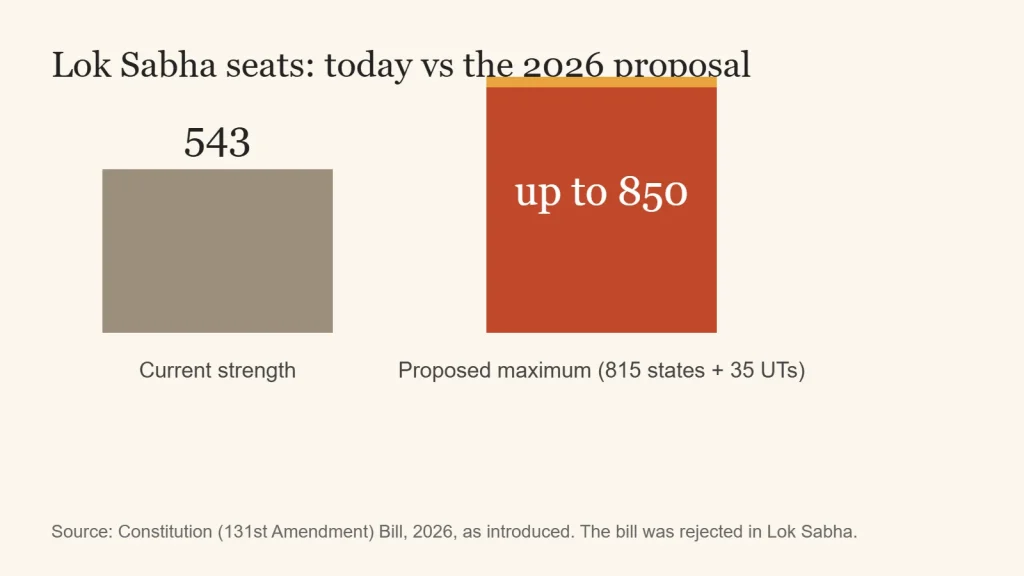
What did the Centre propose in 2026? On 16 April, three bills reached Lok Sabha. The main one, the Constitution (131st Amendment) Bill, wanted to raise the ceiling on Lok Sabha seats to 850, up to 815 for states and 35 for Union Territories. Law Minister Arjun Ram Meghwal said every state’s seats would rise by 50%. The redraw would use the 2011 census. The package also tied in women’s reservation, which was passed in 2023 but only takes effect after delimitation.
Where does the south stand? The government argued the five southern states would go from 129 to 195 seats, and that their share of the House would barely move, rising from 23.76% to 23.87%. The opposition was not convinced. The INDIA bloc said it backed women’s reservation but would oppose the delimitation bill.
What happened? A constitutional amendment needs a two-thirds majority, and the NDA does not have one in either House. The Lok Sabha rejected the amendment, and the Centre withdrew the delimitation bills.
And now? The idea has not gone away. In July, reports said Sharad Pawar’s NCP (SP), with eight Lok Sabha MPs, might support a revised push, and its working president Supriya Sule said the party would back a bill if every state got the same 50% increase. Sule also denied that a decision had been taken. On 16 November she strongly backed the bill, even as the party remained in the opposition INDIA bloc. Any revised bill faces the same arithmetic that sank the first: the NDA lacks a two-thirds majority in either House, so it needs support from outside its ranks. That is why the stand of parties like the NCP (SP) is watched so closely.
The politics may change, but the question will not: how do you share power fairly between states that grew at different speeds?
Chart: original graphic by Deshwale Online, based on the bill as introduced.