



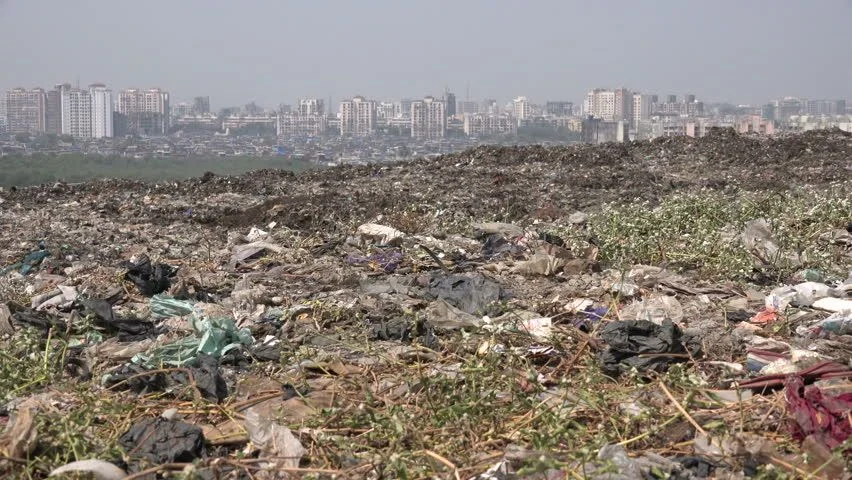
At dawn, as the sun rises over Mumbai, the slums of Govandi stir to life under a cloud of dust and smoke. Welcome to Deonar Dumping Ground—India’s oldest and largest landfill. Since 1927, it has silently devoured Mumbai’s waste, now towering over 120 feet—higher than an 18-storey building. Buried below are 16 million tonnes of legacy waste, and every day, 5,500 tonnes more arrive.
A City’s Breathing Hazard
Deonar isn’t just a landfill. It’s a living monster—spitting methane, spewing smog, and shortening lives. In Govandi, next to the dumping ground, the average life expectancy is just 39 years. Infant mortality here is double the city average.
In 2016, thick toxic smoke from landfill fires shut down schools for days. Many residents developed chronic asthma, bronchitis, and tuberculosis. Today, over 1 million people live under its shadow, breathing poison.
Why It Remains Uncontrolled
The Brihanmumbai Municipal Corporation (BMC) has tried—often failed—to manage the beast. Monsoon season swells daily waste inflow to 9,000 tonnes. Fires, often set by waste pickers trying to extract metals, release a toxic cocktail: hydrogen sulfide, carbon monoxide, and despair.
A ₹704 crore plan to scientifically cap parts of the landfill was announced. It stalled. Bio-mining contracts were floated. No takers. Instead, the government plans to build Dharavi’s slum rehabilitation homes right on Deonar’s edge—a move activists call “a gas chamber waiting to explode.”
A Fiery Fix or A Fatal One?
A new ₹2,648 crore Waste-to-Energy (WTE) plant is under construction. Slated to begin operations in October 2025, it will incinerate 600 tonnes of waste daily to produce electricity. The BMC claims this is a modern solution.
But locals aren’t convinced.
“Everyone in our building either has TB or asthma,” says Zakir Ahmed of Baiganwadi. Advocates warn that burning mixed waste—including biomedical and plastic—will release deadly dioxins and furans into the air.
Studies show Mumbai’s garbage has high moisture and low calorific value, making it scientifically unfit for large-scale incineration. Still, a 50-metre chimney now rises above Shivaji Nagar’s densely packed tenements.
A National Waste Emergency
Deonar is not alone. India is sitting on 3,159 waste mountains, holding over 800 million tonnes of garbage. Delhi’s Ghazipur landfill grows every year. Ahmedabad’s Pirana releases smoke over 84 hectares of urban life.
Solutions exist. Cities like Indore and Ambikapur have become landfill-free through segregation, composting, and community participation. But Mumbai, India’s financial capital, drowns in denial.
Lives on the Edge
At the centre of this toxic story are waste pickers like Farha—ignored by policies, but essential to survival. They often pay ₹50 daily bribes just to work inside Deonar. Machines can’t match their eyes or hands. Saumya Roy’s Mountain Tales calls their work a form of “recycling hope.”
They deserve safety, dignity, and health—not more smoke.
Deonar in Numbers
- Established: 1927
- Size: 311 hectares (approx.)
- Height: 120+ feet
- Daily Waste: 5,500–9,000 tonnes
- Biomedical Waste: 25 tonnes/day
- Local Life Expectancy: 39 years (Govandi)
- Waste-to-Energy Plant: ₹2,648 crore (by Oct 2025)
Mumbai’s Garbage Future
Can Mumbai become a world-class city with a garbage volcano at its heart? Rishi Aggarwal of the Mumbai Sustainability Centre doesn’t think so. “You don’t build homes on poison. You clean it up.” His call is urgent: treat waste scientifically, decentralize segregation, and stop housing projects on dump sites. Until then, Watching new trucks dump new waste. On old waste. On old wounds. On an old city struggling to breathe.
