



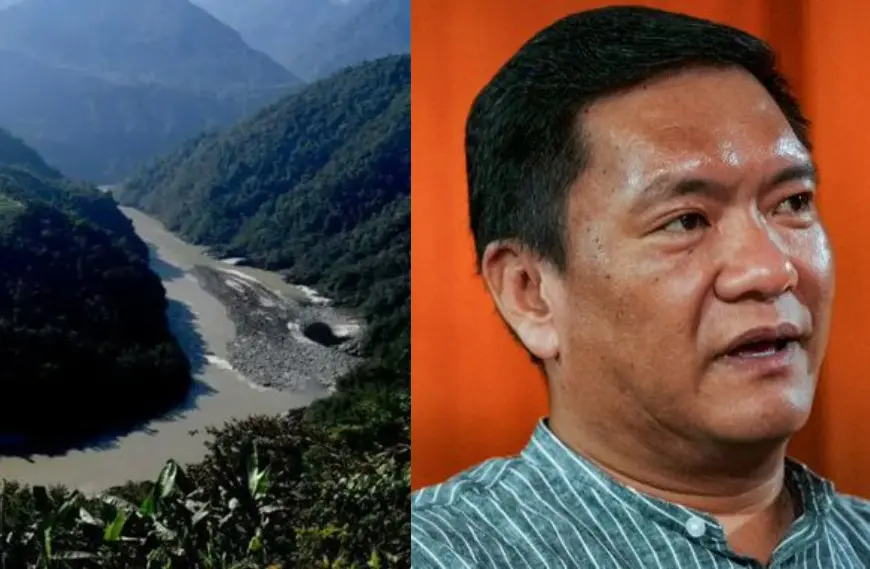
China’s $137 billion mega-dam on the Yarlung Tsangpo, the Brahmaputra’s source, threatens India’s water security, agriculture, and ecology. Set to generate 300 billion kWh annually, it could disrupt downstream flows, prompting India to plan a counter-dam in Arunachal Pradesh despite local protests and environmental risks.
Hydropower Potential and Strategic Ambition
On December 25, 2024, China announced a project that sent ripples across South Asia. The world’s largest hydropower dam, approved for construction on the Yarlung Tsangpo River in Tibet, promises to reshape the region’s energy, ecology, and geopolitics. Known as the Brahmaputra in India, this mighty river is the lifeline for millions in Arunachal Pradesh, Assam, and Bangladesh. Costing an estimated $137 billion, this colossal infrastructure venture is set to dwarf even China’s Three Gorges Dam. For India, it raises urgent questions about water security, environmental impact, and strategic tensions. As the river’s flow hangs in the balance, the regional implications are profound.
The Yarlung Tsangpo originates from the Angsi Glacier in western Tibet. It carves through the Himalayas, plunging 2,000 metres over a 50-kilometre stretch in the Yarlung Tsangpo Grand Canyon, the world’s deepest. This dramatic descent, coupled with heavy rainfall in the region, makes it a hydropower goldmine. China’s plan involves building a dam at the Great Bend in Medog County, near the Indian border. The project, part of China’s 14th Five-Year Plan, aims to generate 300 billion kilowatt-hours of electricity annually, enough for 300 million people. Yan Zhiyong, former chairman of the Power Construction Corporation of China, called it “a project for national security, including water resources and domestic security” in 2020, highlighting its strategic weight.
This is not China’s first foray into damming the Yarlung Tsangpo. In 2014, the Zangmu Dam, a 510 MW project, sparked controversy in India. China initially denied its construction, only for Foreign Minister Yang Jiechi to confirm it earlier in 2010, assuring minimal downstream impact. Since then, smaller dams have dotted the river’s upper reaches. But the new mega-dam, with a capacity three times that of the Three Gorges, is unprecedented. It requires drilling four to six 20-kilometre tunnels through Namcha Barwa mountain to divert half the river’s flow. This engineering feat, while ambitious, sits in a seismically volatile region, raising fears of catastrophic failure.
India’s Concerns and Counterplans
For India, the dam is a geopolitical lightning rod. The Brahmaputra sustains agriculture, fisheries, and livelihoods in the Northeast. It carries nutrient-rich silt that enriches Assam’s farmlands and supports Bangladesh’s delta. A dam could disrupt this delicate balance. “Control over these rivers effectively gives China a chokehold on India’s economy,” warned a 2020 Lowy Institute report. India’s concerns are twofold: reduced water flow during dry seasons and the risk of sudden releases causing floods. Pema Khandu, Arunachal Pradesh’s chief minister, called it “a big threat” that could “dry up the river or unleash floods.” The dam’s proximity to the disputed border, where China claims Arunachal as “South Tibet,” adds a strategic edge.
India’s response has been swift but contentious. The government is planning the Siang Upper Multipurpose Project, a $13.7 billion, 11,000 MW dam in Arunachal Pradesh. “The Siang dam will counter China’s mega-dam. It’s a matter of national security,” said Deputy Chief Minister Chowna Mein. Yet, local Adi tribes have protested, fearing displacement and ecological harm. The National Hydroelectric Power Corporation faces resistance as locals worry about aquatic ecosystems. This mirrors concerns in Tibet, where the dam threatens one of the planet’s richest biodiversity hotspots, home to ancient trees and rare big cats.
Environmental and Seismic Risks
Environmental risks loom large. The Yarlung Tsangpo Grand Canyon supplies an estimated 45% of the Brahmaputra’s sediment, vital for downstream agriculture. Diverting water could starve India’s farmlands and Bangladesh’s delta, accelerating coastal erosion. The region’s seismic activity, highlighted by a 6.8-magnitude earthquake in January 2025 that killed 126 people, adds to the peril. “Planning a dam in such complex terrain poses significant risks,” said Y. Nithiyanandam of Bengaluru’s Takshashila Institution. A dam collapse could unleash a “water bomb,” devastating communities downstream.
China insists the project is safe. Foreign Ministry spokesperson Guo Jiakun claimed it underwent “rigorous scientific evaluation” and won’t harm downstream states. Beijing touts its green credentials, saying the dam will help achieve net-zero emissions by 2060. It’s expected to generate $3 billion annually for Tibet, boosting local economies. Yet, critics argue China’s track record raises doubts. The Three Gorges Dam displaced over a million people and altered the Yangtze’s ecology. “This is an irresponsible project,” said former Indian Ambassador Ashok Kantha, citing the region’s fragility.
Diplomatic Gaps and the Way Ahead
The lack of a comprehensive treaty complicates matters. Neither India nor China is a signatory to the UN’s 1997 Watercourses Convention, which governs shared rivers. A 2013 Memorandum of Understanding on Brahmaputra data-sharing lapsed in 2023, and talks for renewal drag on. India has urged transparency, with Ministry of External Affairs spokesperson Randhir Jaiswal stressing the need to protect downstream interests. But China’s refusal to fully share data fuels mistrust. “It’s not just about water flow; it’s about power,” said Saheli Chattaraj, a Chinese studies expert at Jamia Millia Islamia.
Historically, rivers have shaped destinies. As Jawaharlal Nehru once said, “The story of the Ganges, from her source to the sea, is the story of India’s civilisation.” The Brahmaputra holds equally profound cultural and ecological value. Its waters have nourished cultures for millennia, from the Yarlung civilisation to Assam’s tea gardens. A dam could disrupt this legacy, threatening food security in one of the world’s most populous regions. Bangladesh, where 70% of people live in the Brahmaputra basin, faces similar risks. Reduced sediment could weaken the Sundarbans, a UNESCO World Heritage Site.
India’s counter-dam faces its own challenges. The Siang project could displace thousands, sparking local resistance and environmental concerns. Environmentalists warn it may mirror China’s ecological missteps. “Both dams could cause the same problems with soil fertility and erosion,” said Dr. Rudra of the West Bengal Pollution Control Board. Yet, India sees it as a necessary bulwark. The project aims to store water, mitigate floods, and generate clean energy, aligning with India’s renewable energy goals. But at what cost?
The dam’s shadow extends beyond borders. In Vietnam, China’s Mekong dams have been accused of diverting water, a playbook India fears may repeat. Posts on social media reflect public anxiety, with one user warning, “China’s mega-dam could ruin vast areas.” The project’s secrecy, China has shared little about its design or displacement plans, fuels suspicion. “China’s veil of secrecy mutes international reaction,” noted an Indian commentator.
As tensions simmer, diplomacy is critical. India and China have an Expert-Level Mechanism for river data, but it lacks teeth. Collaborative agreements, like those for the Danube, show what’s possible. Without them, the Brahmaputra could become a flashpoint. “Water is life, but it can also be a weapon,” said Omair Ahmad of The Third Pole, comparing China’s approach to its Mekong strategy. India must balance assertive diplomacy with strategic caution to safeguard its interests.
The Yarlung Tsangpo dam is more than an engineering feat. It’s a test of regional cooperation in an era of climate change and geopolitical rivalry. For India, it’s a call to protect a river that defines its Northeast. As the Brahmaputra flows through the heart of millions, its future hangs in a delicate balance. The world watches as two giants navigate this high-stakes game, where every drop counts.
