



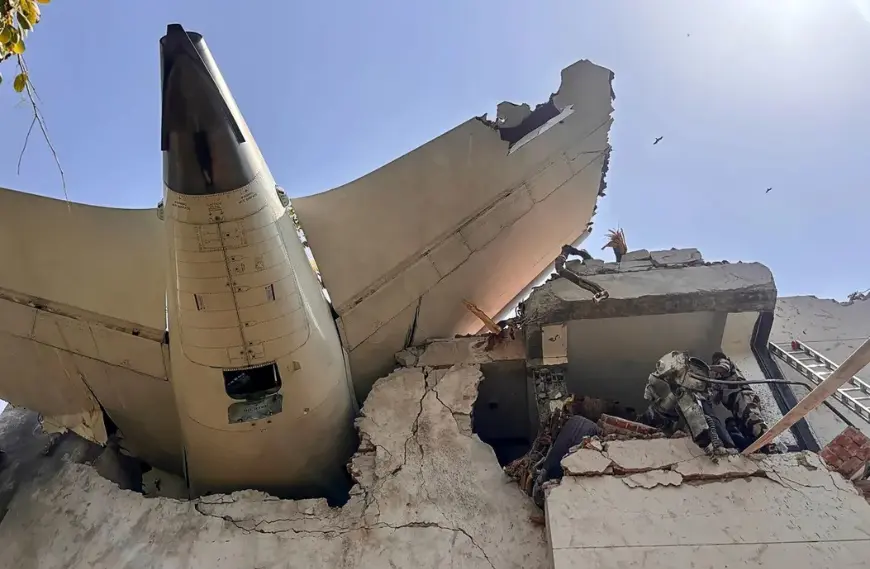
AHMEDABAD, June 12, 2025, A preliminary investigation report released by the Aircraft Accident Investigation Bureau (AAIB) has revealed startling new details about the tragic crash of Air India Flight AI171. The Boeing 787-8 aircraft, registered as VT-ANB, suffered a catastrophic failure just seconds after takeoff from Ahmedabad airport en route to London Gatwick, resulting in 260 fatalities, including passengers, crew, and civilians on the ground.
Dual Engine Shutdown Seconds After Takeoff
According to the AAIB’s initial findings, both engines of the aircraft unexpectedly shut down during the aircraft’s initial climb. Flight data from the aircraft’s forward Enhanced Airborne Flight Recorder (EAFR) indicated that Engine 1 and Engine 2 fuel control switches were moved to “CUTOFF” within one second of each other, immediately halting fuel supply. The engines’ core speeds began decelerating, and the Ram Air Turbine (RAT) was automatically deployed, a clear indication of complete loss of engine power.
In a chilling revelation from cockpit voice recordings, one pilot is heard asking the other: “Why did you cutoff?”, to which the other responds, “I didn’t.” Investigators suggest that this indicates inadvertent or unintended activation of the fuel control switches.
Timeline of the Final Minutes
The flight, carrying 230 passengers, 10 cabin crew, and 2 flight crew, was cleared for takeoff from Runway 23 at 13:07 IST (08:07 UTC). The aircraft lifted off at 13:08:39 IST, achieving its takeoff speeds. However, within seconds, both engines lost power:
- 13:08:42 IST: Both engines transitioned to fuel cutoff
- 13:08:47 IST: RAT deployed, indicating power loss
- 13:08:52 IST: Fuel control switches moved back to “RUN” in an attempt to relight engines
- 13:09:05 IST: A “Mayday” distress call was made
- 13:09:11 IST: Flight recorder stopped; aircraft crashed shortly thereafter
While Engine 1 showed signs of partial relight, Engine 2 failed to recover. The aircraft began to lose altitude before crossing the airport boundary and ultimately crashed into a cluster of residential and institutional buildings, including the BJ Medical College hostel.
Massive Structural Damage on Ground
The aircraft impacted the northeast wall of Building A at the BJ Medical College complex, just 0.9 nautical miles from the runway end. The crash caused extensive damage to five buildings, tearing through structures and igniting fires. Wreckage was scattered across a 1000 ft by 400 ft area, with significant components like the engines, landing gears, wings, and fuselage embedded across buildings A to F.
- The right engine separated after hitting a water tank and landed beneath it
- The left engine struck Building D at ground level
- The tail section and right landing gear were embedded into Building A
- The nose landing gear was recovered 307 feet from the initial point of impact
- The cockpit section came to rest approximately 650 feet away
Aircraft and Crew Information
The aircraft was delivered in 2013 and had logged 41,868 flight hours. It had undergone its last maintenance check on 22 May 2025, and the next major check was due in December. The aircraft had a few open MELs (Minimum Equipment List items), none of which were linked to flight safety-critical systems.
The Pilot-in-Command, aged 56, held an ATPL and had over 15,600 hours of flying experience, including 8,596 hours on the B787. The Co-pilot, 32, held a CPL and had over 3,400 total hours, with 1,128 hours on type. Both had valid medical certificates and had taken adequate rest prior to the flight.
Fuel System Advisory Not Followed
Interestingly, the report notes that in 2018, the FAA had issued a Special Airworthiness Information Bulletin (SAIB) related to potential disengagement of fuel control switch locking mechanisms. This bulletin was advisory, not mandatory, and Air India did not perform the recommended inspections. The fuel control switches in the crashed aircraft matched the part numbers mentioned in that advisory.
However, the investigation has not yet linked this advisory to the engine shutdowns in the AI171 crash.
Flight Recorders and Investigation Status
Two flight data recorders were recovered:
- The aft EAFR was heavily damaged and unreadable
- The forward EAFR, equipped with an independent power supply, was successfully downloaded using a “golden chassis” provided by the NTSB (USA)
The EAFR contained detailed flight data and over two hours of cockpit audio, including the final flight. Fuel samples taken from the aircraft and bowsers tested within safety standards. Post-mortem examinations of passengers and crew are underway to corroborate medical factors.
International investigators from NTSB (USA), Boeing, GE, FAA, UK AAIB, and authorities from Portugal and Canada (whose nationals died in the crash) have joined the Indian probe.
No Immediate Safety Recommendations Issued
As of now, the AAIB has not issued any safety directives related to Boeing 787-8 aircraft or GE GEnx-1B engines. The investigation is ongoing, and the final report may lead to further recommendations or regulatory actions.
The preliminary findings raise alarming questions about the aircraft’s fuel control system and engine shutdown logic. While human error has not been ruled out, the sudden and simultaneous cutoff of both engines mid-air is unusual and suggests a systemic or mechanical failure.
The loss of 260 lives in this catastrophic crash is one of the deadliest in Indian aviation history. Families of the victims and the wider aviation community now await the final report, which will determine who or what is responsible, and how such a tragedy can be prevented in the future.
