



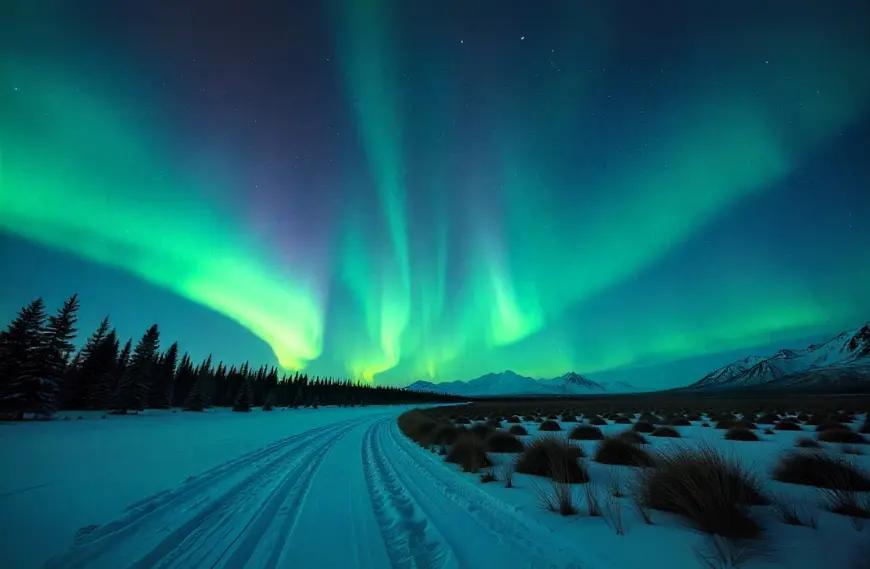
Dancing curtains of green. Veils of pink and purple. A faint, ghostly glow across the horizon. The night sky puts on two spectacular, yet very different, light shows: auroras and airglow. Both transform darkness into colour, but their origins and appearances are worlds apart. Let’s step outside the door of our planet’s protective blanket and explore these ethereal displays.
What Are Auroras?
Auroras, known as the Northern or Southern Lights, are born in space. The Sun’s surface hurls charged particles in a stream called the solar wind. When a coronal mass ejection erupts, trillions of particles race through the solar system. Most sail past Earth, but some slam into our magnetic field.
Earth’s magnetosphere channels charged particles toward the polar regions, where field lines converge. There, electrons and protons plunge into the upper atmosphere – between 80 and 500 km altitude. They collide with oxygen and nitrogen atoms. Those collisions excite atoms, raising electrons to higher energy states. As electrons return to their ground state, they emit photons – light. Oxygen emits green (most common) and red. Nitrogen glows blue and purple.
Auroras take many shapes. Curtains ripple with the wind. Arcs stretch across the sky. Rays sparkle like twisted ribbons. Pulsating patches flicker like neon signs. During powerful geomagnetic storms, they can be seen far from the poles – even in the UK, Spain or India.
The Science Behind the Colours
Green (557.7 nm): Emitted by oxygen about 100 km up.
Red (630.0 nm): Oxygen again, but above 200 km – rarer and fainter.
Blue (427.8 nm) & Purple (391.4 nm): Ionised nitrogen at lower altitudes (80–100 km).
The exact hue depends on altitude, energy of the incoming particles and atmospheric composition. Artists’ renderings often over-saturate these colours – real auroras are more subtle, shifting from pale green to soft pink, dancing behind faint stars.
When and Where to See Them
Auroral Oval: A ring around each geomagnetic pole. In winter months, long nights and high solar activity increase chances.
Peak Solar Cycle: Every 11 years, solar maximum boosts auroral displays. The current cycle peaks around 2025–2026.
Geomagnetic Storm Alerts: Websites and apps track the Kp index – a scale from 0 to 9 measuring geomagnetic disturbance. A Kp of 5 or above can push auroras to mid-latitudes.
Head north of the Arctic Circle (Lapland, Iceland, northern Canada) or south of 60° S (Antarctica’s coasts). But even New York or Edinburgh can catch a show during strong storms. Dress warmly. Find a dark spot away from city glow. Wait patiently; sometimes auroras leap to life with little warning.
What Is Airglow?
While auroras dance near the poles, airglow is the sky’s all-around nightlight. It arises from chemical reactions in the upper atmosphere – between 80 and 100 km altitude – where sunlight ionises atoms during the day. At night, those ions recombine, emitting photons. The result is a faint, diffuse glow across the entire sky.
Three main types of airglow:
- Chemiluminescent Airglow Oxygen green line (557.7 nm): Similar to auroras but much fainter.
Sodium D-line (589.0, 589.6 nm): A yellowish band from metallic sodium atoms. - Hydroxyl (OH) Airglow Emits in the near-infrared, producing a glow invisible to the human eye but prominent in astrophotography.
- Oxygen Red Line A faint red glow at 630.0 nm from high altitudes (>200 km).
Airglow is always present but rarely noticed. It matches the Milky Way’s brightness or fainter. Long-exposure photos reveal a soft greenish veil, sometimes mottled with waves or ripples – known as “gravity waves” in the mesosphere, caused by atmospheric tides and winds.
How They Differ
| Feature | Aurora | Airglow |
|---|---|---|
| Origin | Solar wind + magnetosphere | Daytime ionisation + night recombination |
| Location | High latitudes (polar ovals) | Worldwide, all directions |
| Altitude | 80–500 km | 80–100 km (chemiluminescent), 85–110 km (OH) |
| Brightness | Bright enough to see easily | Extremely faint – needs dark skies |
| Colours | Vivid greens, reds, purples, blues | Pale greenish/yellowish, infrared |
Capturing Them
Auroras: Fast frame rates (2–5 s exposure), wide-angle lenses (f/2.8 or faster), high ISO (800–3200).
Airglow: Long exposures (30 s–2 min), high ISO (1600–6400), still camera. Stack multiple frames to boost signal.
Many astro-photographers post-process to pull out subtle airglow bands. Filters can isolate specific wavelengths, highlighting sodium or oxygen emissions.
Cultural and Historical Notes
Auroras have inspired myths worldwide. The Sámi of northern Scandinavia saw them as the “fox fires” of a magical fox sweeping snow across hills. In Inuit legends, auroras were spirits playing ball with a walrus skull. In medieval Europe, auroras sometimes spooked superstitious villagers, believed to herald war or plague.
Airglow, by contrast, remained unnoticed until the 19th century. French astronomer Jules Janssen first recorded it during the 1870 solar eclipse, noting a faint green line in the sky after sunset. Even today, airglow’s subtlety means few know it exists outside scientific circles.
Why They Matter
Space Weather Monitoring: Auroras indicate geomagnetic activity that can disrupt satellites, GPS and power grids.
Atmospheric Science: Airglow reveals wind patterns, gravity waves and chemistry in the mesosphere – hard to study by other means.
Public Engagement: Both phenomena captivate and educate, connecting people with space and atmospheric science.
Next Steps for Enthusiasts
Join Citizen-Science Projects: Apps like Aurorasaurus let you report sightings to help scientists build real-time aurora maps.
Learn the Sky: Identify constellations around the auroral oval to track movements of the curtains.
Night-Sky Preservation: Help reduce light pollution to make faint airglow and weaker auroras more visible.
