



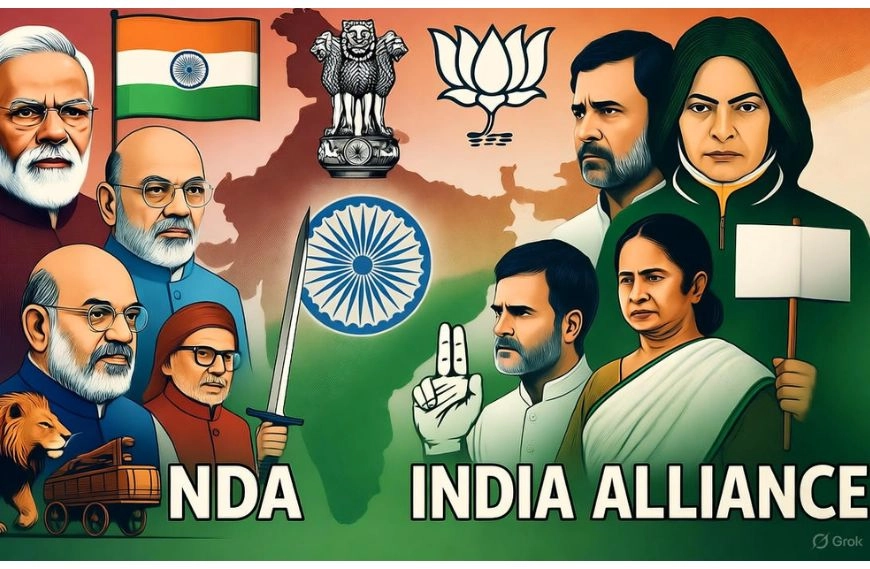
As the Bihar elections draw near, two major women-focused schemes have become the centre of political debate: the NDA’s Ladki Bahin Yojana and the INDIA alliance’s Mai, Behin, Maan Yojana. Both promise financial support to women, but their approaches are quite different. One focuses on direct monthly cash assistance, while the other aims to create employment opportunities and economic independence. This has raised an important question: what truly empowers women with money in hand or work in hand?
Understanding the two schemes
The Ladki Bahin Yojana, proposed by the NDA, promises a direct cash transfer of ₹2,000 per month to eligible women in Bihar. It is designed to provide financial relief to women from low-income households and help them meet daily needs such as food, healthcare, and education. The idea is simple if women have money in their hands, they will have more control over family expenses and decision-making.
On the other hand, the Mai, Behin, Maan Yojana, introduced by the INDIA alliance, takes a different route. Instead of providing fixed cash transfers, it focuses on employment support, skill development, and small business aid for women. The aim is to help them earn a sustainable income through work rather than depend on government allowances. It also includes provisions for training, microloans, and financial literacy to help women start small enterprises.
The core difference: relief vs. empowerment
At first glance, both schemes seem to support women. But when examined closely, they represent two different philosophies. The Ladki Bahin Yojana is about immediate financial comfort. It gives women a sense of security through guaranteed cash every month. For many families struggling with inflation and job loss, this immediate help could be a lifeline.
Meanwhile, the Mai, Behin, Maan Yojana looks at long-term empowerment. It aims to strengthen women’s economic base by helping them earn their own income. The focus is on dignity through work, not dependency on government funds. Supporters of this scheme argue that while cash transfers can help in the short run, employment creates stability that lasts a lifetime.
Women’s voices from the ground
In Bihar’s villages and towns, opinions are divided. Some women prefer the idea of direct cash. For them, ₹2,000 a month can mean food on the table, school fees for children, or a visit to the doctor. Many women who manage their households say that immediate cash helps them survive difficult times, especially when jobs are uncertain or seasonal.
Others, however, want the chance to work and earn for themselves. Women in self-help groups, local cooperatives, and rural industries say that work gives them respect and confidence. It allows them to plan for the future rather than live month to month. A 35-year-old woman from Gaya said, “If I earn through my work, I don’t have to depend on anyone. I can teach my daughter to stand on her own feet.”
Economic experts weigh in
Economists say both schemes have their merits. Direct cash transfers, like the Ladki Bahin Yojana, are easy to implement and bring quick results. They inject money directly into local economies and can lift families out of immediate poverty. However, they also warn that such schemes may not create lasting economic independence.
On the other hand, employment-based schemes can have a multiplier effect: one woman earning an income can support her entire family and inspire others in the community. But these programmes require strong infrastructure, training centres, and monitoring to ensure success. Without proper planning, they can fail to reach the women who need them most.
The election factor
Politically, both schemes are powerful tools. Women make up nearly half of Bihar’s voters, and their participation in elections has risen steadily over the years. Recognising this, both alliances have made women’s welfare central to their campaigns. For many voters, these schemes are not just about money or work, they are about recognition and respect in society.
Political analysts say the outcome of these promises will depend on how well each scheme is implemented. Cash transfers might bring quick popularity, but employment schemes could have deeper, long-term political impact if executed properly.
What do women really want?
There is no single answer. Some women value cash for its immediacy, others value work for its dignity. The real need is a balanced short-term support and long-term empowerment. A combination of financial assistance, job training, and entrepreneurship opportunities could make a lasting difference in women’s lives.
Ultimately, whether it is the Ladki Bahin Yojana or the Mai, Behin, Maan Yojana, what women want is not charity, but a fair chance to shape their own future. Bihar’s women have shown strength and resilience time and again. This election, they hold the power to decide which vision of empowerment they trust the most cash in hand or work in hand.
Subscribe Deshwale on YouTube
