



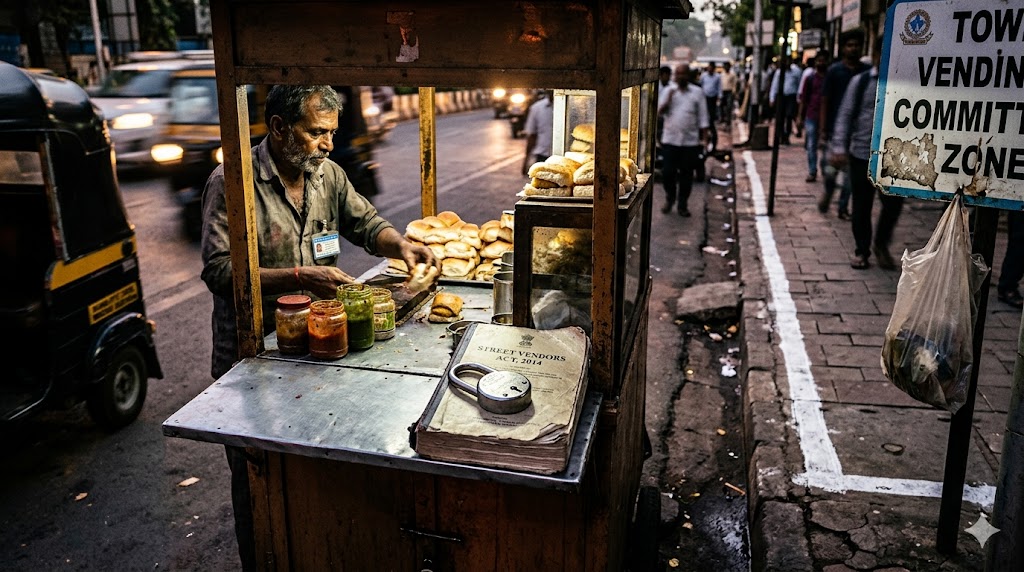
A Bombay High Court order has given the BMC a mandate it has avoided for a decade. The real question isn’t who holds a licence – it’s what kind of city Mumbai wants to be. And the world already has answers.
8 a.m. on the Edge of the Asphalt
The morning at the Linking Road intersection in Bandra does not begin with a prayer. It begins with the metallic scrape of folding tables and the rhythmic thud of wooden crates. By 8 a.m., the geometry of the chaos is nearly complete. A licensed bhelpuri wallah, whose family has occupied this square meter since the seventies, sets out his jars of nylon sev. Next to him, a young migrant from Bengal meticulously clips neon-coloured phone covers onto a wire mesh. A gola cart, dripping with synthetic rose syrup, takes up the remaining sliver of the tile.
An enforcement van from the Brihanmumbai Municipal Corporation (BMC) idles at the curb, its engine a low hum that sounds like a threat. Pedestrians, meanwhile, perform a dangerous ballet. They are forced off the elevated pavement and onto the road’s edge, walking shoulder-to-shoulder with speeding rickshaws. There is no malice here, just a desperate lack of room.
On March 23, 2026, a Bombay High Court bench of Justices Ajey Gadkari and Kamal Khata used the word “deeply concerning” to describe this exact scene. It is a scene every Mumbaikar lives through every single morning, yet it suddenly feels like the city has hit a legal wall.
The Legal Hammer Drops on the BMC
The court was hearing a suo motu plea regarding the unchecked growth of illegal hawking. In a move that sent tremors through the civic body, the bench directed the BMC and the Mumbai Police to immediately verify every single person engaged in vending across the city. This mandate covers everyone from the permanent steel stalls to the mobile wooden carts. Critically, the court specified that this verification must include those alleged to be Bangladeshis or other non-Indian nationals.
While the court permitted 99,435 vendors who had already been found eligible in previous surveys to continue their trade, it came with a stern warning. For the first time, the court suggested that individual officers would be held personally liable for any failure to act. This is a massive shift from the usual institutional finger-pointing.
The court also pointed out a staggering failure: over eight years have been spent just trying to form Town Vending Committees. Neither these committees nor the mandatory schemes under the 2014 Act have been fully implemented. The message was clear. This is not a new crisis. It is a chronic failure of the state wearing a fresh court order as a mask.
The Law That Everyone Ignored
The Street Vendors (Protection of Livelihood and Regulation of Street Hawking) Act, 2014, was supposed to be a landmark piece of social legislation. India has an estimated 10 million street vendors, and Mumbai alone accounts for at least 250,000 of them. The Act was designed to give these workers a legal identity. It mandated the creation of Town Vending Committees (TVCs), five-yearly surveys, and the demarcation of specific vending zones.
In Mumbai, the history of this Act is a study in institutional bad faith. Initially, the BMC surveyed over 1.28 lakh vendors. However, by the time the electoral list for the 2024 TVC elections was prepared, that number had mysteriously shrunk to just 22,000. Hawker unions were quick to call this a systematic exclusion.
As recently as August 2024, the High Court watched a pathetic display of the State Government and the BMC blaming each other. “Why this helplessness?” the bench had asked back then. From an urban planning perspective, the answer is simple but dark. A law that gives a municipality the power to implement while also giving it the power to delay is a law designed to fail. The current incentive structure is broken. Illegal hawkers generate massive amounts of “hafta” or protection money for local officials. They also represent significant voter-bank pressure for politicians. There is simply no built-in corrective in the current legislation to stop this cycle.
The Nationality Question and Political Cover
The court order to take strict action against illegal immigrants, especially from Bangladesh, has added a sharp political edge to a civic problem. The court instructed the authorities to initiate deportation processes without delay if undocumented foreigners are found vending.
A journalist in Mumbai has to hold two truths at once here. First, the legal question of undocumented workers using public space is legitimate. Any city must know who is operating on its streets. However, the second truth is that the “Bangladeshi hawker” narrative is often a political sleight of hand. It is a standard feature of the electoral ecosystem in Maharashtra.
The reality is that Mumbai’s hawker “menace” existed decades before any recent migration patterns became a talking point. The city has had hundreds of thousands of unlicensed vendors from every Indian state long before this current narrative took hold. Ironically, the 99,435 “eligible” vendors are just as likely to block the exits at Dadar or Kurla stations as any undocumented migrant. Scapegoating one group does not solve the math of the footpath.
Japan, Rwanda and the Netherlands
Mumbai likes to call itself a global city, so it should look at how the world handles its streets.
In Japan, the yatai street food carts of Fukuoka provide a brilliant lesson. Most Japanese cities killed off their street food culture before the 1964 Olympics to look “modern.” Fukuoka resisted. Instead of a ban, the city regulated. They capped the number of carts at 120. They required prices to be clearly displayed and banned certain high-risk raw foods. Most importantly, each cart has a fixed, licensed spot where it operates only at night. By morning, the cart is gone, and the street is clear for commuters. They turned a nuisance into a global tourist attraction.
Then there is Kigali, Rwanda. Often called Africa’s cleanest city, Kigali created designated vending zones with standardised kiosks. Vendors wear uniforms and carry ID cards. They are part of the formal economy. But there is a darker side. Human Rights Watch has documented vendors being detained in “re-education centres” as part of the clean-up. Rwanda is a warning for Mumbai: a clean city achieved through state coercion without accountability is just a different kind of crisis.
Finally, look at Amsterdam. In the Netherlands, if you want to sell from a cargo bike or a stall, you deal with the Marktbureau. The system is purely bureaucratic. You need a market pass and a licence before you even touch the pavement. Amsterdam understands that regulation must come before enforcement. In Mumbai, we do the opposite. We wait for the chaos to become unbearable, then we launch a “crackdown” without ever having built the licensing infrastructure in the first place. It is a classic case of putting the cart before the horse.
The City That Lives on the Footpath
The hawker is not some alien intrusion into Mumbai’s urban DNA. The hawker is the very blood of the city’s economy. The legendary dabbawalas, the vada pav stalls that feed the working class for Rs. 20, the flower sellers at Siddhivinayak – these are the city.
The BMC’s failure to implement the 2014 Act is a choice. It is a choice to keep 3 lakh people in a grey zone of permanent illegality. When you are illegal, you are vulnerable. When you are vulnerable, you pay hafta. It’s a very simple and very cruel system.
The statistics are sobering. Around 59% of Mumbai’s street vendors borrow money at interest rates as high as 5% to 10% per month. They do this to pay for basic healthcare or school fees for their children. They work 10 to 15 hours a day in the sun and pollution. Most end up with chronic respiratory issues or hypertension. These are not “encroachers” in the criminal sense. They are workers without a contract in a city that refuses to write one. It’s actually quite sad when you think about it.
What Compliance Actually Looks Like
The court has finally given the BMC a deadline, but “enforcement theatre” is not the answer. We have all seen it before. The vans come, the stools are seized, the hawkers run, and by Friday afternoon, everyone is back in the same spot with a slightly higher hafta rate to cover the “risk.”
True compliance requires a sequence that the BMC has consistently avoided. First, you must designate the vending zones. You cannot tell someone where they can’t stand if you haven’t told them where they can. Second, you license the vendors based on the existing surveys. Third, you enforce the rules strictly. And fourth, you verify nationality and legal status as part of that licensing process.
Mumbai has always tried to do this in reverse. We try to deport or evict first, and then we wonder why the footpaths are still blocked. The footpath belongs to the public, yes. But the public includes the man selling the phone covers and the woman selling the fish.
The High Court order is a chance to stop the cycle of managed chaos. It is a chance to decide if Mumbai wants to be a city of rules or a city of rackets. The world has shown us the models. The law has shown us the way. All that is missing is the political will to stop treating the footpath as a private ATM for the powerful.
