



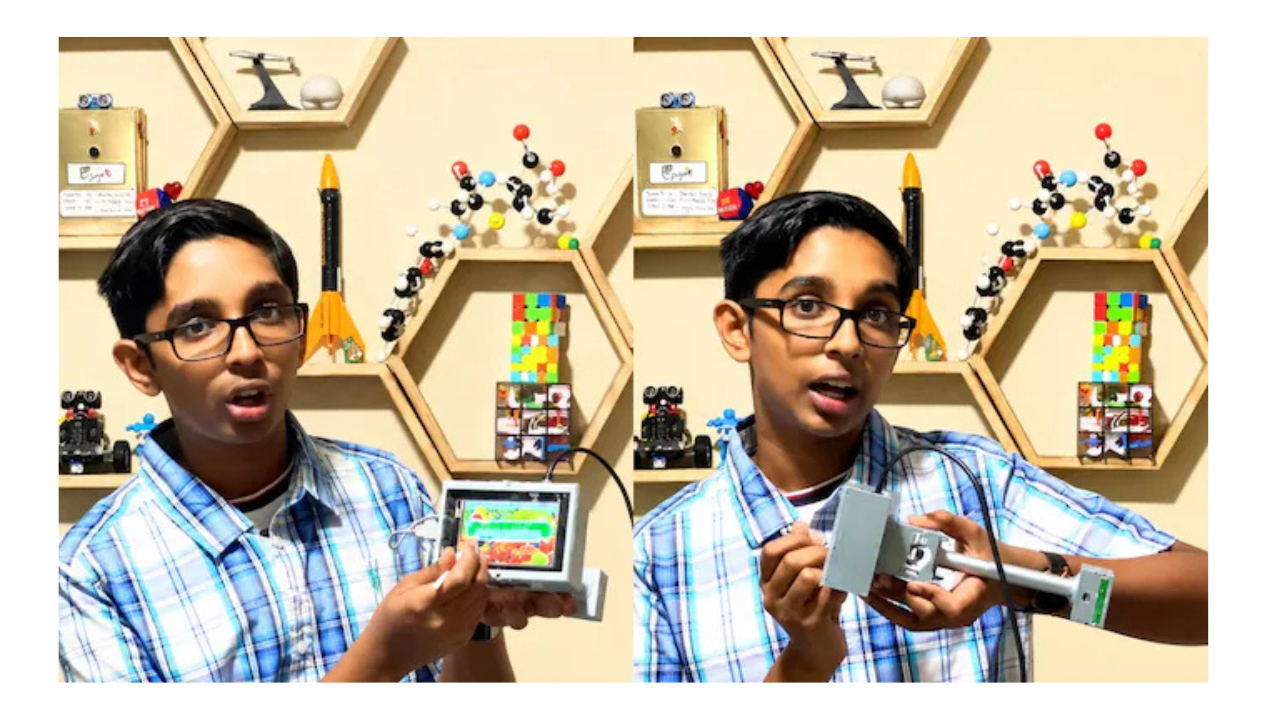
A 13-year-old student from the United States has developed an artificial intelligence-powered handheld device that can detect pesticide residue on fruits and vegetables within seconds without cutting or damaging them. The innovation, named PestiScand, was created by Sirish Subash, an eighth-grade student from Alton C. Crews Middle School in Snellville, Georgia. His invention has earned him a place among the finalists of the prestigious 3M Young Scientist Challenge, one of the world’s leading science competitions for school students.
The idea behind PestiScand came from a simple yet important question many consumers often ask while buying fresh produce: How much pesticide residue is still present on fruits and vegetables? Concerned about food safety and the health risks associated with pesticide exposure, Sirish wanted to create a practical solution that would allow people to check produce before eating it.
According to Sirish, existing home pesticide testing methods are often inconvenient as they require users to cut fruits or vegetables and apply chemicals during the testing process, making the produce unusable afterward. While laboratory testing methods are highly accurate, they are expensive and not easily accessible for ordinary households.
Explaining his motivation during his presentation, Sirish said these limitations inspired him to design a portable, AI-powered pesticide detector that anyone could use at home.
AI-powered device uses spectrometry to detect pesticides
Unlike conventional testing methods, PestiScand does not require any chemicals or physical contact with the fruit or vegetable. Instead, it uses spectrometry, a scientific technique that shines different wavelengths of light onto the surface of the produce and analyses the light reflected back.
Every substance reflects light differently because of its unique chemical composition. Sirish trained an artificial intelligence model to recognise the reflection patterns associated with pesticide residues. Using this data, the device can quickly determine whether pesticide residue is likely to be present on the surface of the fruit or vegetable.
The process is designed to be simple and user-friendly. Users only need to point the handheld device at the produce and tap the “Measure” button. Within seconds, the AI analyses the reflected light and displays whether pesticide residue has been detected.
Since the device does not cut, damage or apply chemicals to the produce, the fruits and vegetables remain completely safe to eat after testing. The non-destructive testing method makes PestiScand a practical alternative for everyday consumers who want to make informed choices about the food they buy.
The innovation combines artificial intelligence with optical sensing technology to make food safety testing faster, easier and more accessible outside laboratory settings.
Smartphone attachment planned for the future
Although PestiScand is currently a working student prototype, Sirish is already planning improvements for future versions. He hopes to make the sensor even more accurate while expanding the AI model by training it with a wider range of pesticide samples and different types of fruits and vegetables.
His long-term vision is to transform PestiScand into a compact smartphone accessory that can easily attach to the back of a mobile phone. This would allow users to scan fruits and vegetables with a single tap before purchasing or consuming them, making pesticide detection even more convenient for everyday use.
Sirish said he entered the 3M Young Scientist Challenge because he wanted expert mentorship to help refine his invention and turn it into technology that could genuinely improve people’s lives.
Sharing his future aspirations, he said, “In 15 years, I hope to be designing and building devices that can help make the world a better place, especially with climate change and environmental issues.”
While PestiScand remains a student-developed prototype, it demonstrates how artificial intelligence and simple engineering can be used to solve real-world challenges related to food safety and public health.
The 3M Young Scientist Challenge, organised by 3M and Discovery Education, invites students in Grades 5 to 8 from all 50 US states and the District of Columbia to develop innovative science and engineering solutions for everyday problems. Sirish’s AI-powered pesticide detector is among this year’s standout finalists, highlighting how young innovators are using technology to create practical solutions that could have a meaningful impact on people’s daily lives.
Subscribe Deshwale on YouTube
