



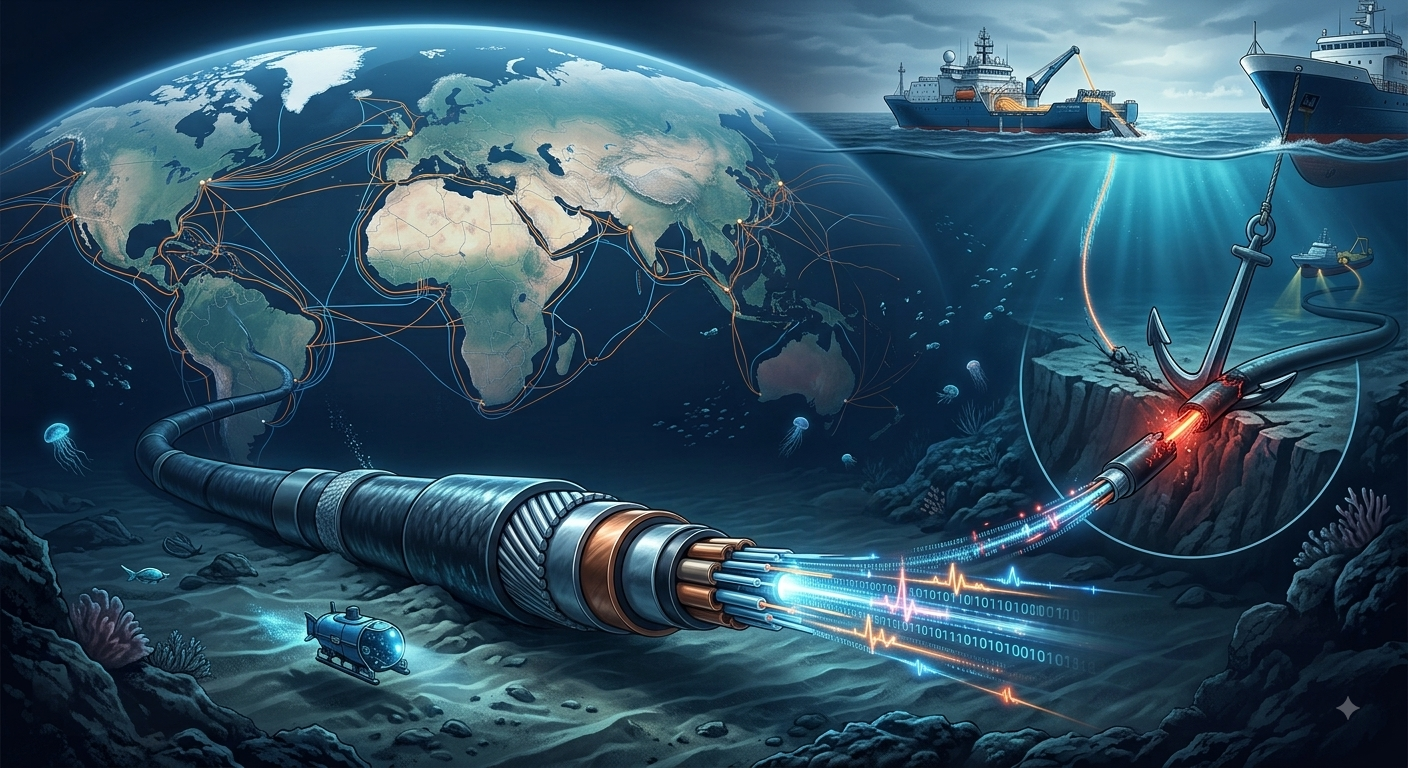
Every time you send a WhatsApp message, join a Zoom meeting, stream a movie or make an international online payment, it’s easy to assume the internet works through satellites floating in space.
The truth is far more surprising.
Nearly 95 to 99 per cent of the world’s international internet traffic travels through fibre-optic cables lying silently on the ocean floor. Stretching over one million kilometres and spread across nearly 600 undersea cable systems, these cables form the backbone of the global internet. Without them, modern communication, banking, cloud computing and international business would come to a standstill.
Although invisible to most people, these underwater cables have quietly become one of the world’s most important—and vulnerable—infrastructure networks.
The internet’s backbone lies under the sea
Despite being only about as thick as a garden hose, submarine cables contain hair-thin glass fibres protected by layers of steel, copper and waterproof insulation. In deep oceans, the cables are laid directly on the seabed, while in shallow coastal areas they are buried beneath the seabed to protect them from fishing nets, ship anchors and other hazards.
Installing these cables is a massive engineering project carried out by specialised cable-laying ships that can deploy thousands of kilometres of fibre across oceans. Repairing them, however, is even more challenging.
When a cable breaks, repair ships must first locate the damaged section several kilometres below the sea. Using giant grappling hooks, they pull the cable to the surface before technicians carefully align and fuse microscopic glass fibres together. A single repair can take several hours, while restoring service may take anywhere from a few days to several months depending on the location and weather conditions.
Ownership of these cables has also changed dramatically over the past decade. While telecom companies once controlled most submarine cable networks, global technology giants such as Google, Meta, Microsoft and Amazon now own or co-own many of them. Meta’s 2Africa project, spanning nearly 45,000 kilometres, is expected to become the world’s longest undersea cable system, highlighting how essential these networks have become for the digital economy.
Growing tensions beneath the waves
In recent years, undersea cables have increasingly found themselves at the centre of geopolitical tensions.
Since the Russia-Ukraine war began, several submarine cables and pipelines in the Baltic Sea have been damaged, prompting NATO to increase surveillance in the region. While some incidents were initially suspected to be acts of sabotage, investigations later suggested that a few may have been caused accidentally by dragged ship anchors, making it extremely difficult to determine whether the damage was deliberate or not.
A similar situation unfolded near Taiwan’s Matsu Islands, where two submarine cables were cut in 2023, leaving around 13,000 residents with severely limited internet connectivity for nearly 50 days until repairs could be completed. Another cable was damaged again in 2025, raising fresh concerns about the security of Taiwan’s digital infrastructure.
The Red Sea has also emerged as a major vulnerability. In 2024, a damaged cargo ship dragged its anchor across the seabed, severing three major submarine cables that carried internet traffic between Asia and Europe. The disruption affected nearly 100 million people across several African countries, with repairs taking almost five months because of security concerns in the conflict zone.
A fragile system the world depends on
Perhaps the biggest concern is that the world has only around 60 specialised cable ships, with fewer than 20 dedicated solely to repair work. Every year, nearly 150 to 200 cable faults are reported worldwide, most caused by fishing activities or ship anchors rather than sabotage.
Experts warn that while the network is designed with backup routes, multiple cable failures during a conflict could overwhelm the limited repair fleet and leave entire regions disconnected for months.
As demand for cloud computing, artificial intelligence and global digital services continues to grow, these hidden fibre-optic cables are becoming more important than ever. They may lie thousands of metres beneath the ocean, but they carry the conversations, businesses and economies of the modern world every second.
The next time a message reaches someone on another continent in an instant, remember that it probably travelled not through space, but through a thin strand of glass resting quietly on the ocean floor.
Subscribe Deshwale on YouTube
