



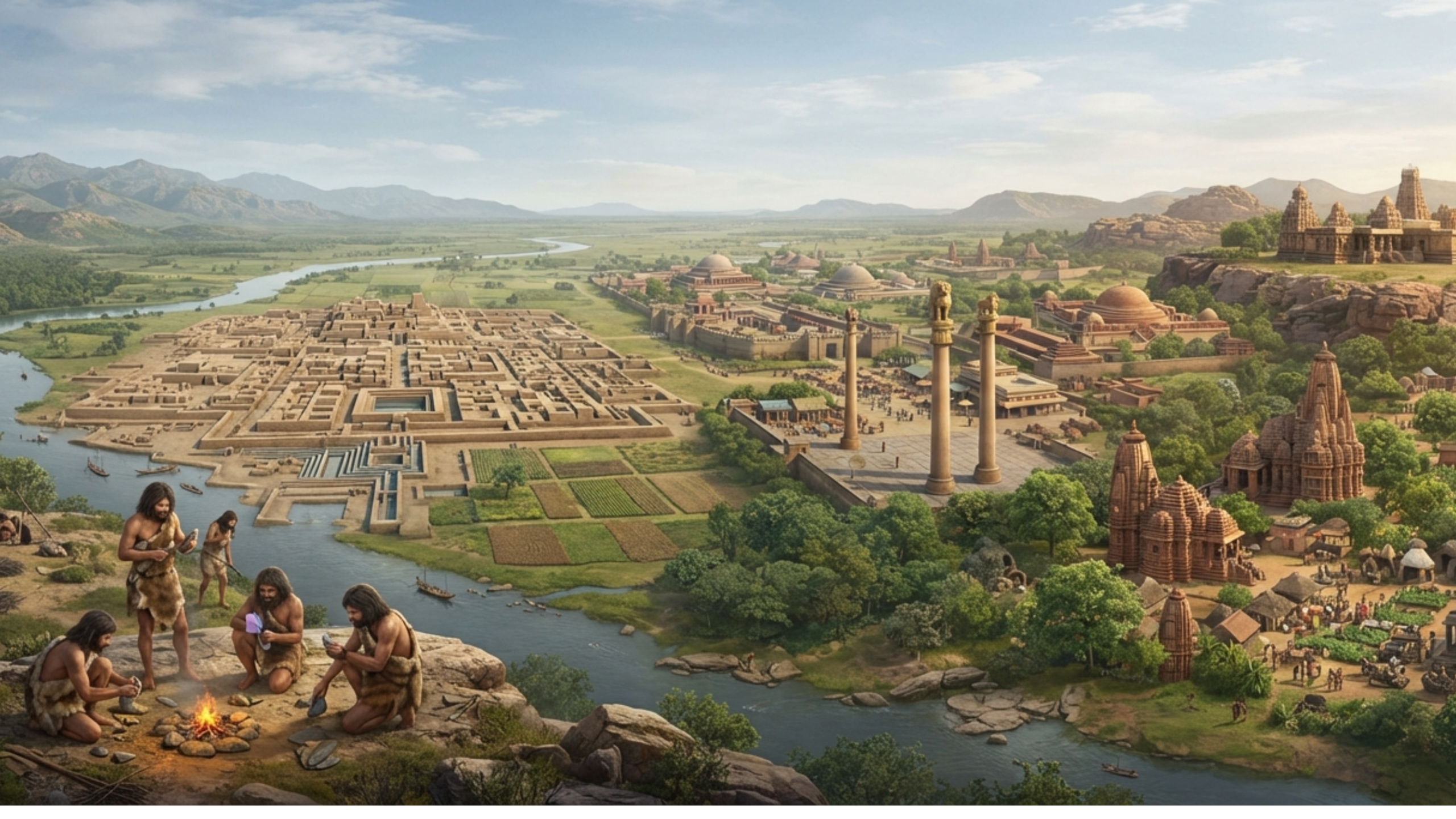
India’s history did not begin with a single kingdom or a single civilisation. It unfolded over thousands of years through settlements, cities, states, empires and regional cultures. From prehistoric communities and the cities of the Harappan world to the Mauryan and Gupta empires, and from the kingdoms of the south to the powerful regional states of early medieval India, each period reshaped the world that followed. This is Part 1 of our History of India series, covering 12 major eras from prehistoric India to the rise of the early medieval powers.
1. Prehistoric India
Prehistoric India stretches back hundreds of thousands of years, long before written records, cities or organised kingdoms existed. The earliest known stone tool traditions in the Indian subcontinent date to the Lower Palaeolithic, with evidence of human activity found at sites including Attirampakkam in present-day Tamil Nadu and the Soan Valley region. Later came the Middle and Upper Palaeolithic periods, followed by the Mesolithic and Neolithic ages. These communities occupied a vast geographical area, from the Himalayan foothills and northwestern plains to central India and the southern peninsula. Their lives were shaped by hunting, gathering, early food production and, eventually, settled agriculture.
The transformation was gradual, but profound. Stone tools became more sophisticated, while human communities adapted to an increasingly diverse range of landscapes. Mesolithic communities left behind distinctive microlithic tools and, at several sites, rock art. During the Neolithic period, farming and animal domestication became increasingly important. Settlements became more permanent in several parts of the subcontinent. Sites such as Mehrgarh, in present-day Balochistan, provide important evidence of early farming communities and date back to the 7th millennium BCE. Pottery, domesticated animals, agricultural practices and increasingly settled life laid important foundations for later village societies.
The significance of this period lies in what came next. There were no empires or unified political systems, yet the foundations of settled civilisation were taking shape. Agriculture, permanent settlements, technological adaptation and growing social organisation made increasingly complex communities possible. The story of India’s cities and kingdoms began long before those cities and kingdoms existed.
2. Indus Valley Civilisation
The Indus Valley, or Harappan, Civilisation developed in the northwestern Indian subcontinent, with its Mature Harappan phase generally dated to around 2600–1900 BCE. Its roots reach further back into the Early Harappan period, while regional cultures continued after the decline of its major urban centres. Its geographical reach was enormous. Major settlements appeared across parts of present-day Pakistan and northwestern and western India, including Haryana, Rajasthan and Gujarat. Harappa, Mohenjo-daro, Dholavira, Rakhigarhi, Kalibangan and Lothal are among its best-known sites.
The civilisation was remarkable for its urban planning. Cities and settlements featured carefully organised streets, drainage systems, wells, storage facilities and standardised brick construction. Dholavira had an elaborate system for managing and storing water. Harappan communities also traded across long distances, with evidence linking them to regions beyond the subcontinent, including Mesopotamia. They produced distinctive pottery, beads, seals, metal objects and other crafts. The civilisation also used a script that remains undeciphered. Its political structure is still debated because there is no clear evidence identifying a single emperor or centralised monarchy. Around 1900 BCE, major urban centres began to decline, although Harappan cultural traditions continued in different forms across several regions.
The importance of the Harappan era extends far beyond its impressive cities. It demonstrated that large-scale urban civilisation had emerged in South Asia remarkably early. Its achievements in city planning, water management, craft production and long-distance trade reveal highly organised societies operating across a vast geographical area. Its decline also transformed settlement patterns, with populations increasingly living in smaller and more regionally distinct communities. The urban system disappeared, but the Harappan legacy remained part of the archaeological history of South Asia.
3. Vedic Age
The Vedic period is generally associated with the composition and transmission of Vedic literature and is broadly placed between the 2nd and 1st millennia BCE, although its exact dates remain debated. The earliest Vedic traditions are closely associated with northwestern South Asia before spreading and developing further across the northern plains. During the later Vedic period, communities increasingly occupied the western and central Ganga–Yamuna region. This was a period of major social, economic and political change rather than a single unified kingdom or empire.
Early Vedic society was organised around clans and pastoral communities, with agriculture becoming increasingly important over time. The later period saw the expansion of settled agriculture, greater use of iron in some regions and the emergence of larger territorial states. Political institutions developed alongside increasingly complex social structures. Vedic texts, especially the Rigveda and later Vedic literature, provide important evidence for the religious and social world of the period. They must, however, be interpreted carefully because they were composed and transmitted over long periods and do not describe every part of the subcontinent. The period also saw the development of ritual traditions that would have a lasting influence on Indian religious and philosophical thought.
The Vedic age mattered because it witnessed a major transformation in social and political organisation. Predominantly clan-based societies increasingly developed into settled territorial communities and, eventually, larger states. The period also produced some of the earliest surviving textual traditions from South Asia. Its political, social and religious developments helped shape the world from which the Mahajanapadas would emerge.
4. Mahajanapadas
By roughly the 6th century BCE, northern India had entered a new political age. Sixteen Mahajanapadas are traditionally identified in early Buddhist and Jain sources. They occupied large parts of northern and central India, stretching from the northwestern regions towards the Ganga plains and into eastern India. They included Anga, Magadha, Kashi, Kosala, Vatsa, Avanti, Vajji, Malla, Kuru, Panchala, Gandhara, Kamboja, Chedi, Matsya, Surasena and Assaka. Some were monarchies, while others had oligarchic or republican political structures.
This was an age of intense competition. States fought over territory, trade routes, agricultural land and strategic locations. The Ganga plains became increasingly important because fertile land supported growing populations and agricultural production. Urban centres expanded, trade networks grew and coinage began to play a greater role in economic life. This was also the age in which Buddhism and Jainism emerged. Siddhartha Gautama, the Buddha, and Vardhamana Mahavira developed influential new religious traditions that challenged established ideas and practices. At the same time, cities such as Rajagriha, Vaishali, Shravasti and Varanasi became important centres of political and commercial activity.
The significance of the Mahajanapada era lies in the political competition it created. Among the competing states, Magadha gradually gained a remarkable advantage. Its fertile territory, access to resources, strategic location and capable rulers allowed it to expand. The age of many competing states was slowly giving way to the age of empire.
5. Magadha’s Rise
The rise of Magadha unfolded between roughly the 6th and 4th centuries BCE in what is now Bihar and surrounding parts of eastern India. Initially one among several major Mahajanapadas, Magadha benefited from fertile agricultural land in the lower Ganga basin and access to important rivers. Its early capital at Rajagriha was later replaced by Pataliputra, which occupied a strategically powerful location near major river routes.
Three dynastic phases were especially important in Magadha’s rise: the Haryankas, Shishunagas and Nandas. Bimbisara expanded Magadha through conquest and alliances, while Ajatashatru continued its expansion and fought major conflicts, including against the Vajji confederacy. The Shishunagas consolidated Magadhan power, while the Nandas built a powerful state with substantial military resources. By the 4th century BCE, Magadha had emerged as the dominant power in much of northern India. Greek accounts associated with Alexander’s invasion also describe the formidable military strength of the Nanda realm.
Magadha’s importance lies in what its rise made possible. Its geography, agricultural resources, river networks and expanding political institutions created conditions for unprecedented territorial expansion. From the Magadhan heartland would emerge the Mauryan Empire, one of the largest political formations in ancient Indian history. The transformation of Magadha from one Mahajanapada into the dominant state of northern India was therefore a decisive step towards the creation of empire.
6. Mauryan Empire
The Mauryan Empire emerged in the late 4th century BCE and became one of the largest political formations in ancient Indian history. Founded by Chandragupta Maurya around 321 BCE, the empire grew from the Magadhan heartland and eventually controlled extensive territories across northern and central India. Under Ashoka, its influence extended across much of the subcontinent, although the far south remained outside direct Mauryan rule. The empire’s political centre was Pataliputra.
Chandragupta Maurya defeated the Nanda dynasty and established Mauryan rule. He later confronted Seleucus I Nicator, a successor state to Alexander’s empire in the east, and reached a settlement that strengthened the Mauryan position. His successor Bindusara expanded the empire further into the Deccan. Ashoka became its most famous ruler. His invasion of Kalinga was followed by a profound change in his public policy. Ashoka promoted dhamma, issued inscriptions across the empire and supported the Buddhist tradition, although his policies were not simply a conversion programme for the entire empire. Mauryan administration involved provincial governance, taxation, officials and a large military establishment. Ashoka’s inscriptions are among the most important surviving primary sources for ancient Indian history.
The Mauryan era demonstrated that an enormous territory could be governed through a central imperial state. Its administrative systems, inscriptions and diplomatic contacts provide an unusually rich window into ancient India. Ashoka’s inscriptions also carried ideas of ethical conduct and governance across a vast geographical area. Although the empire declined after Ashoka, the Mauryan achievement became a defining chapter in the political history of the subcontinent.
7. Post-Mauryan India
After the Mauryan Empire weakened during the 2nd century BCE, India did not fall into a single political vacuum. Instead, numerous kingdoms and cultural zones emerged and interacted across the subcontinent. This broad post-Mauryan period lasted for several centuries and included powerful states such as the Shungas, Indo-Greeks, Shakas, Indo-Parthians, Satavahanas and Kushans. Their territories stretched across northern India, the northwest, the Deccan and parts of western India.
The period was marked by movement and exchange. Indo-Greek rulers established kingdoms in parts of the northwest. Shaka rulers controlled territories in western India, while the Satavahanas became a major power in the Deccan. The Kushans eventually created a vast empire under rulers such as Kanishka, connecting parts of Central Asia, Afghanistan and northern India. Trade routes linking the Indian subcontinent with Central Asia, the Mediterranean world and Southeast Asia became increasingly important. Buddhism expanded along these networks, while Gandharan and Mathura artistic traditions produced influential forms of Buddhist sculpture. Indian coinage, trade and urban life also developed across several regions.
The post-Mauryan period connected India more deeply with the wider ancient world. Political boundaries shifted, but trade, religion, art and ideas crossed those boundaries. The era also demonstrated that Indian history was not simply a succession of centralised empires. Regional kingdoms and international connections were equally important in shaping the subcontinent.
8. Sangam Age
The Sangam Age refers broadly to the period associated with early Tamil literary traditions and the political and cultural development of southern India, generally placed around the late centuries BCE and the early centuries CE. Its core region was Tamilakam, covering much of present-day Tamil Nadu and adjoining parts of southern India. The three major Tamil dynastic powers were the Cheras, Cholas and Pandyas, alongside numerous smaller chiefs and local rulers.
Sangam literature provides valuable evidence about warfare, trade, agriculture, kingship, social life and landscapes. Tamil ports connected southern India to overseas trade networks. Roman coins and archaeological evidence found in southern India point to commercial links with the Roman world. Pepper, pearls, textiles and other goods formed part of these networks. The period also saw distinctive Tamil literary traditions develop, with poems describing love, war, generosity, landscapes and political life. However, Sangam texts were compiled and transmitted over time, so they must be used alongside archaeology and other evidence rather than treated as straightforward historical records.
The Sangam Age reveals a sophisticated and distinctive civilisation developing in southern India while major powers were also emerging elsewhere. It is a reminder that ancient Indian history cannot be understood only through the Ganga plains. Tamil literature, maritime trade and the political traditions of the Cheras, Cholas and Pandyas became enduring foundations of South Indian history.
9. Gupta Empire
The Gupta Empire rose in northern India during the 4th century CE and reached its greatest influence under rulers including Chandragupta I, Samudragupta and Chandragupta II. Its core territories lay in the Ganga basin, while its political influence extended into parts of northern, central and western India. The Gupta period is often dated broadly from the 4th to 6th centuries CE, although Gupta power changed significantly over time.
Samudragupta expanded Gupta influence through military campaigns and political alliances. His achievements are recorded in the famous Allahabad Pillar inscription, which provides important evidence about the political landscape of the time. Chandragupta II strengthened the empire and expanded towards western India. Gupta rulers issued gold coins and supported centres of learning and culture. Sanskrit literature flourished, with Kalidasa traditionally associated with the period. Advances in mathematics and astronomy also occurred in this broader era, including the work of Aryabhata in the late 5th and early 6th centuries. Hindu traditions developed alongside Buddhism and Jainism, while temple architecture and sculpture evolved.
The Gupta era brought together political power, economic activity and major cultural developments across northern India. The period later became associated with a supposed “Golden Age”, although historians now use that label cautiously because prosperity and cultural achievement were not uniform across society or the entire subcontinent. Gupta political power eventually weakened, particularly amid the rise of regional powers and incursions by the Hunas, opening the way for a new age of regional kingdoms.
10. Age of Regional Kingdoms
After the decline of Gupta power, India entered a period of strong regional political development. From roughly the 5th to 7th centuries CE, important kingdoms emerged across northern, central and western India. The Vakatakas had already become a major Deccan power, while the Maitrakas established themselves in western India. The Pallavas rose in the south, while the Chalukyas became powerful in the Deccan. Political authority was increasingly divided among competing regional states.
The period was not simply an age of political fragmentation. Regional kingdoms developed sophisticated systems of administration, agriculture, trade and patronage. The Pallavas made Kanchipuram an important political and cultural centre and contributed significantly to South Indian temple architecture. The Chalukyas established their power in the Deccan, with Vatapi, or Badami, becoming an important capital. Rock-cut and structural temples expanded across several regions. Buddhism, Jainism and different Hindu traditions continued to coexist, while Sanskrit and regional languages developed within different cultural spheres.
This era laid important foundations for the political map of early medieval India. Instead of one dominant empire controlling most of the subcontinent, multiple powerful kingdoms shaped different regions. Their competition encouraged distinctive political traditions, architecture, literature and religious institutions. Many of the regional powers that became dominant in the following centuries had their roots in this period.
11. Harsha and the Northern Kingdoms
Harshavardhana, commonly known as Harsha, ruled much of northern India during the first half of the 7th century CE, with his reign generally dated from around 606 to 647 CE. His power centred on northern India, particularly the Ganga–Yamuna region, and his capital eventually became Kannauj. His authority was substantial but should not be confused with direct control over the entire Indian subcontinent.
Harsha inherited a kingdom in the Thanesar region and expanded his influence after a period of political upheaval. He brought large parts of northern India under his influence through military campaigns and alliances. However, his southern expansion was checked by the Chalukya ruler Pulakeshin II, showing that powerful regional states continued to resist northern expansion. Harsha was also a patron of learning and religion. The Chinese Buddhist pilgrim Xuanzang visited his court and left an important account of northern India during the period. Harsha himself is associated with Sanskrit literary works, although the exact nature of his authorship remains a subject of scholarly discussion.
Harsha’s era briefly restored a significant degree of political unity across parts of northern India after the Gupta decline. Yet his kingdom did not survive him as a durable empire. After his death, political power again became dispersed among regional states. The struggle for control of northern India would eventually produce new powers, including the Gurjara-Pratiharas, Palas and Rashtrakutas.
12. Rise of the Early Medieval Powers
From roughly the 7th to 10th centuries CE, India entered an age dominated by powerful regional dynasties. In northern India, the Gurjara-Pratiharas became a major force. In eastern India, the Palas established a powerful kingdom and became important patrons of Buddhism. In the Deccan, the Rashtrakutas built a large empire. In the south, the Cholas began their rise, while the Pallavas, Pandyas and other powers continued to compete for influence. The subcontinent was increasingly shaped by several major states rather than a single empire.
The period witnessed prolonged competition over strategic regions, especially Kannauj. The Gurjara-Pratiharas, Palas and Rashtrakutas were involved in the long struggle for influence over northern India. Meanwhile, South Indian powers expanded their territories and developed sophisticated temple-centred political and economic systems. The Rashtrakuta rulers patronised remarkable architecture, including the Kailasa temple at Ellora. Pala rulers supported major Buddhist centres such as Nalanda and Vikramashila. The Cholas would soon transform into one of the most powerful maritime and imperial states in South Indian history. Land grants, temple institutions, agriculture and expanding trade networks became increasingly important to regional economies.
This period established much of the political landscape that would shape India in the centuries that followed. The great regional powers developed distinct administrative systems, artistic traditions, religious institutions and economic networks. The Cholas would expand across the south and overseas, the Palas would shape eastern India, and the Pratiharas would remain a dominant northern power. With this, Part 1 of the History of India series comes to an end, leaving the subcontinent on the threshold of the great medieval powers explored in Part 2.
Subscribe Deshwale on YouTube
