



India’s farms have supported the country’s agricultural growth for decades. However, long-term farm productivity depends on healthy soil, efficient use of resources and strong ecosystems. Regenerative agriculture offers a way to improve all three.
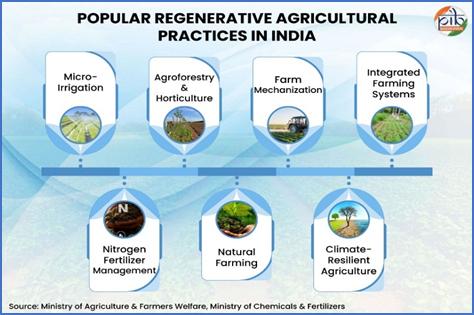
The approach focuses on restoring soil health, supporting biodiversity and helping farms cope with climate stress. Across India, farmers are using practices such as natural farming, agroforestry, micro-irrigation, integrated farming and scientific soil management.
Government schemes are also helping farmers adopt these methods. As of March 2026, natural farming clusters covered 8.80 lakh hectares and included 18.19 lakh farmers. Meanwhile, the Per Drop More Crop scheme had covered about 109 lakh hectares by May 2026.
The Soil Health Card Scheme has also reached a major milestone. Since its launch, the government has generated 25.89 crore Soil Health Cards as of March 2026.
Together, these efforts aim to create a farming system that uses resources wisely, protects the environment and supports farm incomes.
Why India Needs Regenerative Agriculture
India’s agriculture and allied sectors have shown strong growth. Between FY16 and FY25, the sector recorded a decadal growth of 4.45 per cent, the highest among previous decades.
However, maintaining this growth requires healthy agricultural resources. Farmers return to the same fields each season, often facing rising pressure from changing weather and resource constraints.
Intensive cultivation, heavy chemical use and irregular rainfall can affect soil health. At the same time, heatwaves, dry periods and excess rainfall can put crops under stress.
For small and marginal farmers, these challenges can increase production costs and make harvests less certain. Therefore, improving the natural foundations of farming has become increasingly important.
Regenerative agriculture addresses this need by focusing on soil vitality and ecosystem health. Unlike approaches that mainly seek to maintain current conditions, regenerative farming aims to improve them.
The approach can restore soil health, support biodiversity and improve the ability of farms to deal with climate changes.
What Is Regenerative Agriculture?
Regenerative agriculture is a holistic approach to farming. It aims to restore soil health while improving biodiversity and long-term farm resilience.
Healthy soil supports crop growth and can improve food and nutritional output. It also supports microorganisms and other forms of life that play an important role in the farm ecosystem.
The approach rests on several key principles. These include:
- Minimising soil disturbance
- Keeping living roots in the soil
- Maintaining soil cover
- Integrating livestock
- Limiting chemical inputs
- Improving biodiversity
Together, these practices help rebuild the natural systems that support agriculture.
Improving Water and Resource Use
Water management is an important part of regenerative farming. Micro-irrigation systems such as drip irrigation, sprinklers and foggers deliver water closer to plant roots.
As a result, farmers can reduce water wastage and improve water-use efficiency. Better water management can also help farms cope with drought and water stress.
Farm mechanisation can support resource efficiency as well. Agricultural machinery helps farmers complete operations on time and with greater precision. It can also improve the use of water, fuel and fertilisers.
By reducing wastage, better farm management can improve productivity while lowering the environmental impact of agriculture.
Building Healthier Soil
Soil and nutrient management form another important part of regenerative agriculture.
Farmers can improve nitrogen use by selecting suitable fertilisers and applying them at the right time and in the right quantity. Practices such as deep placement of supergranular urea and the use of leaf colour charts can help farmers assess nitrogen needs.
Biological inputs, including cyanobacteria and legume intercropping, can also support better nutrient management. Consequently, farmers can improve nutrient use while reducing losses.
Natural farming takes this approach further by reducing the use of chemical inputs. It uses on-farm biological preparations such as Beejamrut, Jeevamrut, GhanJeevamrut, Neemastra and Dashparni.
Natural farming also promotes traditional seed varieties, tree planting along farm boundaries, mulching, multi-cropping and minimal soil disturbance. Livestock can form part of the system as well.
Other soil health practices include green manuring, cover cropping and mulching. Green manure crops add organic matter and nutrients to the soil. Cover crops protect the soil surface and support nutrient cycling.
Mulching uses materials such as leaves and straw to cover the soil. It can conserve moisture, regulate soil temperature and suppress weeds. It can also support beneficial microbial activity.
Integrated Farming and Agroforestry
Farmers can also build resilience by combining different activities on the same farm.
Integrated Farming Systems (IFS) bring together crops, livestock, fisheries and other activities. These may include horticulture, agroforestry and apiculture.
Practices such as crop rotation, intercropping and mixed farming help farmers use resources more efficiently. They also reduce dependence on a single crop and can provide additional sources of income.
Agroforestry combines trees with crops and other farm activities. It can provide additional income while improving soil moisture, regulating local temperatures and storing carbon.
In rainfed areas, agroforestry can also help restore degraded land. Furthermore, it can reduce the impact of uncertain rainfall and improve farm resilience.
Making Farms More Climate-Resilient
Climate-Resilient Agriculture focuses on preparing farms for a changing climate.
It includes balanced nutrient use, effective pest management and careful water management. It also promotes soil moisture conservation and land preparation practices that protect soil health.
The approach can also include community-based measures. These include water-sharing groups, seed and fodder systems, community nurseries and collective marketing.
Such measures can help farming communities respond better to climate-related shocks.
Benefits for Farmers and the Environment
Regenerative agriculture can provide environmental, economic and social benefits.
First, healthier soil can improve soil structure and organic matter. This can support long-term farm productivity.
Second, regenerative practices can support biodiversity. Better farm ecosystems can provide suitable conditions for pollinators, beneficial insects and soil microorganisms.
Third, healthier soils can retain more water. This can reduce runoff and soil erosion while helping protect rivers and lakes from sediment and pollutants.
There can also be economic benefits. Lower dependence on synthetic fertilisers, pesticides and irrigation can reduce input costs. At the same time, healthier soils can support more stable farm production.
Regenerative agriculture can also create livelihood opportunities in farming, advisory services, technology and ecological management.
Government Support for Regenerative Farming
The government has introduced several schemes that support regenerative farming practices.
National Mission on Natural Farming
The National Mission on Natural Farming (NMNF) was launched in 2024. It aims to create a support system for farmers who want to move towards natural farming.
The scheme provides an output-based incentive of ₹4,000 per acre per year for two years, covering up to one acre per farmer.
It also plans to establish 10,000 need-based Bio-input Resource Centres. These centres can provide access to inputs such as Jeevamrit and Beejamrit.
As of March 5, 2026, 18,786 natural farming clusters had been formed. These clusters covered 8.80 lakh hectares and included 18.19 lakh farmers.
In addition, 33,676 Community Resource Persons had received training at Krishi Vigyan Kendras, agricultural universities and local natural farming institutions.
Paramparagat Krishi Vikas Yojana
The Paramparagat Krishi Vikas Yojana (PKVY) was launched in 2015. It supports organic farming and helps farmers adopt eco-friendly practices.
The scheme also supports organic certification and access to markets. Farmers adopting organic farming receive ₹31,500 per hectare over three years.
As of October 31, 2025, PKVY had covered 16.90 lakh hectares since its launch.
Per Drop More Crop
The Per Drop More Crop (PDMC) scheme has operated across India since 2015-16. It focuses on improving farm-level water-use efficiency through drip and sprinkler irrigation.
The government provides 55 per cent financial assistance to small and marginal farmers and 45 per cent to other farmers for installing micro-irrigation systems. Some states also provide additional support.
By May 2026, the scheme had covered about 109 lakh hectares. Central assistance released under the scheme stood at ₹26,325 crore.
Rainfed Area Development Programme
The Rainfed Area Development Programme (RAD) has promoted Integrated Farming Systems since 2014-15.
The programme uses an area-based cluster approach. It supports multi-cropping, crop rotation, intercropping and mixed cropping along with activities such as horticulture, livestock, fisheries and apiculture.
Clusters generally cover about 20 hectares across one or more nearby villages. Farmers receive ₹30,000 per family for adopting IFS. An additional ₹10,000 per cluster supports training and capacity building.
Since its launch, ₹2,251.98 crore in central assistance has been provided to states. The programme had covered 9.53 lakh hectares and benefited 15.73 lakh farmers as of December 2025.
During 2024-25, Krishi Vigyan Kendras conducted 4,416 demonstrations and trained 96,013 farmers on different IFS models.
Agroforestry Support
The Agroforestry Component under the Pradhan Mantri Rashtriya Krishi Vikas Yojana (PM-RKVY) supports the development of agroforestry nurseries.
The programme helps provide farmers with quality planting material. It also supports new nurseries, sapling production, tissue culture units, skill development, research and other activities.
During 2025-26, sanctions worth ₹78.31 crore were issued to 27 States and Union Territories as of October 31, 2025.
The programme established 135 new nurseries and supported sapling production in 614 existing nurseries. These nurseries raised about 176.59 lakh saplings, benefiting around 25,693 farmers.
Soil Health Card Scheme
The Soil Health Card Scheme was launched in 2015. It provides farmers with scientific soil test reports for individual landholdings.
The card assesses 12 soil health parameters, including macro-nutrients, micro-nutrients and key soil properties.
Farmers receive the cards every two years. The reports also provide crop-specific recommendations for fertilisers, bio-fertilisers, organic inputs and soil treatments.
As of March 13, 2026, the government had generated 25.89 crore Soil Health Cards.
In addition, around 7.17 lakh demonstrations had promoted balanced fertiliser use. The government had also trained 70,002 Krishi Sakhis to help spread soil health advisories at the grassroots level.
A More Resilient Future for Indian Agriculture
Regenerative agriculture is gradually gaining importance in India’s farming systems. Its focus on soil health, biodiversity and efficient resource use can help farmers respond to environmental and economic pressures.
Natural farming, agroforestry, micro-irrigation, integrated farming and scientific soil management each offer different ways to strengthen agricultural resilience.
Government programmes are supporting these practices through financial assistance, training, demonstrations, infrastructure and farmer guidance.
As adoption grows, regenerative agriculture can help create farming systems that use resources more efficiently while protecting the natural foundations of agriculture.
The focus begins with healthier soil. From there, it can lead to stronger farms, better resource management, greater resilience and more secure livelihoods for India’s farming communities.
Subscribe Deshwale on YouTube
