



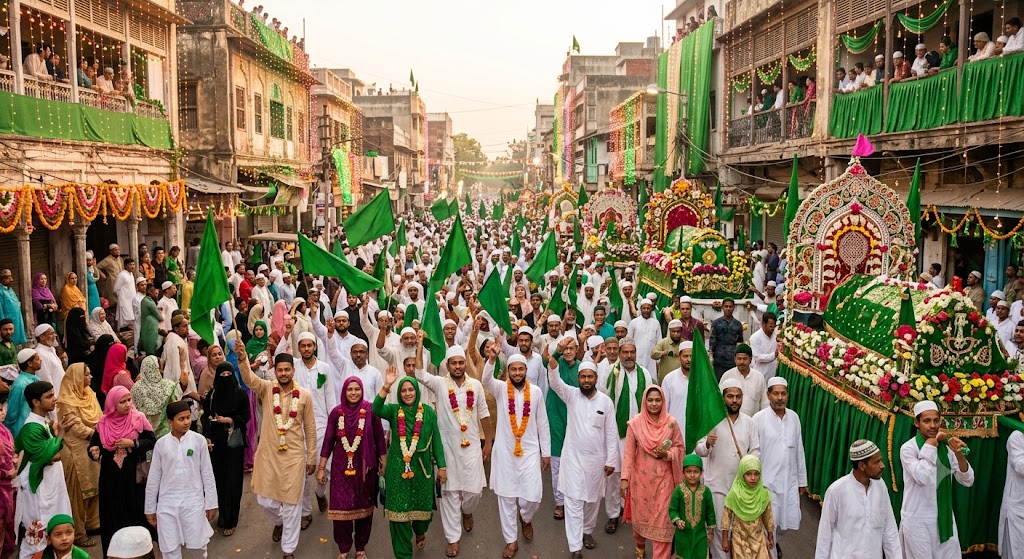
Every year, millions of Muslims across the world observe Eid-e-Milad, also known as Milad-un-Nabi, to commemorate the birth anniversary of Prophet Muhammad (PBUH). More than a festival, the occasion serves as a reminder of the values that the Prophet stood for throughout his life – kindness, honesty, compassion, justice and service to humanity.
The word “Milad” means birth, while “Nabi” means Prophet. The day is observed during the Islamic month of Rabi al-Awwal and holds deep spiritual significance for Muslims. Across India and many other countries, people gather in mosques, homes and community centres to remember the life and teachings of Prophet Muhammad.
On Eid-e-Milad, mosques and neighbourhoods are often decorated with lights and banners. Special prayers are organised, verses from the Holy Quran are recited and religious gatherings known as Mehfil-e-Milad are held. During these gatherings, scholars speak about the Prophet’s life while devotees recite Naats, devotional poems praising him.
One of the most visible aspects of the celebration is the community spirit it creates. In many cities, peaceful processions are taken out, carrying messages of harmony, brotherhood and faith. Families and friends come together, share meals and exchange greetings.
What truly makes Eid-e-Milad special is its emphasis on compassion. Many people choose the occasion to help those in need by distributing food, clothes and other essentials. Charity is considered an important way of honouring the Prophet’s teachings.
In recent years, several communities have also organised blood donation drives, health camps and social service activities on Eid-e-Milad. These initiatives reflect the belief that faith should inspire positive action and benefit society as a whole.
Another important message of Eid-e-Milad is respect for all human beings. Prophet Muhammad’s teachings encouraged people to treat others with dignity, regardless of their background, status or beliefs. His message of peace and mutual respect remains relevant even in today’s fast-changing world.
For young people, Eid-e-Milad can also be seen as a lesson in character building. The Prophet’s life highlights values such as truthfulness, patience, humility and responsibility – qualities that continue to inspire millions.
Beyond religion, the festival offers a universal message: societies become stronger when people choose kindness over hatred, understanding over division and service over selfishness.
As homes, mosques and streets light up during Eid-e-Milad, the true essence of the day lies not in decorations or celebrations alone, but in remembering a timeless message – a message of love, humanity, generosity and unity. In a world often marked by differences, Eid-e-Milad reminds us that compassion remains one of the most powerful forces for bringing people together.
Subscribe Deshwale on YouTube
