



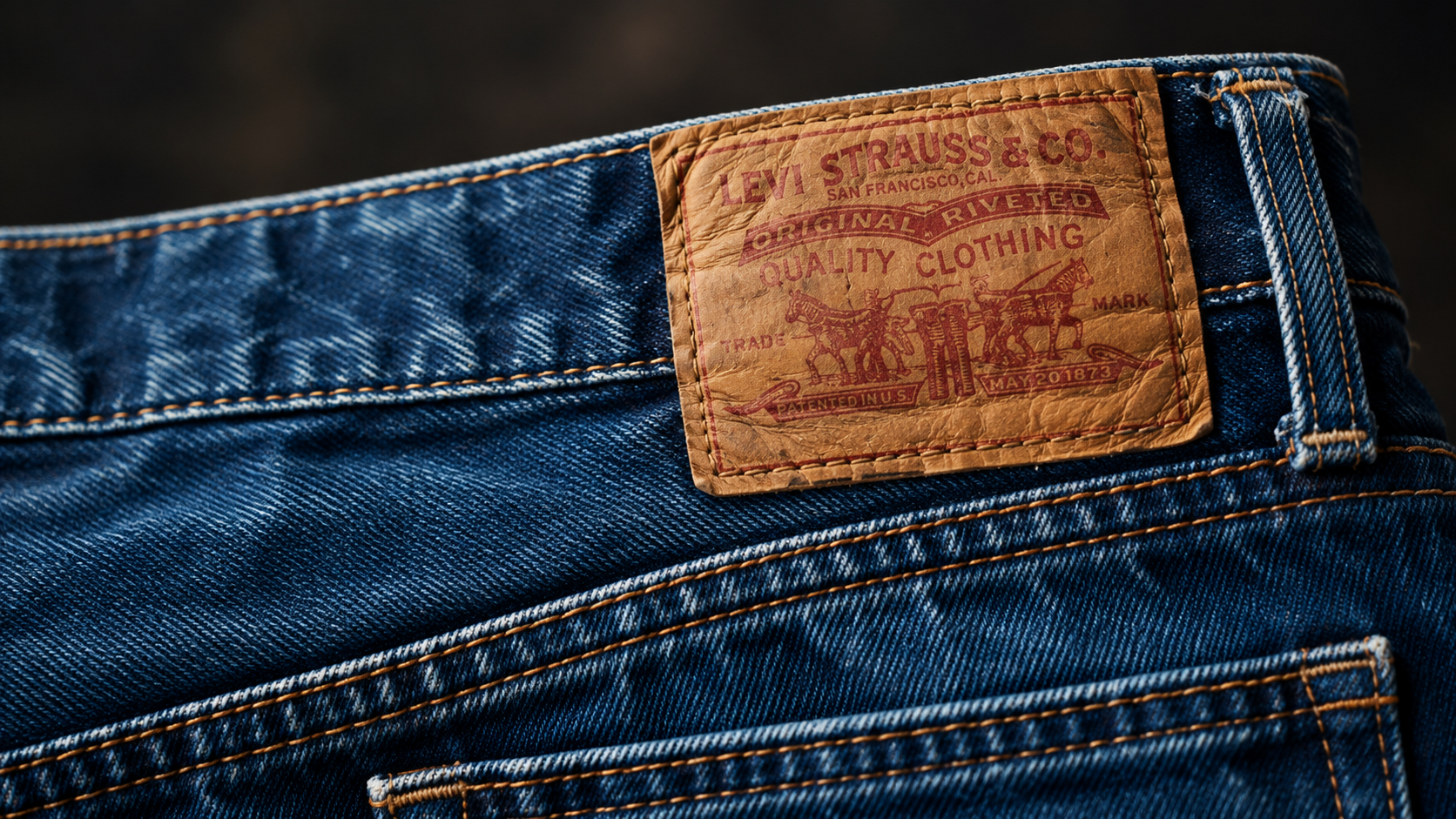
Look at the back of your jeans. Just below the waistband, there is a small square of leather, or something that looks like leather. Most of us have seen it a thousand times. Almost none of us have wondered why it is there.
It looks like a style choice. But that patch did not begin as decoration at all.
Its story starts in the 1800s, in America, with a pair of work trousers.
In 1873, a tailor named Jacob Davis and a businessman named Levi Strauss received a US patent for putting metal rivets on work pants. The rivets sat at the places that tore most often, like the corners of the pockets. The trousers became far stronger, and they eventually turned into the blue jeans we know today.
Strong trousers were a good idea. But they created a new problem. Once people saw how well they sold, others wanted to sell the same thing.
According to Levi Strauss & Co., the company introduced its Two Horse trademark in 1886. The picture shows two horses pulling in opposite directions, trying to tear a pair of jeans apart. The jeans do not tear.
Think about what that image was really saying. It did not need a single word. A buyer who could not read the brand name could still look at the picture and understand: these are the tough ones.
The picture was printed on a patch and stitched onto the back of the jeans. So the patch was never meant to make the jeans look good. It was meant to make them easy to recognise.
In simple terms, it worked like a signature. As more companies started making denim, a customer needed some way to tell whose jeans they were holding. The patch gave them one.
Think of it like the stamp on a coin or the seal on a letter. You do not buy a coin for the stamp. But the stamp is what tells you it is real.
So why leather? The answer is fairly practical. Leather lasts. A logo printed on cloth would fade and fray, but a leather patch could survive years of washing and wear. It also suited the rough, hard-working image of the product.
Here is something that surprises many people, though. The patch is not always leather. Levi’s own history says that in the 1950s the company moved away from real leather on some products and used a heavy, leather-like card stock instead. Over the years, brands have also used paper, fabric and synthetic materials.
That tells us something important. If jeans could carry on with a paper patch, the patch was never holding anything together.
This is a common mix-up. It is easy to assume the patch makes the jeans stronger. It may add a little reinforcement where it is stitched, but that is not its main job. The real strength comes from the denim itself, the stitching and, on some jeans, the metal rivets.
The patch has a different job. It tells you who made the jeans, and it connects them to a long history of workwear.
On many jeans, it can also carry useful details. Look closely at a traditional Levi’s patch and you will often find the style number and size printed on it.
One thing is worth remembering here. A patch is easy to copy. Anyone can stitch one onto a pair of jeans, so the patch alone cannot tell you whether a pair is genuine. Stitching, fabric, tags and the price you are paying all matter just as much.
That is the odd thing about a mark of trust. The more famous it becomes, the more people want to borrow it. A patch only means something because buyers have learned to link it with a particular maker.
Today, the patch is going through a quiet change. Some brands still use traditional leather. Others have switched to recycled paper or synthetic materials. A few modern styles leave the patch off completely.
That last point is worth thinking about. Jeans are now worn everywhere, by almost everyone, and they have travelled a very long way from their days as plain work trousers. Yet the patch is still here.
Part of the reason is habit. We expect to see it, and jeans can look a little bare without it. But part of it is also trust. For an old denim brand, the patch is a recognisable mark. The shape, the colour and the logo help a buyer know what they are looking at in a second.
Maybe that is why the patch has survived so many changes in fashion. Trends come and go, from baggy to skinny and back again, but this small mark has stayed put through almost all of them.
The next time you pull on a pair of jeans, take a moment to look at that patch. It is not there to be pretty. It began as a promise of strength, drawn for people who may never have read the name on the label.
That is the real reason.
Subscribe Deshwale on YouTube
