



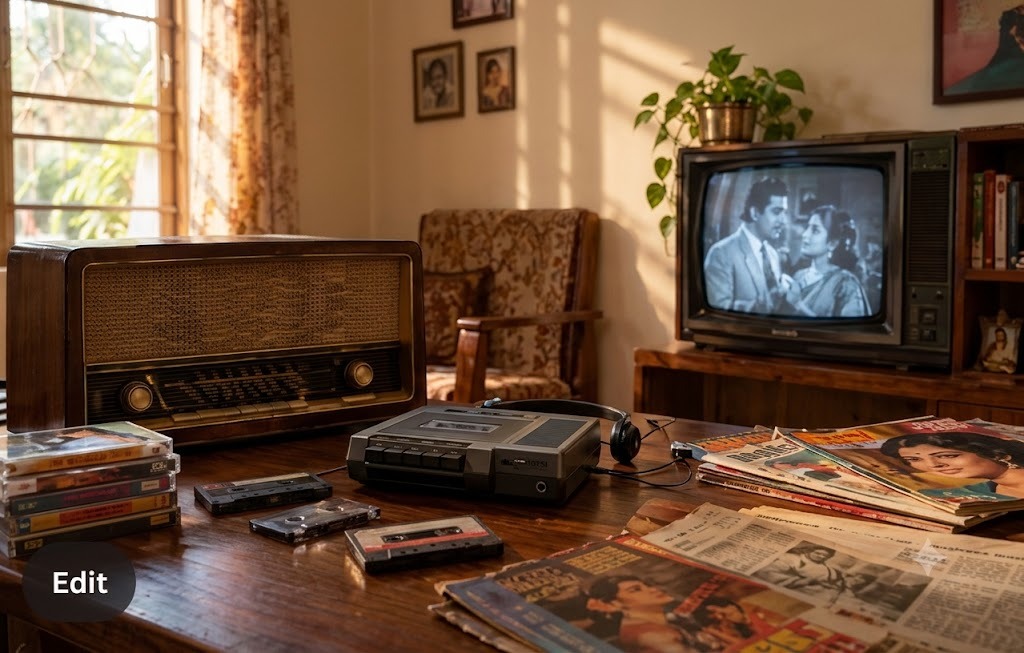
Imagine hearing a song you love but not knowing its name. You cannot search for its lyrics, watch its video or instantly identify the singer. You wait for it to play on the radio again, ask a friend or visit a music shop. For many Indians, discovering something new once involved patience, curiosity and help from people around them.
Before YouTube made music videos, film clips, interviews and tutorials available at the touch of a screen, India had its own ways of discovering entertainment and knowledge. Radio, cassette tapes, television, newspapers, magazines and conversations connected people with stories, sounds and ideas from across the country.
When Radio Made Songs Travel
For generations of listeners, radio was more than a household device. It was a way to discover singers, film music and voices beyond their immediate surroundings.
All India Radio launched Vividh Bharati on 3 October 1957. Its programmes included popular film music, short plays and other entertainment. Over time, programmes such as Chhaya Geet, Hawa Mahal and Aap Ki Farmaish became familiar names for listeners. Radio brought music into everyday routines, whether people were preparing meals, working in shops or relaxing at home.
A song could become popular with listeners before they knew the singer’s name or the film it belonged to. They might ask someone to identify it or wait for another broadcast to hear it again.
Sometimes, discovering a song began with nothing more than hearing it once and wanting to hear it again.
The Cassette That Travelled Between Friends
During the 1980s, cassette technology transformed India’s popular music culture. Portable cassette players and recordings gave listeners more control over what they heard. Music no longer depended entirely on a radio station’s schedule.
Music scholar Peter Manuel’s book Cassette Culture: Popular Music and Technology in North India (1993) documents how inexpensive cassette technology helped change India’s music industry. It opened opportunities for local producers and expanded the variety of music available, including regional and folk-based styles.
A cassette might contain film songs, devotional music, folk performances or a collection recorded for a friend. People could lend tapes, record music and carry their favourite songs on journeys.
This made music discovery a personal experience. Someone might hear an unfamiliar singer through a borrowed cassette and then recommend the same recording to another person. In this way, music travelled through friendships and family circles as well as commercial markets.
Before Film Clips Were Always Available
How did people decide which film to watch when they could not instantly browse trailers and online reviews?
Newspaper advertisements, cinema posters, film magazines, radio programmes and conversations helped audiences learn about upcoming releases. A song heard on the radio could create interest in the film it came from. A review or a friend’s recommendation might persuade someone to buy a cinema ticket.
Television added another route. Doordarshan began experimental broadcasts on 15 September 1959, initially reaching a limited audience. Its service expanded over the following decades. Colour broadcasting began with the Independence Day telecast on 15 August 1982, and the Asian Games hosted by New Delhi that November brought colour television to many more viewers.
Video cassette recorders and rental libraries later gave people more ways to watch films at home. Videocassettes, video libraries and informal video parlours expanded access to films beyond traditional cinema halls.
A film could therefore reach a viewer through a poster outside a theatre, a song on the radio, a rented cassette or a television broadcast.
How People Discovered New Ideas
Entertainment was only one part of the story. Newspapers, books, libraries, magazines and educational broadcasts helped people explore unfamiliar subjects.
Doordarshan’s early educational initiatives included the School Television Project, launched in Delhi in 1961. Later, the Satellite Instructional Television Experiment (SITE) of 1975–76, a joint ISRO–NASA effort, used satellite broadcasting to deliver educational programmes to villages across six states. The programmes covered subjects relevant to education and rural development.
Beyond television, a student might discover a new subject in a library book. A newspaper article could introduce a reader to a scientific development. A teacher might recommend an author, while a conversation with a knowledgeable neighbour could lead to a new interest.
These routes were not equally accessible to everyone, and finding information could take time. Yet they show that curiosity did not begin with the internet. People were already finding ways to learn, ask questions and explore ideas using the resources available to them.
The Discovery Was Often Shared
Today, a song can be identified in seconds, a film trailer can be watched almost anywhere and a tutorial can be replayed whenever needed. Online platforms have also made it easier for independent artists, regional creators and specialised subjects to reach new audiences.
Earlier ways of discovering culture offered a different experience. A friend introduced a song, a family member recommended a film, or a teacher pointed someone towards a book. The discovery often came with a conversation, a personal memory or a recommendation that made it worth exploring.
The past was not necessarily easier or better. Access depended on location, money and the technologies available at the time. But it reminds us that culture has always travelled through both media and human relationships.
Before YouTube, a song could arrive through a radio speaker, a film through a rented cassette and a new idea through a book or conversation. The technology has changed, but the moment of discovery remains familiar: we encounter something that catches our attention, and we want to know more.
Subscribe Deshwale on YouTube
