



The whole world is living in the 21st century, and in this modern age, most of us can hardly imagine life without technology.
But what if I told you that there is a village in our own India that has neither electricity nor internet?
You may think I am joking, because in today’s world, living without the internet seems impossible. But there is a Vedic village called Kurmagram in Andhra Pradesh.
Kurmagram is in Srikakulam district, roughly 110 kilometres from Visakhapatnam. Only 56 people live here, including 14 families and a few Krishna devotees. The village was founded in 2018 under the Nanda Gokulam Goshala Trust and spreads over about 60 acres.
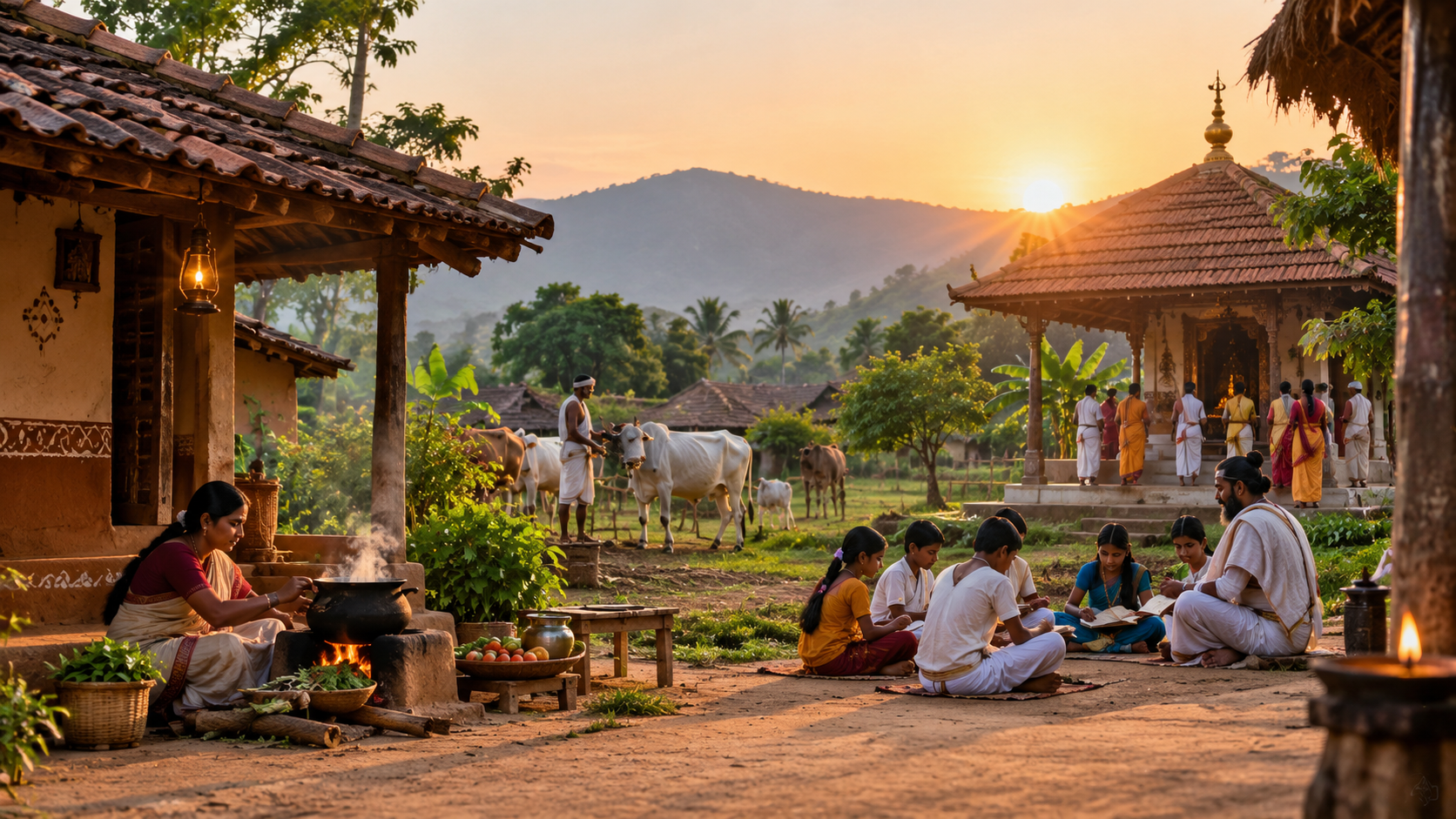
If you imagine that people here reach for their phones first thing in the morning, that could not be further from the truth. While our mornings begin with alarms and notifications, theirs begin with the Mangal Aarti. The day starts at Brahma Muhurta, around 3:30 a.m., and by 7:30 p.m. everyone is asleep. There is no electricity in the village, so oil lamps provide light. Food is cooked not on gas but on wood-fired stoves. According to one report, the entire village has just one basic mobile phone, used only for essential contact with the outside world. In short: no internet, no TV, no crowd of gadgets.
The houses are different too. They are built from mud, stone, brick, wood and lime, with no cement or iron. According to an ETV Bharat report, some huts are made from a mixture of sand, lime, jaggery and arhar dal. It may sound strange, but this is their way. For them, a home is not just a roof; it is a way of living in harmony with nature.
Clothing and food also come largely from the village’s own labour. According to one article, the residents weave their own clothes, and the women cook in a community kitchen. Visitors from outside are served a meal as prasadam. In other words, there is less buying and more making. Life here is certainly slower, but it carries the satisfaction of one’s own effort.
The people of Kurmagram grow their own grain. According to ETV Bharat, the village produced 198 sacks of grain in 2022, along with vegetables. The village also has a goshala and a Vedic gurukulam. Alongside English, Sanskrit, Telugu and Maths, children are taught scriptures such as the Bhagavad Gita, the Ramayana and the Mahabharata. According to the report, no fees are charged for their education.
The most interesting part is that these people have not chosen this life because of a lack of resources. According to reports, many residents come from well-off families, and some even left jobs in the IT sector to take this path. Their argument is that once electricity arrives, modern conveniences will follow gradually, and life will turn mechanical. It is, in a sense, a reverse journey: while the rest of the world moves forward, these people are deliberately walking backwards. Behind this thinking lies a religious conviction as well. This is a community rooted in Krishna bhakti, where aarti, mantra chanting and simplicity are part of the daily routine.
It is worth pausing here for perspective. The village has no internet or electricity, but it is not entirely cut off from the world either. There is one phone, outsiders visit, and the village’s stories have reached the media. Moreover, most of what is known about Kurmagram comes from the village’s own website and media reports. It should therefore be seen as the chosen way of life of a religious community, not as an ideal model for everyone.
Honestly, would we want to live like this? Probably not, and it isn’t necessary for everyone. Our jobs, education, healthcare and relationships are deeply tied to technology. Our day often begins with notifications and ends on a screen. The people of Kurmagram begin their day with aarti and end it at sunset. Still, Kurmagram leaves us with one question: are we running technology, or is technology running us? Perhaps we don’t need a life like Kurmagram’s, but there is no harm in staying away from the phone for a few hours each day.
Subscribe Deshwale on YouTube
