



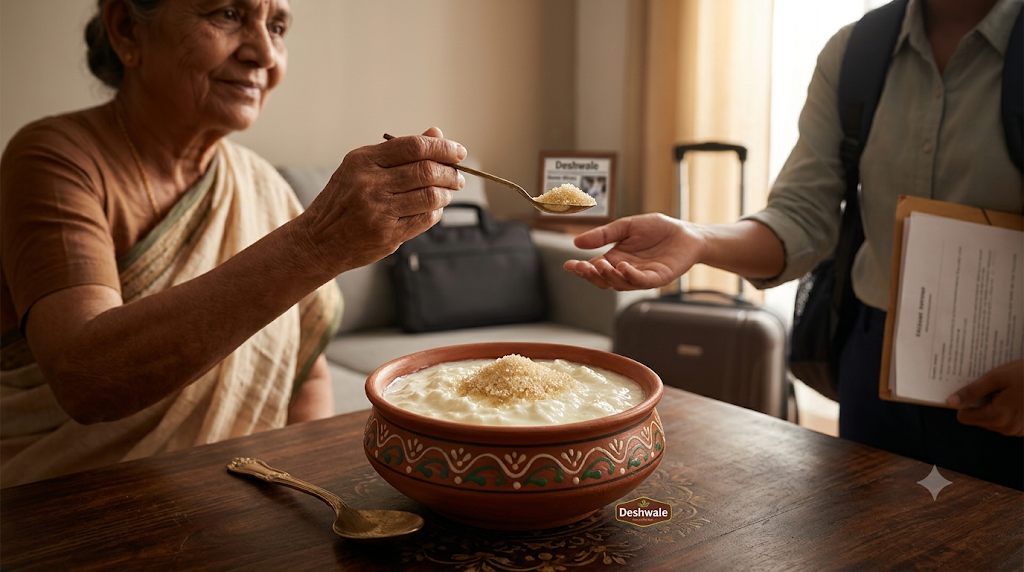
There is a familiar moment in many Indian homes. Someone is about to leave for an important task, begin something new or take the first step towards a long-awaited plan. Just before they walk out, a family member offers them a spoonful of curd, sometimes mixed with sugar.
“Kuch shubh kaam karne ja rahe ho toh dahi kha kar jaana,” they say.
It could be the first day at a new job, an examination, a business opening, a journey, a new purchase or even the beginning of a personal project. The reason may change, but the gesture remains familiar. For generations, many Indian families have believed that eating curd before beginning something auspicious is a way of inviting good fortune and positive beginnings.
But why curd? How did this simple food become connected with new beginnings, and why does the tradition continue even today?
More Than Just Something to Eat
In many Indian households, curd is associated with purity, nourishment and auspicious occasions. It is part of everyday meals, religious ceremonies and several traditional food practices.
The custom of eating curd before stepping out is particularly familiar in parts of northern and western India. It is commonly known as dahi-shakkar or dahi-cheeni, referring to curd mixed with sugar. However, the practice and its form can differ between families and regions.
The belief behind the custom is simple. Beginning something with an auspicious food is considered a positive sign. People eat it with the hope that their efforts will bring good results and that whatever they are about to begin will go smoothly.
For many families, it is also a way of seeking blessings before taking a new step. It is less about predicting what will happen and more about beginning with a positive thought.
Why Curd and Sugar Together?
Curd and sugar both have familiar places in Indian food traditions. Curd is valued as a nourishing food, while sweetness is commonly associated with happiness, celebrations and good news.
When combined, they carry a symbolic meaning. Curd is associated with auspiciousness and nourishment, while sugar represents the hope that whatever lies ahead will bring sweetness and happiness.
This connection can also be seen in everyday celebrations. When someone gets a new job, achieves something important or shares good news, families often distribute sweets. It is a simple way of sharing happiness with others.
Dahi-shakkar brings a similar feeling to the beginning of an activity. It is a small gesture that expresses the hope for a positive outcome.
A Tradition That Continues Beyond Family Kitchens
This custom is not limited to everyday family occasions. It has also been seen during important public events.
On 23 July 2024, President Droupadi Murmu offered curd and sugar to Finance Minister Nirmala Sitharaman before she left to present the Union Budget. A similar gesture was seen again before the 2025 Budget presentation.
These occasions offer a glimpse of how familiar cultural practices continue to find a place in public life.
At home, however, the moments are often more personal. Parents offer curd before their children leave for examinations. Families follow the custom before a new business venture, a housewarming ceremony or an important journey. Sometimes, even a small everyday decision becomes an occasion for this familiar gesture.
The circumstances may differ, but the intention remains the same: to begin something with hope and good wishes.
Is There a Practical Side to the Tradition?
Apart from its cultural meaning, curd and sugar also have nutritional value. Curd provides protein and calcium, while sugar supplies carbohydrates that the body can use for energy.
However, it would be incorrect to claim that eating dahi-shakkar guarantees success, removes nervousness or ensures that a task will go well. There is no established scientific evidence for such claims.
The tradition is better understood through the connection between food, belief and family encouragement. Eating something familiar before an important moment may also offer a little comfort, especially when someone is nervous or excited about what lies ahead.
Its meaning is cultural and emotional rather than a scientifically proven way of influencing outcomes.
A Spoonful of Tradition Before a New Beginning
Life has changed in many ways. People now begin businesses online, attend interviews through video calls, book journeys on their phones and make important decisions in a fast-moving world. Yet, in many homes, the familiar bowl of curd and sugar continues to appear before someone begins something new.
Not everyone follows this custom, and its form may vary. Some prefer plain curd, while others mix it with sugar. Some observe it as a cultural or religious practice, while others continue it simply because their parents and grandparents did the same.
Perhaps that is what makes this tradition special. A spoonful of curd cannot decide whether a new venture will succeed, an examination will go well or a journey will be smooth. But when someone offers it with a smile and says a few encouraging words, it becomes more than just food.
It becomes a family’s way of saying, “May everything go well. Begin with a positive heart.”
And sometimes, that little gesture is all the encouragement someone needs before taking their next step.
Subscribe Deshwale on YouTube
