



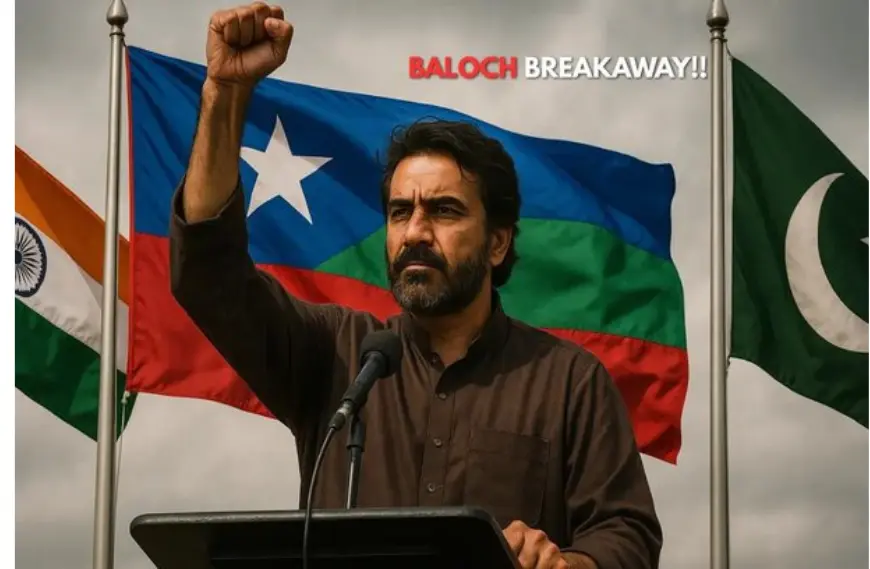
Balochistan Breaks Free: A New Republic Rises
Balochistan, Pakistan’s largest province, is in uproar. Leaders have declared independence, proclaiming the “Republic of Balochistan.” Social media platforms buzz with the hashtag #BalochistanIsNotPakistan. The announcement, led by activist Mir Yar Baloch, marks a bold escalation in the region’s decades-long struggle.
The roots trace back to 1948. Balochistan, once the princely state of Kalat, was annexed by Pakistan. Many Baloch view this as forced occupation. Since then, insurgencies have flared, driven by demands for autonomy or outright independence. The region, rich in gas, minerals, and coastline, remains Pakistan’s poorest. Locals accuse Islamabad of exploitation, leaving them with little benefit.
On 9 May 2025, Mir Yar Baloch posted on X, declaring independence. He urged India to open a Baloch embassy in New Delhi. He also called for the Pakistani army to withdraw and requested UN peacekeeping forces. His posts sparked a viral trend, with maps and flags of an independent Balochistan flooding online.
Hyrbyair Marri, leader of the Free Balochistan Movement, added fuel. From London, he suggested India rename Jinnah’s House in Mumbai as “Balochistan House.” Marri argued the site, where Pakistan’s founder planned India’s partition, should now symbolise Baloch freedom.
The Baloch Liberation Army (BLA), a key separatist group, intensified the conflict. Labelled a terrorist organisation by Pakistan, the BLA claimed responsibility for 71 attacks across 51 locations. Dubbed “Operation Herof,” these strikes hit military bases, police stations, and infrastructure tied to the China-Pakistan Economic Corridor (CPEC). The BLA’s spokesperson, Jeeyand Baloch, rejected claims of foreign backing, insisting the group fights for self-determination.
Tensions spiked after the killing of Tariq Baloch, a prominent rally driver. Activists allege Pakistan’s “kill and dump” policy, where dissenters are abducted, tortured, and left dead. The Baloch Yakjehti Committee (BYC) condemned the murder of Fahad Lehri, a student, on 15 May 2025. Lehri was abducted on 4 May, his body later found riddled with bullets. The BYC called it part of a systematic campaign to silence Baloch voices.
On the same day, a seven-year-old girl, Rokia Baloch, died from gunshot wounds in Panjgur. The BYC blamed Pakistan’s Frontier Corps for firing indiscriminately. These incidents have galvanised protests, with crowds chanting, “Balochistan is not Pakistan.”
The declaration has geopolitical ripples. Baloch leaders seek UN recognition and international aid to stabilise their fledgling republic. They’ve announced a national anthem, emblem, and visa-on-arrival for Indians, though implementation remains unclear. Mir Yar Baloch even proposed a cricket match between India and Balochistan, suggesting Gwadar or Delhi as venues.
India’s role is pivotal. Baloch leaders express solidarity with New Delhi, especially after recent India-Pakistan tensions. They back India’s call for Pakistan to vacate Pakistan-occupied Kashmir. Some Indian platforms have echoed the #BalochistanIsNotPakistan trend, amplifying the cause.
Pakistan faces a crisis. The declaration challenges its territorial integrity. Balochistan’s Gwadar Port, a CPEC cornerstone, is strategically vital for China. The unrest threatens Beijing’s investments, raising concerns in Islamabad and beyond.
Despite the momentum, hurdles remain. No country has officially recognised the Republic of Balochistan. The declaration, while symbolic, lacks formal statehood mechanisms. Pakistan’s response is awaited, but military crackdowns are likely.
The Baloch movement is undeterred. “Bullets may bury bodies, but they cannot bury truth,” the BYC stated. As social media amplifies their cause, the world watches. Will Balochistan emerge as a new nation, or will Pakistan quash the rebellion? Only time will tell.
