










From the Margins to the Main Contest: The Rise of the BJP in West Bengal
For decades, the political contest in West Bengal appeared to revolve around two principal forces: the communist establishment led by the Communist Party of India (Marxist) and the regional mobilisation spearheaded by Mamata Banerjee through the All India Trinamool Congress. Yet within a decade of the Left’s electoral collapse in 2011, an unexpected challenger had emerged as the principal rival to Banerjee’s political dominance.
That challenger was the Bharatiya Janata Party.
The rise of the BJP in Bengal represents one of the most striking shifts in the state’s contemporary political history. A party that had once been electorally marginal in the region gradually transformed itself into the central pole of opposition politics, fundamentally altering the electoral geometry of the state.
A Historically Weak Presence
For most of the post-independence period, the Bharatiya Janata Party and its ideological predecessors struggled to gain traction in Bengal. The state’s political culture was shaped by intellectual traditions, labour movements, and ideological debates that favoured socialist and secular narratives.
Even during the expansion of the BJP in northern and western India in the 1990s, Bengal remained largely resistant. The party lacked both organisational depth and influential regional leadership capable of mobilising large sections of the electorate.
As a result, the political landscape in Bengal remained dominated by the Left and, later, by the rising influence of the All India Trinamool Congress.
The Political Vacuum After the Left
The decisive defeat of the Left Front in 2011 created a structural vacuum in opposition politics. While the Communist Party of India (Marxist) retained pockets of influence, its organisational morale and electoral strength had been severely weakened.
At the same time, the Indian National Congress, once the state’s principal national party, had already been reduced to a marginal role. Much of its traditional voter base had been absorbed by the Trinamool Congress during the rise of Mamata Banerjee.
In this environment, Bengal’s political system gradually shifted toward a new dynamic: the search for a credible counterweight to Banerjee’s expanding authority.
The Impact of National Political Transformation
The broader transformation of Indian politics during the 2010s also played a significant role. The electoral victory of Narendra Modi in the 2014 general elections provided the BJP with unprecedented national momentum.
Under Modi’s leadership, the party pursued an ambitious strategy of expanding into regions where it had historically remained weak. Bengal became one of the most important arenas in this effort.
The BJP began to invest heavily in organisational expansion across the state. Party workers sought to establish networks in districts that had previously been dominated by the Left or the Trinamool Congress. Over time, this groundwork began to produce electoral dividends.
Electoral Breakthrough
The transformation became visible in the parliamentary elections of 2014. Although the Trinamool Congress remained dominant, the BJP recorded a noticeable increase in vote share and secured two seats in the Lok Sabha from Bengal.
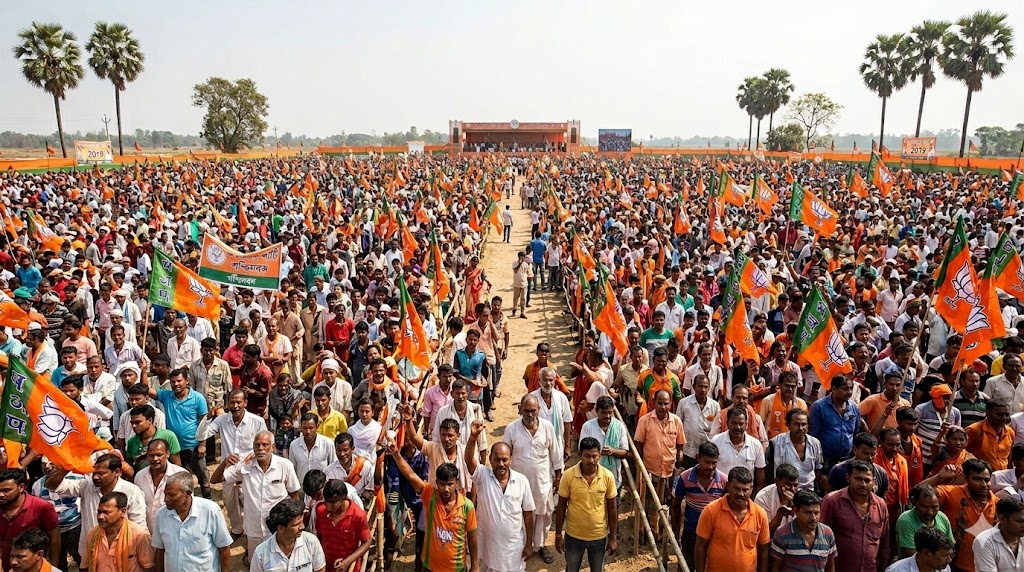
What initially appeared as a modest breakthrough soon evolved into a more dramatic shift. By the time of the 2019 parliamentary elections, the BJP had expanded its presence significantly across the state.
In that election, the party won eighteen parliamentary constituencies in West Bengal, a remarkable rise for a party that had once struggled to register a meaningful electoral presence in the region.
Realignment of the Opposition Vote
One of the most important drivers of the BJP’s rise was the realignment of the anti-Trinamool vote. As the electoral strength of the Left and the Congress declined, many voters seeking an alternative to Banerjee’s government began consolidating behind the BJP.
In several districts, former supporters of the Communist Party of India (Marxist) shifted toward the BJP, attracted by the party’s promise of political change and stronger central leadership.
This transfer of political allegiance marked a significant reconfiguration of Bengal’s electoral landscape.
Identity, Governance, and Political Messaging
The BJP also attempted to reshape political discourse in Bengal by emphasising issues related to governance, political violence, and identity politics. Party leaders frequently criticised the Trinamool Congress government for alleged administrative irregularities and law-and-order concerns.
At the same time, the BJP’s campaign strategy sought to appeal to voters who felt that regional politics had become excessively personalised around Mamata Banerjee’s leadership.
Through a combination of organisational expansion, national leadership visibility, and strategic messaging, the party succeeded in establishing itself as the most formidable opposition force in the state.
The High-Stakes Contest of 2021
The growing rivalry between the BJP and the Trinamool Congress reached its most intense phase during the 2021 state assembly elections in West Bengal.
The campaign became one of the most closely watched political contests in India. National leaders from across the political spectrum participated in the campaign, transforming the election into a symbolic battle over the political future of Bengal.
Ultimately, the Trinamool Congress led by Mamata Banerjee retained power with a decisive mandate. However, the BJP emerged as the principal opposition party in the state assembly, displacing both the Left and the Congress.
A New Bipolar Political Order
The rise of the BJP has fundamentally altered the political configuration of West Bengal. The state’s politics, once defined by the long dominance of the Left and later by the ascendancy of the Trinamool Congress, has gradually evolved into a bipolar contest between Banerjee’s regional party and a nationally dominant challenger.
This transformation has introduced a new intensity to Bengal’s political competition, reshaping electoral strategies and political discourse across the state.


