









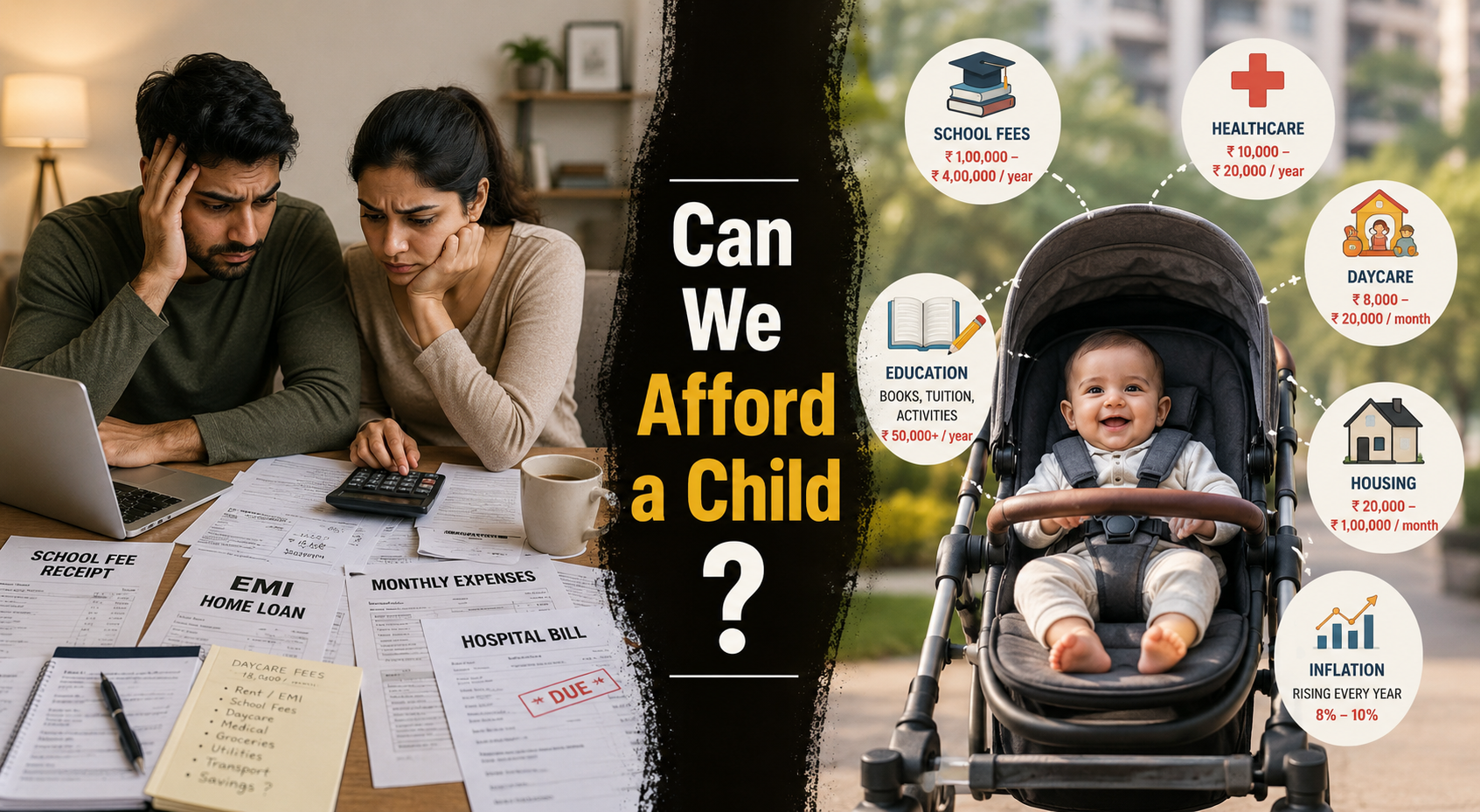
India’s fertility rate has fallen to 1.9 and for millions of city-dwelling millennials, the reason isn’t complicated. A child has simply become too expensive.
Priya Mehta, a 31-year-old marketing professional in Mumbai, earns a decent salary. Her husband works in tech. Together, they bring home around ₹2 lakh a month. On paper, they are exactly the kind of couple you would expect to start a family without much hesitation. But for the past two years, they have been doing the math and the math keeps saying the same thing: not yet, maybe not ever.
“We sat down one evening and actually wrote out what a baby would cost us in this city,” she says. “By the time we finished, we were too scared to even talk about it for a week.”
Priya’s story is not unusual. Across India’s cities, a quiet but seismic shift is underway. The country’s Total Fertility Rate has dropped to 1.9 children per woman, according to the latest Sample Registration System report released in May 2026 below the 2.1 replacement level, a threshold India has now been under for five consecutive years. In urban India, the number is even lower, sitting at just 1.5. And Delhi, the capital, has fallen all the way to 1.2.
Demographers will cite education, contraception, and women’s agency all of which matter. But ask a young couple in Bengaluru or Mumbai why they are delaying or rethinking parenthood, and the answer is almost always the same. Money.
It starts before the baby even arrives
The cost of having a child in India’s metros begins well before the birth certificate. A normal delivery at a private hospital in Mumbai costs anywhere between ₹60,000 and ₹1 lakh. A C-section, now the most common delivery method in urban hospitals, can run anywhere from ₹75,000 at a mid-range facility to ₹2.5 — 4.5 lakh at a premium hospital. Add prenatal checkups, scans, medications, and a few months of maternity wear, and a couple can easily spend ₹1–2 lakh before the baby has taken its first breath.
Then comes daycare. For working mothers in Tier-1 cities who cannot afford to step away from their careers, a creche or daycare facility in Mumbai or Bengaluru costs between ₹8,000 and ₹20,000 a month. That is ₹1–2.4 lakh per year before the child is old enough to even sit upright.
School fees that would make your head spin
The real sticker shock comes when the child is ready for school. A survey by LocalCircles, which drew over 27,000 responses across 312 districts, found that annual school fees in Tier-1 and Tier-2 cities range between ₹1 lakh and ₹4 lakh. In Bengaluru, one private school recently charged ₹2.1 lakh per year for a Class 3 student. An international school in the same city quoted ₹7.35 lakh for Class 1, rising to ₹11 lakh for Classes 11 and 12. A Reddit user in the city highlighted a preschool charging over ₹1.85 lakh annually for a child who has not yet learned to read.
Even mid-range ICSE schools in Mumbai routinely charge ₹1.5–5 lakh per year. And these fees are not staying still. According to a BankBazaar report, education costs in India are rising at 8–10 per cent annually, nearly double the general inflation rate. The Ministry of Statistics recorded education inflation at 7.2 per cent in September 2024. Some schools are hiking fees by 30–50 per cent in just two years, according to the LocalCircles survey.
“We normally see about a 15 per cent increase in school fees every year,” one Bengaluru parent told the Deccan Herald. Their child’s annual school cost? Close to ₹3 lakh all inclusive.
The hidden costs nobody warns you about
School fees are only the visible part of the iceberg. Add tuitions and coaching classes, extracurricular activities, school transportation, annual books and stationery, and the bill climbs quickly. A Mumbai couple with an eight-year-old son reportedly spends ₹1.72 lakh annually on school fees, around ₹2,000 a month on extracurricular activities, ₹10,000–12,000 a year on medical expenses, and ₹20,000–24,000 on clothing alone.
Urban families also spend significantly more on healthcare. Children fall sick. Pediatric consultations, vaccinations, and the occasional hospital visit add up especially in cities where private healthcare is the default for the middle class.
When Bengaluru-based entrepreneur Meenal Goel ran the full numbers for a middle-class urban family and shared them in a viral LinkedIn post in 2025, her estimate came to roughly ₹45 lakh to raise one child to adulthood in a metro city. The post was shared thousands of times. The reaction was not surprising. It was recognition.
Two incomes are no longer enough
What makes this conversation sharper today is that it is happening among people who, by any traditional measure, should be financially comfortable. These are not struggling families. These are double-income households in India’s most prosperous cities.
But city life has its own economy. Rents in Mumbai and Bengaluru have surged. EMIs eat deep into monthly salaries. And unlike previous generations, today’s urban parents are expected to provide more than a roof and meals, private school education, foreign language classes, coding camps, sports coaching. The aspirational cost of parenting has ballooned even as the middle class itself feels increasingly squeezed.
One IT couple in Bengaluru, both earning a combined ₹50 lakh a year, noted online that they would still struggle to afford a good international school for even two children. That observation went viral because it resonated so widely.
A demographic turning point
India spent five decades trying to slow down population growth. Governments ran campaigns. Policies were drafted. And it worked perhaps more thoroughly than anyone expected.
The TFR decline has been sharpest in the cities. Urban India’s fertility rate of 1.5 is now comparable to several ageing European societies. Delhi at 1.2 sits closer to South Korea (0.75) and Taiwan (0.86) than to its own national average. The southern states of Tamil Nadu and Kerala, long celebrated for their development outcomes, sit at 1.3. Meanwhile, Bihar records the highest TFR at 2.9, followed by Uttar Pradesh at 2.6 reflecting the deep divide between India’s north and south.
What India is learning, slowly and somewhat painfully, is that once the economics of parenthood shift, they are very hard to reverse. Andhra Pradesh has begun offering ₹30,000 for families who have a third child and ₹40,000 for a fourth. But no government payment has yet managed to compete with the weight of a school fee receipt.
Back in Mumbai, Priya and her husband are still doing the math. They have not ruled out having a child. But they are waiting for a better salary, a bigger house, a city that feels a little less expensive. They are not alone. And that, more than any fertility statistic, is the real story of India’s changing population.
Subscribe Deshwale on YouTube


