










There are novels that entertain. There are novels that illuminate history. And then there are novels that become mirrors reflecting not just the society they describe, but the prejudices of the age that produced them.
The Adventures of Hajji Baba of Ispahan belongs to this rare and controversial class.
Published in 1824, the novel turned an obscure Persian barber’s son into one of the most memorable rogues in world literature. Its creator, British diplomat James Justinian Morier, had spent years in Qajar Persia and channelled his experiences into a sweeping picaresque adventure filled with trickery, humour, danger and political satire.
Yet Hajji Baba is far more than an entertaining rascal. For nearly two centuries he has remained one of literature’s most debated characters. To British readers of the nineteenth century, he represented “the Persian character.” To many Persians, he represented a caricature shaped by colonial eyes.
A barber’s son who refused to remain ordinary
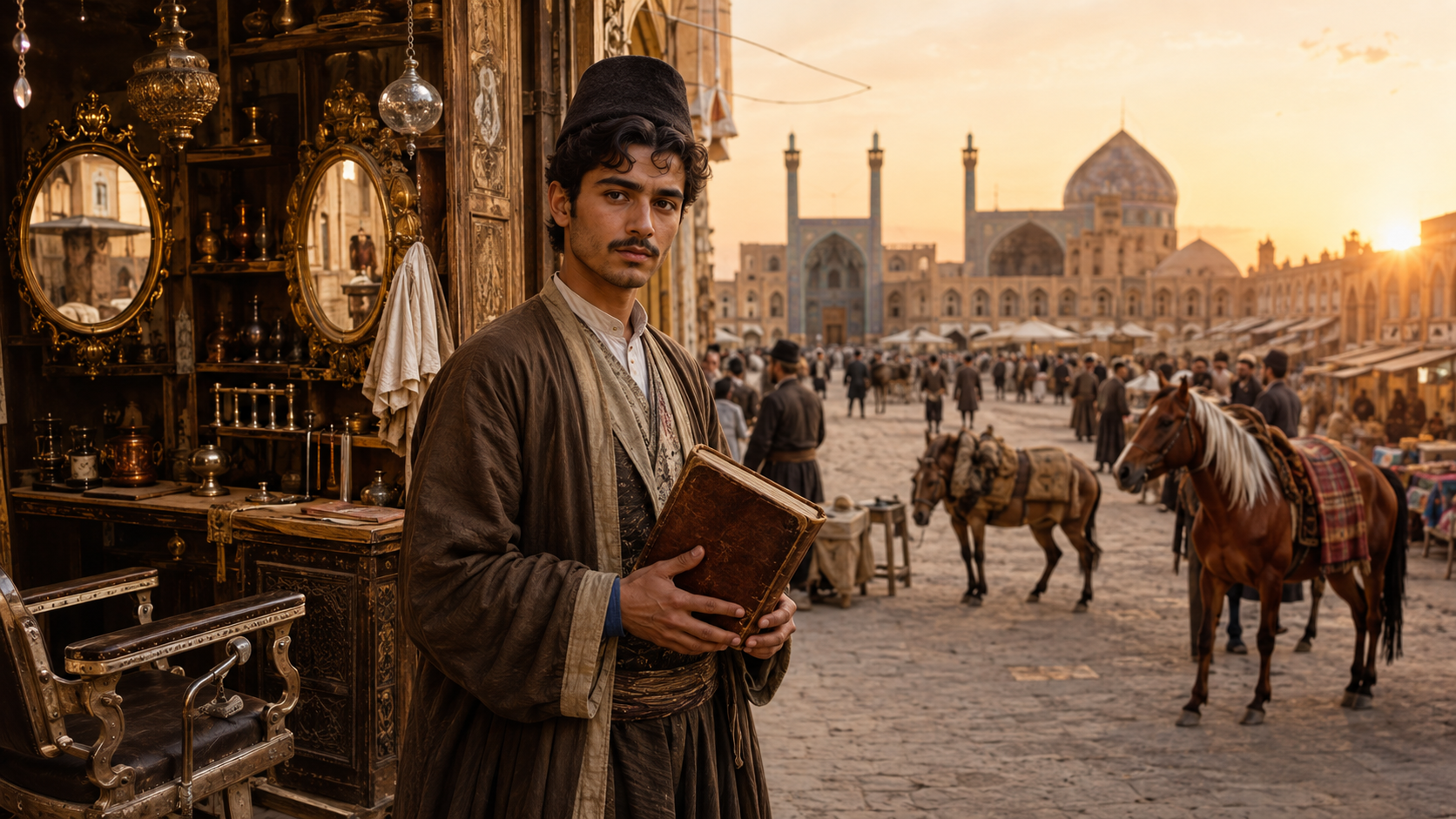
Great adventure heroes are rarely born into privilege. Robin Hood is an outlaw. Don Quixote is an impoverished gentleman. Hajji Baba begins life even more modestly, as the son of a barber in the ancient city of Isfahan.
Barbers in old Persia were far more than hair-cutters. They doubled as surgeons, dentists, storytellers and political gossip-collectors; the barber’s shop functioned as a miniature newsroom. Young Hajji grows up surrounded by conversation rather than wealth, and learns early that intelligence is often more profitable than honesty. That single insight drives the entire novel.
Fortune favours the quick-witted
Unlike traditional heroes, Hajji Baba has no extraordinary strength. He is neither a fearless warrior nor an idealistic philosopher. His only real weapon is adaptability.
Across his journey he becomes, at various points, a barber, prisoner, merchant, physician, robber, diplomat and courtier. Each profession teaches him something new about human nature: greed, vanity, fear, ambition. He survives not because fate is kind, but because he reads people the way an experienced chess player reads the board.
Persia as seen through British eyes
When Victorian readers encountered Hajji Baba, they believed they were reading an authentic portrait of Persia. Morier’s years in the country gave his descriptions of caravan routes, markets, royal courts and religious scholars remarkable texture.
But detail is not the same as fairness. Scholars have long pointed out that Morier’s novel repeatedly casts Persians as cunning, dishonest and morally unreliable, a reflection of the Orientalist attitudes common in nineteenth-century Europe. This is what makes the book historically significant: it reveals as much about how the British Empire viewed the East as it does about Persia itself.
A story that refused to die
Most nineteenth-century bestsellers vanished long ago. Hajji Baba did not. French and German translations appeared within the same year as the original, and the book’s success led Morier to write a sequel, Hajji Baba of Ispahan in England, in 1828.
Its most surprising afterlife unfolded inside Iran. Decades after publication, Persian writer Mirza Habib Isfahani translated the novel into Persian and his 1886 version is now considered one of the masterpieces of nineteenth-century Persian prose in its own right, admired even by readers who objected to how the book portrayed their country.
That is one of literature’s great paradoxes: a novel accused of mocking Persians became genuinely beloved in Persian partly because of the sheer craft of its translator.
Hollywood comes calling
The story’s staying power eventually reached the screen. In 1954, Hollywood released The Adventures of Hajji Baba, directed by Don Weis and starring John Derek, credited in its titles as “suggested by” Morier’s novel.
The film borrows the hero’s name and setting but takes considerable liberties, turning the picaresque satire into a colourful adventure-romance built around a runaway princess and a stolen emerald ring. It is less a faithful adaptation than a Hollywood reinvention proof that Hajji Baba’s basic appeal, a clever underdog talking his way through danger, could survive translation into an entirely different medium and century.
Why readers still love him
Strip away the political controversy and the historical arguments, and Hajji Baba remains irresistibly entertaining. Every chapter brings another crisis. Every crisis demands another deception. Every deception opens another adventure.
His flaws, sometimes selfish, sometimes dishonest, occasionally immoral, never cost him the reader’s attention, because he possesses one quality that never fails: he never stops moving. Life knocks him down, and he simply invents another identity.
Every great classic rewards two readings once for the story, once for the society that produced it. The Adventures of Hajji Baba holds up on both counts. As adventure fiction, it remains lively and inventive. As history, it reveals exactly how nineteenth-century Europe imagined the East.
Very few novels manage both at once. Perhaps that is why, two centuries on, Hajji Baba still refuses to retire carrying with him, across languages and generations, equal measures of laughter, controversy and literary brilliance.
Subscribe Deshwale on YouTube


