




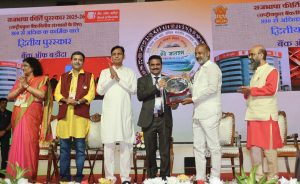




On the occasion of World Menstrual Hygiene Day last week, Delhi Chief Minister Rekha Gupta held a virtual meeting with principals of government schools across the capital. The agenda was not about textbooks, exam results, or teacher shortages. It was about toilets, sanitary pads, and the silence that surrounds a girl’s period. The government announced dedicated “Menstruation Corners” in every school’s private spaces stocked with sanitary napkins, clean water, and basic supplies. Vending machines for sanitary pads will be fast-tracked in school washrooms. A toll-free helpline for students and parents will be displayed on school walls and gates. And 1,000 new toilet blocks have been set up across Delhi schools.
It sounds ambitious. It also sounds, to anyone familiar with the ground reality of India’s government schools, overdue.
The numbers behind the crisis
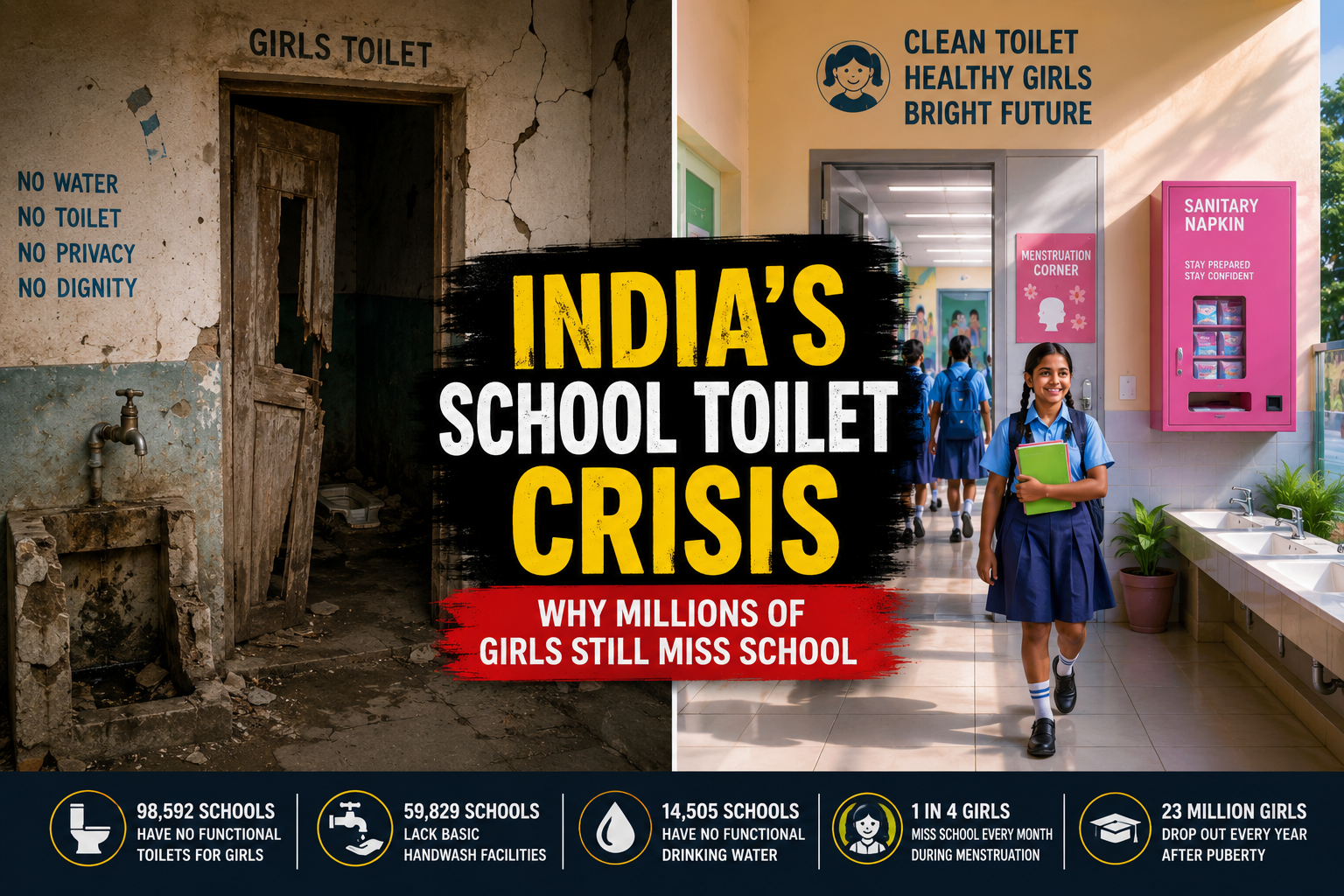
A NITI Aayog report released on May 6, 2026, based on UDISE+ data for 2024-25, put the state of school sanitation in stark terms. India has over 14.71 lakh schools serving nearly 24.69 crore students. Of these, 98,592 schools do not have functional toilets for girls. Another 61,540 schools have no usable toilets at all. Close to 59,829 schools lack even basic handwashing facilities. And 14,505 schools have no functional drinking water source on their premises.
The government has made progress; the share of schools with functional toilets rose from 85.17 percent in 2014 to 94 percent in 2024-25. But progress on paper does not always mean progress on the ground. A CAG audit of toilets built under the Swachh Vidyalaya Abhiyan found that nearly 40 percent of toilets surveyed were non-existent, partially constructed, or unused, and over 70 percent did not have running water. A toilet that exists on a government form but has a broken door, no water supply, and no lock is not a toilet any girl is going to use.
Why Girls Bear the Heaviest Cost
When a school has no toilet, boys find a way to manage. Girls, especially adolescent girls, often cannot. The consequences fall hardest on them and they fall quietly, without complaint, in the form of absences that pile up month after month.
According to a meta-analysis of 138 studies involving over 97,000 girls across India, one in four girls between the ages of 10 and 19 misses school every month because of her period. The reasons are straightforward no private space to change, no way to dispose of sanitary products, no water to wash up, and no guarantee that a stained uniform will not lead to teasing or humiliation. Some girls drink less water during school hours deliberately, to avoid needing a toilet they know does not work properly. That habit affects concentration, health, and in the long run, their ability to stay in the classroom.
The dropout numbers make this concrete. According to a Dasra report, approximately 23 million girls drop out of school every year in India after reaching puberty, with lack of proper menstrual hygiene facilities cited as a key reason. A UNICEF study found that over 71 percent of adolescent girls had no knowledge of menstruation before their first period. That first experience, confusing, often frightening, with nowhere to go and no one to speak to, can be enough to push a girl out of school permanently.
The official UDISE+ 2024-25 data released by the Ministry of Education shows that the dropout rate at the secondary level stands at 8.2 percent down from 10.9 percent the previous year. That is the stage when girls are hitting puberty, when the absence of a clean, private toilet matters most. The connection is not incidental.
A problem of maintenance, not just construction
India has spent years building toilets in schools. The Swachh Vidyalaya Initiative, launched in 2014, resulted in the construction or restoration of over 4.17 lakh toilet units in more than 2.61 lakh government schools. States like Delhi, Goa, and Puducherry have achieved 100 percent coverage in terms of having separate girls’ toilets on record.
But the real problem has always been maintenance, not construction. Toilets get built and then left to deteriorate. Doors fall off hinges. Taps run dry. Locks break. Cleaning stops. A school can technically report full sanitation coverage while its girls quietly stop using a facility that is no longer safe or functional. Delhi CM Rekha Gupta herself acknowledged this during her interaction with school principals she expressed concern over damaged toilet facilities in some schools and directed officials to ensure cleanliness and timely repairs.
This is not a new observation. It has been flagged in government reports, court hearings, and independent surveys for over a decade. The Supreme Court has previously directed states to submit menstrual hygiene plans and formulate models for building toilets proportionate to the number of girl students. Progress has been uneven. States like Tamil Nadu and Kerala have demonstrated better outcomes through consistent school-based sanitation and menstrual health programs. Bihar, Jharkhand, and Uttar Pradesh continue to lag significantly.
What good infrastructure actually changes
The research on this is unambiguous. When schools have clean, private, functional toilets for girls with water, waste disposal, and working locks attendance improves. A study conducted across government schools in Tamil Nadu, Maharashtra, and Chhattisgarh found that girls in schools with adequate sanitation facilities reported significantly lower absenteeism during menstruation compared to those in schools without proper facilities. The same study found that access to disposable pads at school and pain medication also reduced absences substantially.
These are not complicated interventions. They do not require new technology or significant policy innovation. They require maintained infrastructure, consistent supply chains, and the basic acknowledgment that a girl’s ability to attend school on every day of the month is a matter of dignity, not a hygiene footnote.
Beyond the toilet
Delhi’s latest initiative goes beyond construction. It includes awareness campaigns for both boys and girls, a deliberate move to reduce the stigma that often makes girls reluctant to report problems or ask for help. It includes HPV vaccination tracking, medical rooms, and a helpline. It treats menstrual health as part of the educational environment, not as a separate welfare concern.
That framing matters. Girls do not miss school simply because there is no toilet. They miss school because no toilet is part of a broader message that the system was not built with them in mind. Every broken door, every dry tap, every school that goes through the school day without once acknowledging that half its students menstruate all of it adds up to an environment where a girl learns, quietly, that her presence is conditional.
India’s school system has 24.69 crore students. Half of them are girls. Building a toilet and keeping it functional is not an extraordinary task. It is the minimum. And until that minimum is reliably met across every school in every state, no amount of progress in enrolment numbers or learning outcomes will tell the full story of what education in India actually looks like for girls.
Subscribe Deshwale on YouTube


