









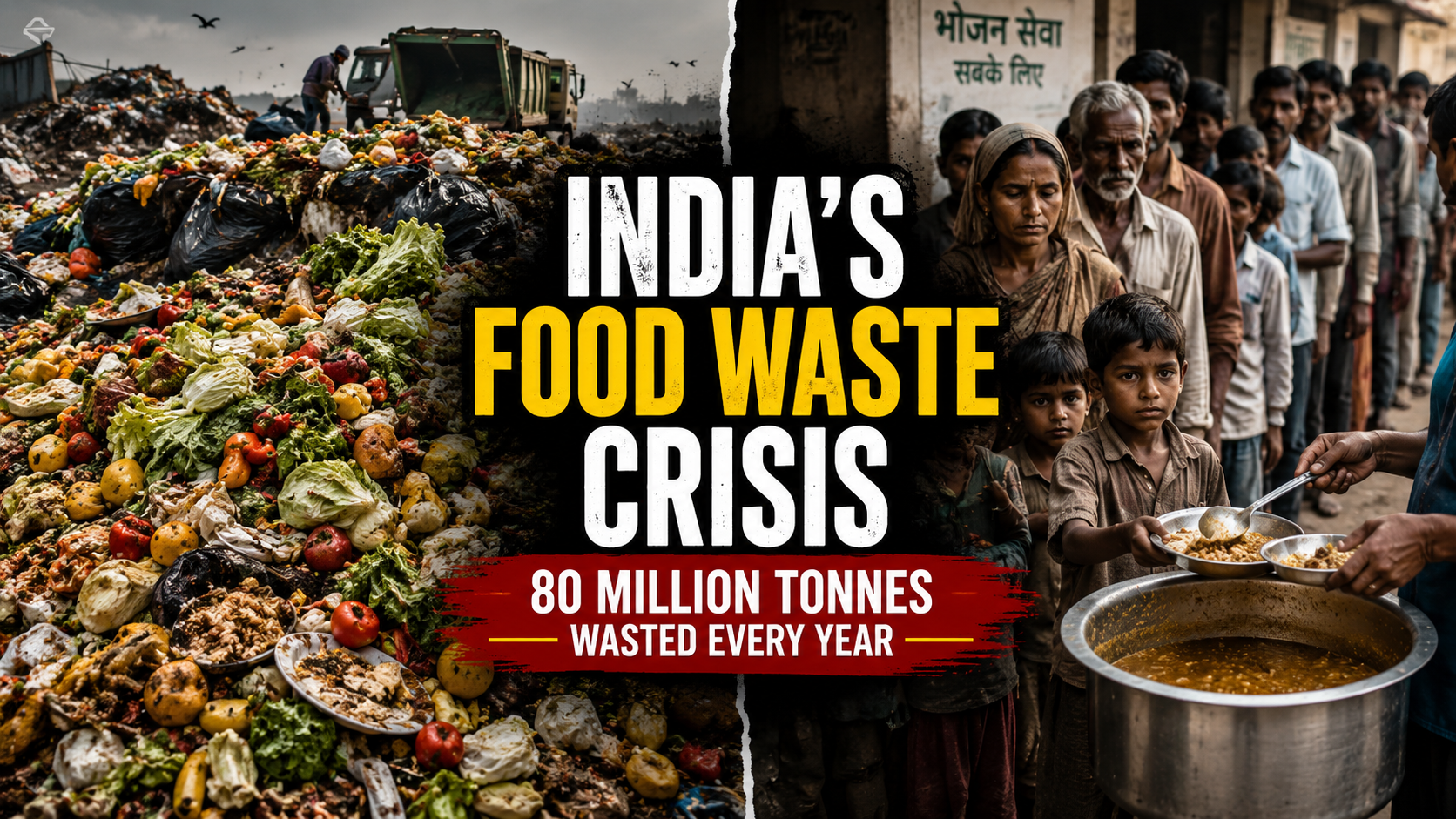
While scientists at Stanford University are turning food scraps into cheese using fermentation, India one of the world’s largest food producers is quietly dealing with a food waste problem of staggering proportions. The irony is hard to ignore: a country where millions go to bed hungry every night is also one of the biggest food-wasting nations on the planet.
The Numbers Tell a Painful Story
According to the UNEP Food Waste Index 2024, India wastes 78 to 80 million tonnes of food every year, worth approximately ₹1.55 lakh crore. To put that in perspective, that is enough food to feed a large portion of the country’s population for an entire year.
What makes this even harder to accept is the human cost behind these numbers. Even as India discards tens of millions of tonnes of food annually, around 194 million people in the country remain undernourished. A nation that grows enough food to feed its people and export to the world is simultaneously letting that food rot.
The food wasted in Indian households every year could feed almost 377 million people. That is more than the entire population of the United States.
Where Does All This Food Go to Waste?
The problem does not start at the dining table it begins much earlier, at the farm itself.
According to the Food and Agriculture Organization (FAO), approximately 40% of all food produced in India is wasted every year due to fragmented supply chains and post-harvest inefficiencies. Highly perishable items like fruits, vegetables, dairy, and meat suffer post-harvest losses of 30–40% due to inadequate cold storage facilities and weak transportation links, meaning food spoils long before a consumer ever sees it.
India’s cold storage infrastructure is simply not keeping pace with its agricultural output. More than 30% of agricultural produce is lost due to inadequate cold chain infrastructure.
Then there is the processing gap. Processing levels in India stand at just 4.5% for fruits and 2.7% for vegetables, compared to 23% in China and 65% in the United States. This means that the vast majority of India’s fruit and vegetable harvest either gets consumed fresh or it rots.
India’s food processing sector processes only about 8 to 10% of its agricultural produce overall, compared to 65% in the USA and 23% in China. This lack of value addition leads to surplus produce rotting in local markets.
At the consumer end, the problem is growing too. Rising urban incomes, changing lifestyles, and the culture of extravagant weddings and banquets contribute heavily to end-consumer food wastage. A single Indian wedding can waste hundreds of kilograms of food in a single evening.
What Is India Doing About It?
Some solutions are already emerging on the ground. In Hyderabad, a startup called Jsamey Biotech is using fermentation the same ancient process now being explored in high-tech labs abroad to address food waste in a practical way. The company collects food waste from hotels and restaurants and converts it into biogas and organic fertiliser through the fermentation process, selling compressed biogas at subsidised rates and organic manure to local buyers.
On the policy front, the government is also beginning to act. India’s Environment Ministry’s draft Solid Waste Management Rules, 2024 mandate source segregation of waste a first step toward better management of the food that is discarded every day.
The government’s Mega Food Park scheme is also trying to bridge the gap between farms and markets by building processing infrastructure in agricultural zones, though progress has been slow.
The Fermentation Opportunity India Is Missing
What researchers at Stanford and companies across Europe and Asia are discovering is that food waste is not really waste it is a raw material waiting to be used. Fermentation, one of the oldest food techniques in the world, can turn discarded pea pulp into protein, cocoa shells into chocolate substitute, and food scraps into something that tastes like Parmesan cheese.
India, with its deep-rooted fermentation traditions idli, dosa, dahi, achaar, kanji is culturally no stranger to this process. The knowledge has existed in Indian kitchens for centuries. What is missing is the industrial scale, the investment, and the policy push to take this knowledge from the kitchen to the factory.
With 78 million tonnes of food going to waste every year and 194 million people still hungry, India cannot afford to keep treating its food waste as garbage. The ingredients for a solution both literally and figuratively are already here. The question is whether the country will use them.
Subscribe Deshwale on YouTube


