



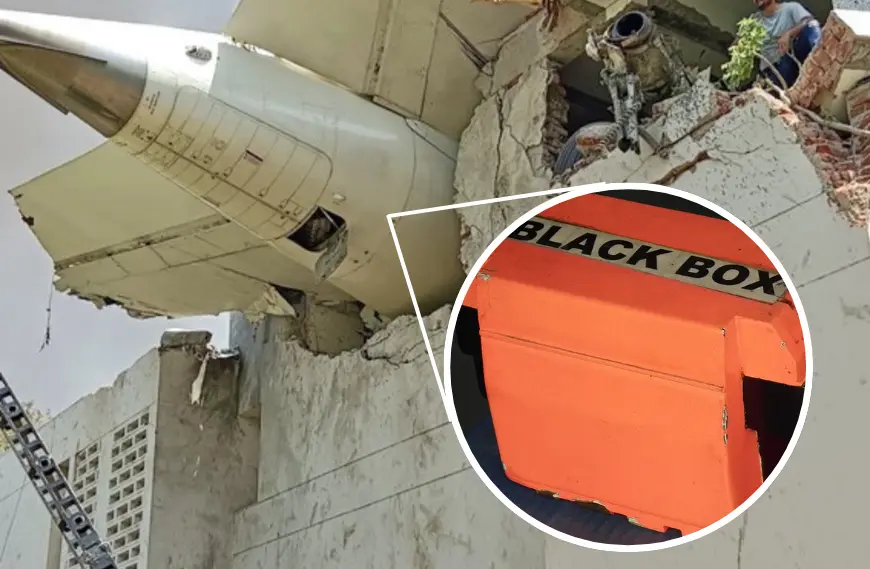
The sky is a vast canvas, where dreams of flight paint stories of human ambition. Yet, sometimes, those stories end in tragedy. On Thursday, 12 June 2025, an Air India Boeing 787 Dreamliner, Flight AI-171, bound for London, plummeted into Ahmedabad’s Meghani Nagar moments after takeoff. Over 260 lives were lost, marking one of India’s darkest aviation disasters.
Amid the grief, a small, bright orange device emerged as a beacon of truth: the black box. This unassuming machine, often misunderstood, holds the power to unravel the mysteries of a plane crash. But what is a black box? Why does it matter to Indians grieving in Ahmedabad or families awaiting answers worldwide? Let’s journey into its world, exploring its silent role in decoding disasters and offering closure, while weaving in the haunting context of Ahmedabad’s tragedy.
Imagine a device no larger than a shoebox, tucked away in a plane’s tail. It’s not black but a vivid orange, designed to stand out amid wreckage. The black box is two machines in one: the Flight Data Recorder and the Cockpit Voice Recorder. The Flight Data Recorder logs every heartbeat of the aircraft. It captures speed, altitude, engine performance, and control movements. Over 1,000 parameters are recorded every second, creating a digital diary of the flight’s life. The Cockpit Voice Recorder, meanwhile, listens quietly. It captures pilots’ conversations, radio chatter, and even ambient sounds like alarms or engine hums.
Together, these devices form a time capsule, preserving the final moments of a flight. They are built to survive the unthinkable: fires hotter than 1,100°C, impacts of 3,400 times gravity’s force, and deep-sea pressures. This resilience ensures answers endure, even when lives do not.
The black box’s story began in the 1950s, sparked by an Australian scientist, David Warren. After a series of unexplained crashes, Warren envisioned a device to record flight details. His idea, initially dismissed, became a global standard by the 1960s. Today, every commercial flight carries one. In India, where aviation connects bustling cities like Mumbai to remote towns like Leh, black boxes are vital. Our skies are crowded, with over 15 crore passengers flying annually. When accidents occur, these devices offer clarity. They don’t prevent crashes, but they prevent ignorance. They ensure lessons are learned, making future flights safer for every person boarding a plane.
Now, picture Ahmedabad on that fateful June day. Flight AI-171, carrying 242 souls, including 169 Indians, took off at peak afternoon. Within thirty seconds of its takeoff, it issued a MAYDAY call. The plane crashed into nearby BJ Medical College Hostel, killing students and passengers alike. The wreckage smouldered, a grim tableau of twisted metal and shattered dreams. Yet, within hours, the Airports Authority of India recovered the black box. This was no small feat. The device, though tough, could have been buried under debris or damaged by fire. Its recovery sparked hope. Investigators knew it held clues to why a modern Boeing 787, with an exemplary safety record, fell from the sky.
What makes the black box so crucial in cases like Ahmedabad? It’s a neutral witness. Unlike human accounts, clouded by trauma or bias, the black box speaks in data and sound. It tells a story without prejudice. In Ahmedabad, preliminary reports suggested a bird strike might have caused engine failure. But only the black box can confirm this. The Flight Data Recorder will reveal if the engines faltered, if the plane’s controls responded, or if systems failed. The Cockpit Voice Recorder will replay the pilots’ final words. Did they mention a bird strike? Were alarms blaring? These details, mundane in isolation, become profound when pieced together. They form a narrative of cause and effect, guiding investigators to the truth.
Consider past crashes where black boxes unlocked answers. In 2020, Air India Express Flight 1344 crashed in Kozhikode. The black box revealed pilot error, not mechanical failure. This finding shaped training reforms, saving future lives. Globally, the 2015 Germanwings crash relied on black box data to expose a pilot’s deliberate actions. These cases show the device’s power to clarify, even when truths are painful. In Ahmedabad, the black box could point to a bird strike, a rare but real threat in India. Our cities, often near migratory bird paths, face this risk. If confirmed, it could prompt stricter wildlife management near airports, a change that resonates with every Indian traveller.
But the black box’s role goes beyond technical answers. It offers emotional closure. For families of the deceased, the pain of loss is raw. They ask, “Why did this happen?” The black box provides a path to understanding. It assures them their loved ones’ final moments were not in vain. Answers lead to accountability, whether it’s an airline, a manufacturer, or even nature’s unpredictability. This closure is cultural in India, where family ties run deep. We light lamps for the departed, seeking peace. The black box, in its own way, lights a path to that peace.
Yet, the black box isn’t infallible. Its data requires skilled interpretation. Investigators, often from India’s Aircraft Accident Investigation Bureau, spend weeks decoding it. They cross-reference data with wreckage, weather reports, and witness accounts. In Ahmedabad, the process is underway. The black box’s recordings will be analysed in Delhi or sent abroad for advanced tools. This meticulous work ensures accuracy but tests patience. Families want answers now. Here lies a tension: the black box promises truth but demands time. For Indians, accustomed to swift news cycles, this wait can feel agonising. Yet, it’s a reminder that truth, like justice, requires care.
The Ahmedabad crash also raises broader questions. Why do we rely on decades-old technology? Modern planes stream data live to satellites. Could real-time data replace black boxes? Experts argue no. Live streaming can’t match the black box’s comprehensive detail or survivability. A plane’s final moments might disrupt transmission. The black box, physically present, endures. Still, India’s aviation sector, growing at 15% annually, could pioneer hybrid solutions. Imagine a future where black boxes and live data work together, offering faster answers. Ahmedabad’s tragedy could spur such innovation, cementing India’s role in global aviation safety.
As we reflect, the black box emerges as more than a machine. It’s a symbol of resilience, a promise of truth in chaos. For Ahmedabad’s grieving families, it’s a lifeline to understanding. For India, it’s a tool to safeguard our skies. Its bright orange shell hides a quiet heroism, speaking for those who cannot. The crash of Flight AI-171 is a wound, but the black box offers a chance to heal. It reminds us that even in tragedy, there’s hope for clarity. As Indians, we board planes with trust. The black box ensures that trust endures, guiding us toward safer tomorrows. The black box’s tale, tied to Ahmedabad’s pain, invites us to ponder. It’s not just technology; it’s a bridge between loss and learning. That’s the magic of insight: it surprises, it moves, it stays with us.
Black Box: The Key to Unlocking Plane Crash Mysteries
- What is it? A black box, painted bright orange, includes two devices: the Flight Data Recorder (FDR) and Cockpit Voice Recorder (CVR).
- Function: FDR logs over 1,000 flight parameters (speed, altitude, engine status). CVR captures pilots’ conversations and cockpit sounds.
- Durability: Built to survive 1,100°C fires, 3,400G impacts, and deep-sea pressure.
- Role in Crashes: Provides unbiased data to decode accidents, like Ahmedabad’s 2025 Air India crash.
- How it Helps: Reveals causes (e.g., bird strikes, pilot error), ensures accountability, and improves aviation safety.
- Indian Context: Vital for India’s 150M+ annual flyers, offering closure and lessons.
- Limitations: Requires weeks of expert analysis; not replaced by live data streaming.
Why it Matters: Offers truth and closure, ensuring safer skies for all Indians.
