



There is a vendor near the Churchgate station in Mumbai who sells bhutta on winter evenings. He chars the cob over coal, rubs it with lemon, smears it with red chilli powder and salt, and hands it over for Rs. 30. You eat it standing up. No plate, no ceremony. The corn is yellow, always yellow, and nobody asks why.
But corn was not always yellow. That part of the story is worth telling.
The Origin That Most People Get Wrong
Maize, as botanists and most of the rest of the world call it, originated in southern Mexico roughly 9,000 years ago. It was domesticated from a wild grass called teosinte, which looks almost nothing like modern corn. The cob was tiny. The kernels were few. But indigenous communities in Mesoamerica slowly, over millennia, transformed it into one of the most productive food crops the world has ever seen.
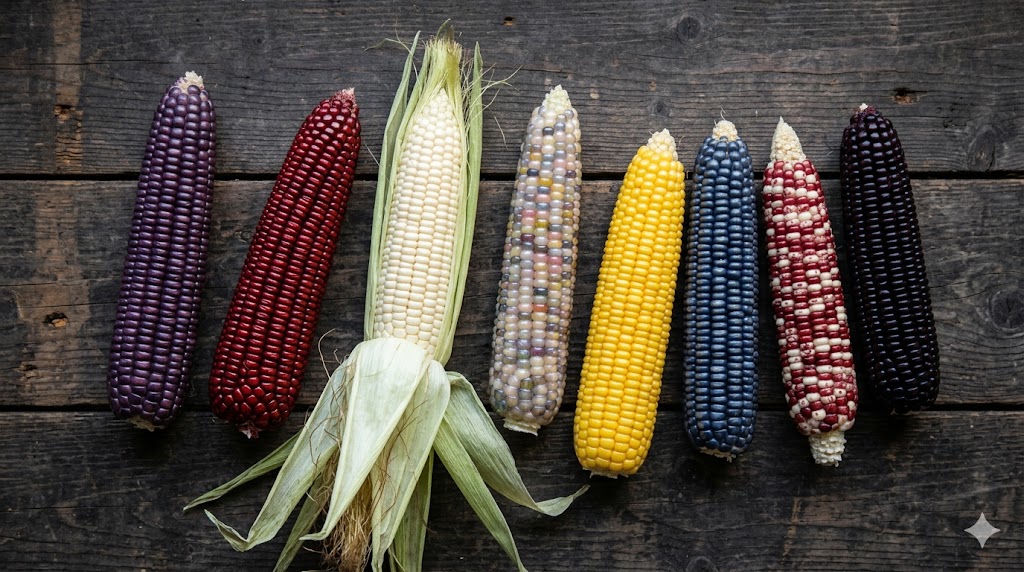
When European colonisers arrived, they found corn in colours that ranged from pale cream to deep indigo. Red, blue, purple, black, white, orange and mottled multicolour varieties all existed, each tied to specific communities, geographies and rituals. The Spanish took the grain back with them, and it spread across the globe, reaching Africa, Asia and eventually India sometime in the 16th century. By the time corn arrived here, it had already been simplified. The colour diversity that indigenous farmers had spent centuries cultivating was mostly left behind.
What India Eats and Where
India grows corn in Rajasthan, Madhya Pradesh, Karnataka, Andhra Pradesh, Bihar, Himachal Pradesh and the Northeast, among other regions. The variety is almost entirely yellow or white.
White corn dominates where the grain is eaten as a staple flour. In Punjab, makki di roti is the obvious example, but what gets less attention is how differently it is made from household to household. Some families grind their own flour coarser than anything a commercial mill would produce. The resulting roti tears rather than folds, holds the sarson da saag differently, and carries a faint bitterness at the edge that the smoother packaged flour version simply does not have. That coarseness is not a flaw. It is the whole point. The industrial flour that now fills most urban kitchens has quietly ironed out the very texture that made the dish worth eating in the first place.
In the Northeast, corn has a different life entirely. Among the Mao Naga communities of Manipur’s hill districts, a sticky glutinous corn variety called millet-adjacent locally is steamed inside banana leaves and eaten as a morning meal with fermented bamboo shoot chutney. The preparation owes almost nothing to mainland Indian corn traditions. It is closer in spirit and technique to what you find in Yunnan province across the border in China, which makes sense given the shared ecological and cultural corridors of that entire highland belt. In Nagaland, dried corn kernels are fermented with soya and used as a flavouring base in meat preparations, functioning the way a fermented paste might in Korean cooking. These are not marginal practices. They are sophisticated culinary systems that have existed for generations and have received almost no serious food documentation in English.
Yellow corn, meanwhile, has become more associated with animal feed and industrial processing than with direct human consumption in much of India. Which is a little bit sad, really, because fresh yellow corn on the cob is genuinely delicious and slightly sweeter than its white counterpart.
Blue and Purple: The Colours That Carry the Most Nutrition
The antidote to industrial uniformity, it turns out, has always existed. You just have to know where to look, and sometimes where to drink.
Somewhere in Peru, a drink called chicha morada is being made right now. It uses dried purple corn, boiled with pineapple rind, cinnamon and cloves, then cooled and sweetened. It is the colour of a deep bruise and it tastes extraordinary. The corn responsible for it is called maiz morado, and it contains some of the highest concentrations of anthocyanins found in any food grain.
Anthocyanins are the pigments that make blueberries blue, red cabbage red and purple corn purple. They are potent antioxidants. Studies have linked high anthocyanin intake to reduced inflammation, better cardiovascular health and some protective effects against oxidative stress. Blue corn, used extensively by Hopi and Navajo communities in the American Southwest, shares this nutritional profile. Blue corn tortillas and blue corn porridge are not novelty items. They are ancient foods.
The nutrition science around coloured corn has gained significant momentum over the past decade, and this has commercial implications. Specialty food markets in the United States and Europe now stock blue corn chips, purple corn flour and black corn pasta at prices that can make your eyes water. A 500-gram bag of blue corn flour can retail for the equivalent of Rs. 590 to Rs. 850 in European health food stores.
Red and Black Corn and the Question of Heritage
Red corn varieties exist across Mexico, the Andes and parts of East Africa. Black corn, which is actually a very deep purple, grows in Mexico and Bolivia. Both are rich in the same anthocyanin compounds that make blue and purple corn valuable. Both have been grown by indigenous communities for thousands of years as part of agricultural systems that prioritised biodiversity over uniformity.
The story of what happened to this diversity is not a comfortable one. Industrial agriculture, which optimised for yield, uniformity and shelf life, reduced the global corn gene pool dramatically through the 20th century. Heritage varieties were replaced by high-yield hybrids. One of the more documented losses is Bloody Butcher, a deep crimson American heirloom corn grown across Appalachia since at least the early 1800s. By the mid-20th century it had nearly vanished from fields, surviving only because a small number of seed savers in Virginia and Tennessee refused to let it go. It has since been partially revived, but most of what was lost across the Americas, Africa and Asia during that period of agricultural consolidation was not saved by anyone. It is simply gone.
The recovery of surviving varieties is now being led, quietly and without much fanfare, by seed-saving communities and small farmers in Mexico, Peru, Bolivia and the American Southwest. In India, Navdanya, the seed sovereignty organisation founded in Dehradun in 1991, has worked for decades on documenting and conserving indigenous grain varieties across multiple states, including traditional corn landraces from the hill communities of Uttarakhand and the Northeast. Their seed bank holds varieties that have no commercial value by industrial metrics and enormous cultural value by any other measure. The work is underfunded relative to its urgency, and the documentation of specifically indigenous corn varieties in India remains far thinner than the subject deserves.
Glass Gem and the Viral Moment That Changed Things
In 2012, a photograph of Glass Gem corn went viral online. The cobs were translucent, jewel-like, in shades of pink, teal, gold, burgundy and lavender. They looked fake. They were entirely real.
The variety had been developed by a Cherokee farmer named Carl Barnes, who spent decades cross-breeding Native American corn landraces to recover colour traits and genetic memory that commercial agriculture had discarded as irrelevant. Barnes was not trying to go viral. He was trying to remember something. Glass Gem corn is fully edible, it can be ground into flour or popped, but that was almost beside the point of what happened when the photograph spread.
What the image touched, in millions of people who had never thought seriously about seed saving or agricultural biodiversity, was something close to grief. The comments on that photograph were not simply about beauty. They were about the instinctive recognition that something had been lost from the world, something vivid and irreplaceable, and that here, unexpectedly, was proof that it had once existed and could still. Food writers and cultural critics spent considerable energy in the months that followed trying to explain the photograph’s emotional pull. The simplest explanation is probably the most accurate. People saw corn that looked like it contained the entire history of human agriculture in a single cob, and they were not wrong. The viral moment introduced millions to the idea that corn could be more than yellow or white, and that the person who brought it back was a farmer preserving his community’s genetic inheritance, not a laboratory.
So What Now
The bhutta vendor near Churchgate is not going anywhere. His coal-charred yellow corn is one of Mumbai’s more reliable small pleasures. But there is something worth sitting with here. The corn we eat, the colours we accept as normal, the grains we never question, all of it has a history. Some of that history is about loss.
Coloured corn is not a trend. It is not a superfood fad. It is, at its core, a record of what human communities chose to grow, protect and eat across nine millennia. Whether enough of it survives the next fifty years is not a question that lemon and chilli powder can answer.
