










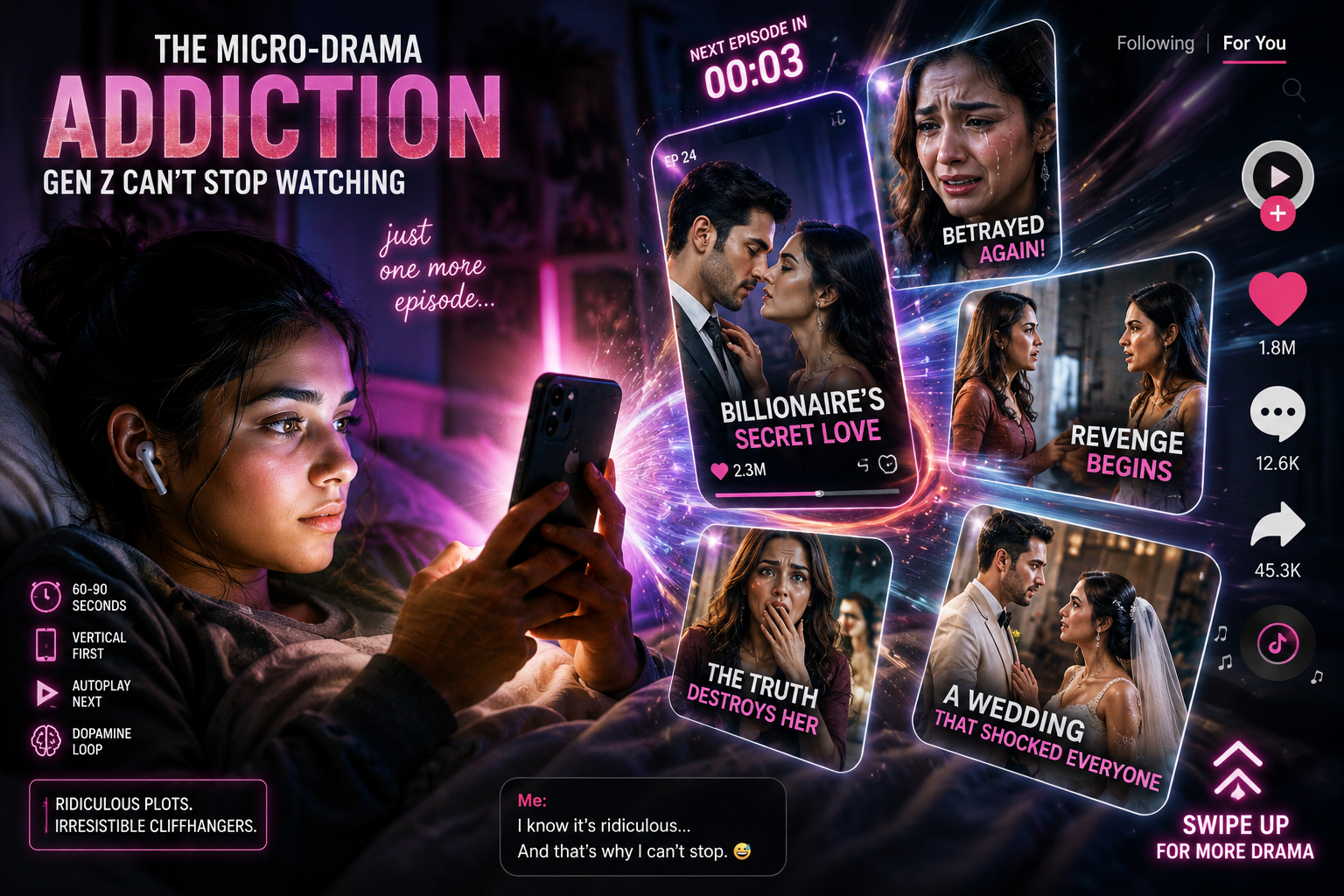
Open any phone on a commute, in a lunch break, or at 1 AM when someone should really be sleeping, and there’s a decent chance you’ll catch someone watching a show where a billionaire secretly falls in love with a waitress, or a wronged wife takes revenge on her cheating husband all in under two minutes per episode.
The plot is outrageous. The acting is over the top. The twists are so dramatic they would make a daily soap opera blush.
And Gen Z absolutely cannot stop watching.
What even is a Micro-Drama?
A micro-drama is exactly what it sounds like a scripted series told in bite-sized episodes, each lasting just 60 to 90 seconds. The episodes are shot vertically, designed for your phone screen, and built for one purpose: to make you press play on the next one before you’ve even processed what just happened in the last one.
The format originated in China, where it is known as duanju. The industry exploded in 2023 widely described as “year one” for micro-dramas and has since spread globally at a pace that has caught traditional entertainment studios completely off guard.
The plots follow familiar patterns: hidden identities, sudden wealth, betrayal, revenge, and romance. Characters go from rags to riches in three episodes. Villains get punished. Underdogs win. And every single episode ends on a cliffhanger.
The numbers tell a shocking story
This is not a niche internet trend. This is a fully grown industry.
Global micro-drama revenue reached $11 billion in 2025 and is projected to grow to $14 billion by the end of 2026, according to research firm Omdia. In the United States alone, viewers paid $1.3 billion directly to micro-drama platforms in 2025.
In-app revenue for micro-drama content money spent inside apps to unlock episodes stood at $3.8 billion in 2025 and is forecast to more than double to $7.8 billion in 2026, according to Deloitte. Apps like ReelShort, DramaBox, FlickReels, and ShortMax now regularly appear among the top 25 most downloaded apps in the US App Store.
DramaBox alone has 90 million registered users and around 30 million monthly active users. Across all platforms combined, micro-drama apps added 5.78 billion hours of user viewing time in 2025.
Among young viewers, the penetration is striking. According to Activate Consulting, 28 million US adults now watch micro-dramas, and 52 percent of them are between the ages of 18 and 34. Separate data from Hub Research found that 35 percent of Gen Z already watch micro-dramas regularly. A Deloitte survey from March 2025 found that around 30 percent of Gen Z and millennials were familiar with the format, and nearly half of those were watching more than they did a year earlier.
The app that beat netflix on mobile
Here is the number that made the entertainment industry sit up and pay attention.
In Q4 2025, ReelShort averaged 35.4 minutes of daily mobile viewing time per user, nearly triple what it recorded just nine months earlier at 12.8 minutes in Q1 2025, according to Omdia’s analysis of Sensor Tower data. To put that in perspective, Netflix averaged 24.8 minutes of daily mobile viewing, Amazon Prime Video averaged 26.9 minutes, and Disney+ averaged 23 minutes during the same period.
A micro-drama app barely known three years ago was outperforming the world’s biggest streaming platforms on the metric that matters most: how long people actually watch every day.
What powered this growth? Partly content, but largely marketing. Micro-drama platforms spend more on social media promotion than on production. The cost of producing 90 minutes of micro-drama content is approximately $100,000. ReelShort alone spent $500,000 on a single TikTok campaign in October 2025 five times its production cost as part of its aggressive push to acquire new viewers.
So why can’t anyone stop?
Here is where it gets genuinely interesting. Viewers are not watching these shows because they think they are great television. Most will openly admit the plots are absurd and the dialogue is melodramatic. And yet, they keep going.
The answer lies in how these shows are engineered, not written.
Dr Ken Fung, a psychologist and director of therapy and counselling at the Jadis Blurton Family Development Centre in Hong Kong, described his own first experience with micro-dramas this way: “At first, I was actually laughing at the ridiculous storyline, but before I even realised what was happening, I was completely sucked in and ended up watching a few episodes.”
The mechanism driving this is the cliffhanger. Each episode, only 60 to 90 seconds long, ends at the exact moment of maximum tension. Something shocking is about to happen, but you don’t find out what until the next episode begins. According to Dr Fung, this uncertainty triggers a release of dopamine, the brain’s feel-good chemical.
“You know something exciting is coming, but you don’t know exactly when. This uncertainty is what keeps people addicted,” Fung said. “This is similar to how a slot machine works.”
When the next episode starts, more dopamine follows. Then the episode ends. Then another cliffhanger. The brain never has time to settle. Dr Fung described longer films and traditional TV shows as “a satisfying multi-course feast,” while micro-dramas are like “snacking on junk food.” The comparison is not a compliment but it is accurate.
Making things worse is the auto-play feature. Every platform plays the next episode the moment the current one ends, eliminating the brief pause in which a person might decide to stop watching. “This gap is usually when our brain self-regulates and says no,” Fung explained. Micro-drama apps have simply removed that gap.
Sima Shah, VP of Research and Insights at Sensor Tower, put it plainly: “Chinese micro-dramas are designed to satisfy the appetite for instant gratification. The key is delivering emotional payoff immediately. The exaggeration, if anything, adds to the appeal.”
The plot Is ridiculous by design
The storylines in micro-dramas are not accidentally over the top; they are carefully calculated to be that way.
The most popular genres are revenge fantasy, rags-to-riches romance, and hidden identity. A woman who was humiliated discovers she is secretly a billionaire. A kind employee is mistreated and then her cruel boss realises she is actually royalty. A cheating husband loses everything while his wife rebuilds her life in record time.
These plots are wish fulfillment at maximum speed. There is no slow build, no character development, no nuanced arc. The underdog wins. The villain suffers. Justice arrives in episode four.
Psychologists point out that this formula works precisely because it bypasses the brain’s critical thinking and goes straight for emotion. Every story beat is designed for instant, intense reaction shock, satisfaction, outrage, delight with no room for anything in between.
Gen Z knows and watches anyway
What is perhaps most interesting about the micro-drama boom is the self-awareness of the audience.
Gen Z viewers are not confused about what they are watching. In online discussions, comments sections, and social posts about micro-dramas, the dominant tone is not admiration, it is amused recognition. People describe getting “trapped” by shows they know are terrible. They share screenshots of ridiculous plot twists the same way others share memes. The absurdity is part of the entertainment.
This is a generation that grew up on internet culture, irony, and the knowing wink. For them, watching something because it is so over the top is a completely coherent form of enjoyment. It is the same energy that makes people watch reality TV or read trashy fiction except now it is compressed into one-minute episodes that fit inside a bus ride or a lunch break.
The format also suits the way Gen Z actually lives. According to Activate Consulting’s Technology and Media Outlook 2026, 43 percent of Gen Z use YouTube and TikTok as their primary source of entertainment and news. They are already comfortable with vertical video, short formats, and content designed for a phone screen. Micro-dramas did not create these habits, they just built a product perfectly matched to them.
Brands have already noticed
Where Gen Z’s attention goes, marketing follows.
Brands are beginning to integrate themselves directly into micro-drama storytelling rather than running ads alongside it. Maybelline produced a five-part micro-drama series called “Maybe This Christmas,” starring Lacey Chabert and Dustin Milligan, with its Instant Eraser Concealer written into the plot itself. The series was developed with Ryan Reynolds’ creative agency Maximum Effort and released across TikTok, Instagram Reels, and YouTube Shorts.
In India, influencer Dolly Singh’s micro-drama series “Best Worst Date” on Instagram ran three seasons with brand partnerships including Myntra Beauty, Jockey Women, and TRESemmé. Homegrown beauty and wellness brand Kindlife launched “Seoul Searching,” described as India’s first K-drama-inspired micro-drama series. TikTok has moved in, testing a dedicated “Short Drama” feed and launching its own platform called PineDrama in select markets.
The production economics are attractive. A traditional streaming series might take a year to produce and cost millions. A micro-drama production can churn out 8 to 10 original shows per month. The barrier to entry is low. The audience is ready. And the engagement data is unlike anything traditional media has seen.
A real shift, not just a phase
What started as a quirky corner of Chinese mobile entertainment is now a $11 billion global industry rewriting the rules of how stories are told, sold, and consumed.
Traditional streaming platforms built their businesses around the idea that people would sit down, choose a show, and commit to it. Micro-dramas operate on the opposite assumption that people are moving, distracted, impatient, and will give you sixty seconds to earn their attention before they scroll away. And then they build everything around that reality.
For Gen Z, this is not a guilty pleasure they are hiding. It is just entertainment that fits their life. Fast, emotional, absurd, and critically honest about what it is.
They know it is ridiculous. And that, more than anything, is exactly why they keep watching.
Subscribe Deshwale on YouTube


