



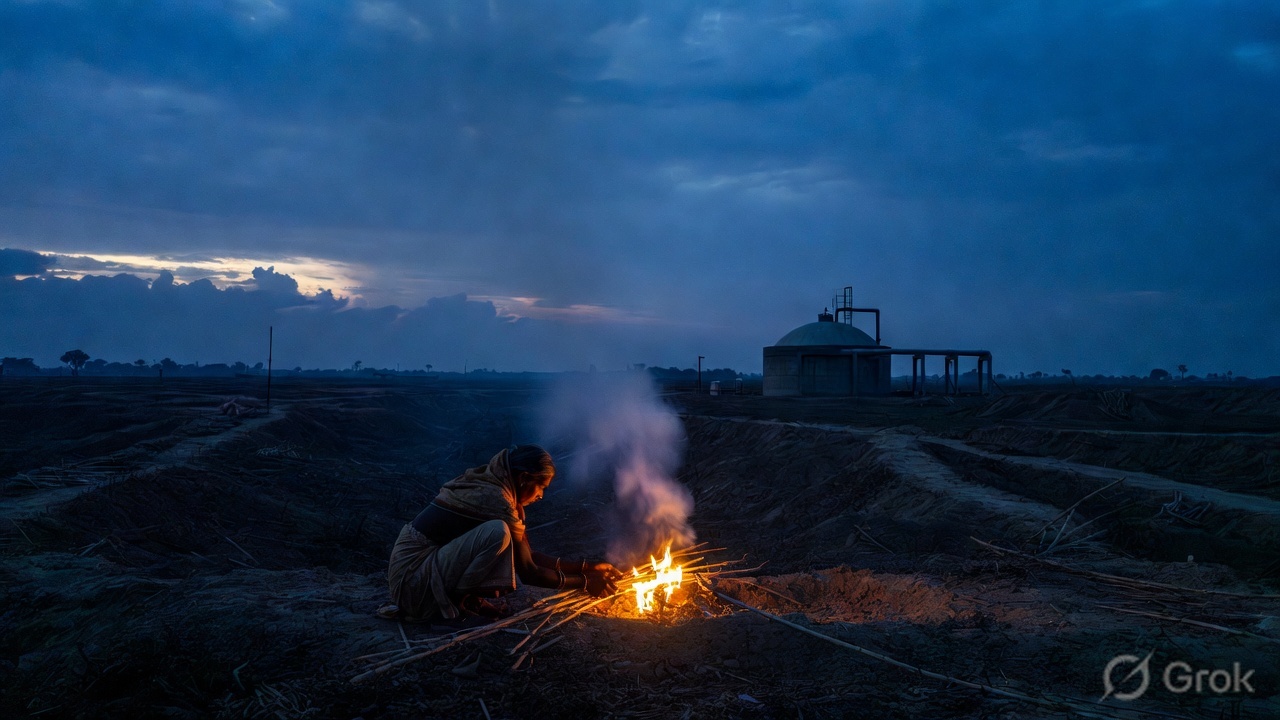
India has 300 million cattle, 62 million tonnes of untreated waste, and a flagship scheme to turn all of it into clean energy. It also has Meena Devi, a Musahar woman in Gaya district who wakes at five every morning and walks to the forest edge to gather wood, because she has no cattle, no land, and no access to the biogas plant three kilometres from her door. The Gobardhan scheme was announced as a revolution. For the poorest women in India’s poorest villages, it has been a ribbon-cutting ceremony they were never invited to attend. This is the story of a technology that works, a policy that does not, and the single word, caste, that India’s clean energy documents have been carefully written to avoid.
The smoke that was always there
Meena Devi wakes at five in the morning with smoke in her eyes. Not metaphorical smoke. Not the smoke of poverty understood as abstraction. The actual smoke of burning wood and dung cake that has been filling her lungs since before she can remember, that has settled into the thatch of her roof and the folds of her sari and the wet cough her children have learned to sleep through. The eastern sky over Gaya district is still the colour of bruised fruit when she walks to the forest edge, her feet hard against the cold earth, gathering fuel the way her mother did and her grandmother before that. Twigs. Dung cakes. Anything that burns.
Three kilometres from her hut, a government-built biogas plant sits idle. It cost fifty lakh rupees. It was inaugurated with a ribbon and photographs and the kind of official language that makes bureaucrats feel visionary. Waste to wealth. Circular economy. Self reliant villages. No one who used that language asked Meena Devi whether she had cattle. She does not. She is a Musahar, one of Bihar’s most marginalised Dalit communities, and like 98 percent of Musahar families, she owns no livestock. She owns the smoke in her eyes and the walk to the forest and the question that no official report will answer: if gobar gas is India’s energy future, why is her present still on fire?
The answer is not technical. It was never technical. The answer is three kilometres long and three centuries deep.
A real crisis and a real opportunity
India has a real energy crisis. This is not rhetoric. It is arithmetic. The country imports more than 85 percent of its crude oil. The import bill for the first nine months of the last fiscal year alone crossed ninety billion dollars, money that leaves the country permanently, flowing toward geographies that do not wish it well. Fossil fuel consumption rose eight percent in a single year. The atmosphere is not an infinite sink, the planet is not indifferent, and the bill for both is coming due in ways that will not spare anyone.
India also has cattle, roughly 300 million of them, the largest bovine population on earth. Cattle produce dung, and dung fed into an anaerobic digester produces methane, and methane burns clean. It can power a stove without filling a room with the particulates that contribute to hundreds of thousands of premature deaths every year. It can fuel a tractor. It can, in theory, displace imported gas with something grown at home, turning a liability into an asset, turning waste into energy, turning the ordinary biological output of an animal into a reason for a child to stop coughing.
The government’s flagship response to all of this is GOBARdhan, Galvanizing Organic Bio-Agro Resources Dhan, launched in 2018 with ambitions that were, on paper, genuinely impressive:
- As of early 2026, over 1,600 plants are registered nationwide, more than 1,150 of them functional.
- Compressed biogas projects are multiplying under a new blending mandate that begins at one percent of natural gas this fiscal year and rises to five percent by 2028.
- In Indore, Asia’s largest municipal solid waste biogas plant produces 17,000 kilograms of fuel daily.
- In Gujarat’s tribal villages, families have traded smoky chulhas for clean gas.
The technology works. The fuel burns. The potential is not imaginary. But Meena Devi is still at the forest edge. And the distance between her and the nearest biogas plant is not a logistical problem awaiting a technical solution. It is a verdict that was written long before the first biogas plant was built, in a language that the GOBARdhan scheme’s architects either did not read or chose not to acknowledge.
Who owns the animal
The problem is not the dung. The problem is who owns the animal that produces it.
In rural Bihar, cattle are not distributed by need. They are distributed by history, concentrated in the hands of dominant castes, the Yadavs and Kurmis and landowning communities who have always controlled the means of production in Indian villages. The Mahadalits, the Musahars, the communities occupying the absolute floor of the hierarchy, own virtually nothing. Landlessness among Musahar families runs between 92 and 99 percent. Livestock ownership, for 98 percent of those households, is nonexistent.
The Gobardhan scheme was designed by people who assumed, without examining the assumption, that everyone has a cow. Most household biogas units require a minimum of three cattle per family. Community plants depend on pooled dung from multiple owners. The entire value chain, collection, digestion, distribution, return of slurry, presupposes that the raw material exists and is accessible. It does not presuppose that some families have been systematically excluded from owning anything for centuries. It does not presuppose caste, because caste is the word that technical documents are not required to contain.
Three villages tell the story with precision:
- In Bataspur, a biogas plant built at fifty lakh rupees of public money sits underutilised because there is not enough dung. No livestock survey was conducted before construction. No one asked who had cattle and who did not. They built the plant and assumed the fuel would arrive.
- In Oiyara, a plant serves 22 households in a village dominated by Yadavs. Dalit families live on the outskirts. They do not receive the gas. The sarpanch explained this with the serenity of someone describing weather: “People from Mahadalit communities live on the outskirts, so they don’t get the gas.” Not malice. Just geography. Just the way things are. But the outskirts are not accidents of landscape. The outskirts are where certain people were put, and have been kept, by arrangements that predate the biogas plant by several hundred years.
- In Supaul district, farmers demanded a higher price for their dung, one rupee per kilogram instead of fifty paise. The plant shut down. Not because the technology failed. Because the human arrangements around the technology could not hold. The landless poor, who had no dung to sell, had no seat at that negotiation. The plant manager had no authority to meet the farmers’ price. The enterprise collapsed into the silence of idle machinery, and no official report recorded whose silence was loudest.
This is what waste to wealth looks like when you forget to ask who owns the waste.
The word the scheme was written to avoid
The word that built this scheme and doomed it is the word its architects never used.
Caste. Not as accusation. Not as the lazy shorthand it becomes when deployed without precision. But as the name for the oldest and most durable architecture of inequality on this subcontinent, a system of graded exclusion so thoroughly embedded in the distribution of land, livestock, water, and political visibility that even a programme designed with genuine goodwill can end up flowing, almost automatically, toward those who already have something to offer it.
Caste is why the biogas plant in Bataspur has no feedstock. Caste is why the gas in Oiyara stops at the Dalit settlement’s edge. Caste is why the Musahar woman has no cow, why she has no land, why she has no political representative who will lose sleep over her cough. Caste is the infrastructure beneath the infrastructure, the invisible pipeline that determines, before any government scheme is designed, who will be able to use it and who will watch it from three kilometres away.
A senior official in the Ministry of New and Renewable Energy, speaking on background, said the scheme was never designed to ignore the poor. The pivot toward municipal solid waste and agro-residues, he explained, was precisely intended to reduce dependence on cattle ownership. New compressed biogas plants in urban areas sidestep livestock entirely. The 2025 to 2026 budget added market development assistance and interest subvention. The guidelines have been revised.
He is not wrong about the pivot. The pivot is real. And the pivot does nothing for Meena Devi, who does not live near a municipal solid waste plant, who does not have a compressed biogas connection, who woke up this morning and walked to the forest edge and is still there. Technical neutrality is a comfortable position when you are the one who gets to be neutral. It is a different thing when the starting point is centuries of unequal distribution, when the market you are being invited to participate in requires assets that were taken from your community before anyone alive today was born. A pipeline carries not just gas but also the history of who gets to decide where it flows. Pretending otherwise is not neutrality. It is a choice about whose history counts.
What a different question looks like
The countries that solved the energy and public health problems that gobar gas promises to address did not solve them by designing schemes and assuming the benefits would distribute themselves fairly. They solved them by asking, before building anything, who needed it most, and then building toward that person rather than away from them.
This is not complicated. It is not even particularly expensive, relative to what is already being spent. There are specific interventions that do not require a new technology:
- Dung buying cooperatives with minimum support prices could allow landless collectors to earn from their neighbours’ cattle, inserting the poorest households into the value chain rather than placing them outside it.
- Hybrid models, small digesters paired with subsidised LPG refills, could serve zero-cattle homes.
- Targeted capital subsidies for Mahadalit clusters, already piloted in Gujarat and West Bengal, need not remain pilots forever.
- The blending mandate creates a commercial market for biogas. That market could be shaped, through procurement rules and subsidy conditions, to require demonstrated benefit to landless communities before public money is released.
None of this requires a new technology. It requires a different question. Not: how do we build more plants? But: who are these plants for?
The reason that question has not been asked, the reason the scheme was designed without a caste survey, the reason Oiyara’s sarpanch can describe the exclusion of Dalit families with the calmness of someone describing geography, the reason fifty lakh rupees of public money can sit idle in Bataspur without triggering an inquiry, is not bureaucratic failure. It is bureaucratic honesty. The scheme reflects its designers. It was built by people who have cattle, who have land, who have always been seen by the state, for people who have cattle, who have land, who have always been seen by the state. Everyone else was an afterthought, dressed up as a beneficiary.
The distance between the plant and the fire
Meena Devi is still cooking. The smoke is still in her eyes. Her children’s cough is still the background sound of a morning that the GOBARdhan scheme was announced to change.
Three kilometres away, the biogas plant is still idle, a fifty lakh rupee monument to a question that was never asked. Fifty kilometres away, another plant runs smoothly for families who had cattle, who had land, who had the standing to be seen when the state came looking for beneficiaries.
India’s energy crisis is real. The methane is real. The potential of 300 million cattle and 62 million tonnes of untreated municipal waste to reduce import dependence, cut particulate pollution, and keep rupees in the country is real, and none of it is the argument this piece is making.
The argument is simpler and harder.
A country which builds energy infrastructure without asking who will be left outside it has not made an oversight. It has made a statement. It has said, in the language of plant locations and eligibility criteria and livestock surveys that were never conducted, that some lives are inside the future it is building and some lives are not, and that this distribution roughly tracks the distribution of every other resource in the four thousand years of recorded history on this subcontinent.
The molecules do not discriminate. The institutions do. The methane will burn for anyone who can reach it. But reach is not a technical problem. Reach is caste. Reach is who was given land in 1950 and who was not. Reach is which village gets a plant with a functioning feedstock survey and which gets a ribbon-cutting and a photograph and a fifty lakh monument to good intentions.
Can gobar gas help mitigate India’s energy crisis? Yes. Unambiguously. The chemistry is not in dispute.
But it will not help Meena Devi until we stop asking only how to build the plants and start asking who they are built for. It will not help her until the word caste appears in the scheme’s official documents, not as an acknowledgment of the problem, but as the organising principle of the solution. It will not help her until someone in a ministry building in Delhi asks, before the ribbon is cut and the photographs are taken: does the woman three kilometres from this plant have a cow? And if she does not, what have we actually built?
Meena Devi is at the forest edge this morning. She will be there tomorrow. The smoke will be in her eyes and the cough will be in her children and the plant will be three kilometres away and idle, and the distance between them will be exactly what it has always been, not a measurement of space, but a record of who this country has decided to see and who it has decided, for century after accumulated century, to leave standing in the smoke.
That is not an energy problem.
That is us.
Subscribe Deshwale on YouTube
